GLOBAL
How Pressure and Temperature Affect Liquid Cooling Hose Reliability in AI Data Centers
A liquid cooling hose can look perfectly normal during installation and still be exposed to demanding conditions once an AI data center begins operating.
Coolant pressure, operating temperature, pressure fluctuations and repeated thermal cycles all contribute to the environment in which the hose must perform.
For this reason, pressure and temperature should be evaluated together when specifying a liquid cooling hose.
For the basic role of hoses in AI cooling systems, see How Does Liquid Cooling Work in AI Data Centers?.
1. Why Pressure and Temperature Matter
A liquid cooling hose performs several jobs simultaneously.
- It contains the circulating coolant.
- It withstands internal pressure.
- It accommodates system movement and routing.
- It operates within a specified temperature range.
- It maintains reliable connections with fittings and UQDs.
These requirements are interconnected.
For example, temperature can influence material behavior, while pressure places mechanical stress on the hose structure.
2. Operating Pressure vs. Maximum Pressure
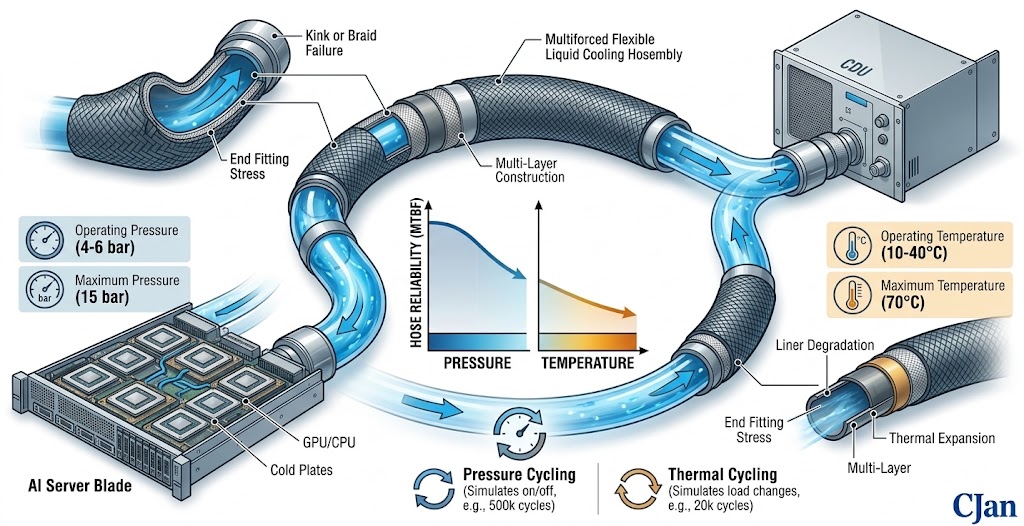
One of the first distinctions engineers should make is between normal operating pressure and maximum design pressure.
Operating pressure describes the pressure expected during normal system operation.
Maximum pressure represents a higher condition that the assembly may need to withstand according to its specification.
The complete application envelope should be considered, including temperature and pressure fluctuations.
3. Pressure Is Not Always Constant
Cooling systems can experience changes in pressure during operation.
Pressure may vary as pumps change operating conditions, valves open or close, or cooling loads change.
These fluctuations are different from a single static pressure value.
Where pressure cycling is expected, the hose assembly should be evaluated for the actual operating pattern.
4. Pressure Pulsation and Cycling
Repeated pressure changes can place cyclic stress on hose reinforcement and connection areas.
The significance depends on the amplitude and frequency of the pressure changes, the hose construction and the operating temperature.
For systems with frequent pressure fluctuations, qualification testing should reflect the actual application where practical.
5. Temperature Affects Hose Materials
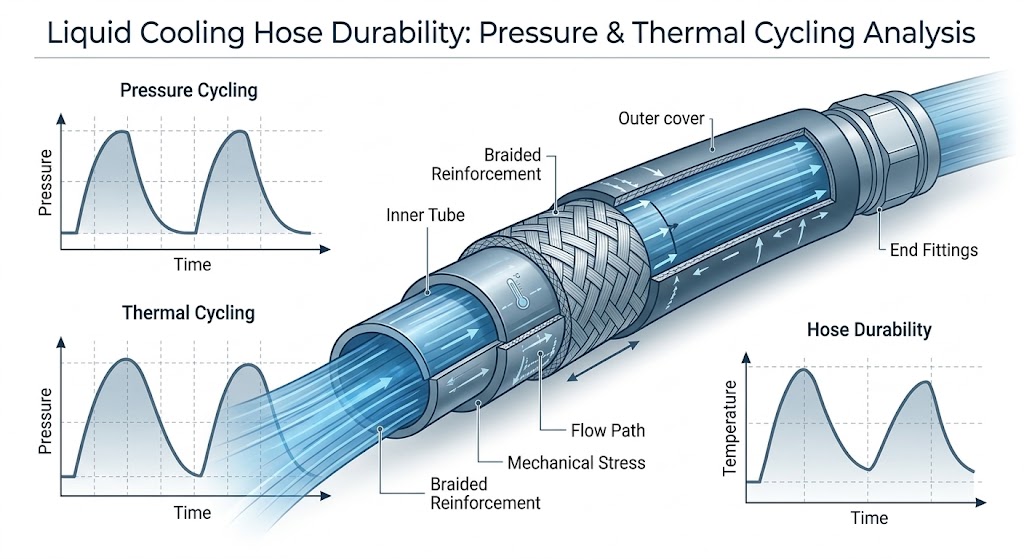
Temperature influences the physical behavior of polymer and elastomer materials.
As temperature changes, characteristics such as flexibility, stiffness and mechanical strength can change as well.
This does not mean that a hose automatically becomes unsuitable at a higher temperature. It means that the hose should be selected and rated for the intended temperature range.
6. Maximum Temperature Is Not the Same as Continuous Temperature
A published maximum temperature and a continuous operating temperature should not be interpreted as the same engineering condition.
A hose may tolerate a short-duration temperature excursion that would not be appropriate as its normal continuous operating condition.
When specifying a cooling hose, engineers should identify:
- Normal operating temperature
- Maximum continuous temperature
- Short-term temperature excursions
- Temperature cycling range
7. Thermal Cycling Can Matter More Than a Single Temperature
AI data center cooling systems can experience changes in thermal load.
As the coolant temperature changes, the hose and other components may repeatedly expand and contract.
Repeated thermal cycling creates a different mechanical environment from constant-temperature operation.
For applications with significant thermal cycling, the complete hose assembly should be considered during qualification.
8. Pressure and Temperature Should Be Evaluated Together
Pressure and temperature should not always be treated as independent specifications.
A hose may have different performance characteristics under different combinations of pressure and temperature.
Therefore, a useful application specification looks more like this:
| Parameter | Example Requirement |
|---|---|
| Operating Pressure | Define actual system condition |
| Maximum Pressure | Define design limit |
| Operating Temperature | Define normal range |
| Maximum Temperature | Define expected upper condition |
| Pressure Cycling | Define if applicable |
| Thermal Cycling | Define if applicable |
9. Why Hose Construction Matters
A liquid cooling hose is typically a multi-layer component rather than a simple piece of polymer tubing.
The inner layer provides the fluid-contact surface, reinforcement contributes to mechanical strength, and the outer layer provides environmental protection.
The construction should be matched to the pressure, temperature and mechanical requirements of the application.
10. Reinforcement Helps Manage Internal Pressure
Reinforcement is an important part of many pressure-capable flexible hose constructions.
It helps the hose maintain its shape and withstand internal pressure.
However, reinforcement should not be considered in isolation.
The inner tube, reinforcement, outer layer and end connections work together as an assembly.
11. Connections Can Be the Weak Point
The hose itself is only one part of the fluid path.
The connection between hose and fitting or UQD also needs to withstand the specified pressure and temperature conditions.
Potential connection components include:
- Hose end
- Fitting
- Crimp or clamp
- Seal
- UQD
A pressure rating for the hose alone does not automatically define the rating of the complete assembly.
12. Pressure Drop Is Different From Pressure Rating
Pressure drop and pressure rating are often confused during hose selection.
Pressure rating concerns the pressure the hose assembly is designed to withstand.
Pressure drop describes the loss of pressure caused by fluid resistance as coolant moves through the system.
They are different engineering parameters.
For pressure-drop calculations, see Liquid Cooling Hose Pressure Drop: How to Calculate and Control It in AI Data Centers.
13. Hose Diameter Still Matters
Hose internal diameter affects coolant velocity and hydraulic resistance.
A smaller internal diameter can increase pressure loss at a given flow rate.
This means hose sizing and pressure considerations should be evaluated together.
For a detailed sizing approach, see How to Select the Right Liquid Cooling Hose Size for AI Data Centers.
14. Temperature Also Affects Coolant Properties
Temperature does not only affect the hose material.
It can also influence coolant properties such as viscosity.
Changes in coolant viscosity can affect the hydraulic behavior of the cooling loop.
This is one reason why pressure-drop evaluation should use realistic operating temperatures where possible.
15. Coolant Compatibility and Temperature
Material compatibility should also be considered across the intended temperature range.
A material evaluation performed at room temperature may not represent the complete service condition.
The actual coolant, temperature and exposure duration should therefore be included in material selection.
For more information, see How Coolant Compatibility Affects Liquid Cooling Hose Selection for AI Data Centers.
16. Temperature, Pressure and Service Life
Hose service life depends on the conditions experienced during operation.
Continuous exposure to pressure and temperature, combined with mechanical movement and cycling, can place demands on the hose over time.
This is why a hose should be evaluated according to its actual service envelope rather than a single maximum value.
17. Avoid Operating Too Close to the Limit
Engineering systems generally benefit from reasonable design margin.
If the normal operating condition is very close to the hose's specified limit, there may be less margin for unexpected operating changes, pressure spikes or temperature excursions.
18. Mechanical Routing Also Influences Reliability
Pressure and temperature are not the only factors affecting hose life.
A hose may also experience bending, twisting, vibration or external contact.
Incorrect routing can create additional mechanical stress even when the pressure and temperature are within specification.
The hose should be installed according to its required bend radius and connection geometry.
19. Avoid Sharp Bends Near Connections
Hose ends and connection areas deserve particular attention during installation.
Excessive bending close to a fitting can place additional stress on the assembly.
Good routing should provide a smooth transition from the hose to the connection without forcing the hose into an unsuitable bend.
20. Vibration and Equipment Movement
Flexible hoses are often used partly because they can accommodate movement between connected components.
However, repeated movement can become a mechanical load if the hose is incorrectly routed or restrained.
In an AI server environment, the hose may need to accommodate maintenance access, component removal or rack-level movement.
Routing should therefore provide sufficient flexibility without creating excessive cyclic bending.
21. Why AI Data Centers Require Consistent Hose Performance
AI infrastructure is increasingly designed around high-density computing equipment and liquid cooling architectures.
Cooling components are integrated into a compact system where hoses may connect cold plates, manifolds, UQDs and CDUs within limited installation space.
Under these conditions, a hose must balance:
- Pressure capability
- Temperature capability
- Hydraulic performance
- Flexibility
- Material compatibility
- Connection reliability
22. Pressure and Temperature Qualification
Where an application requires qualification testing, the test conditions should reflect the intended operating environment.
Depending on the application, evaluation may include:
- Pressure testing
- Leak testing
- Temperature exposure
- Pressure cycling
- Thermal cycling
- Flow testing
- Visual inspection
The exact qualification program should be established according to the system's requirements and applicable standards.
23. What to Monitor During Testing
A useful test program should not focus only on whether the hose immediately fails.
Engineers can also monitor changes in:
- Dimensions
- Appearance
- Leak tightness
- Pressure performance
- Flow performance
- Connection integrity
These observations can provide additional information about long-term suitability.
24. CJAN Liquid Cooling Hose Options
CJAN provides several liquid cooling hose configurations that can be evaluated for AI data center and other thermal-management applications.
The current CJAN LCH Liquid Cooling Hose is available as part of the company's liquid cooling hose range.
Other configurations include LCH-SD and LCH-SDS.
Final product selection should be based on actual pressure, temperature, coolant, flow, dimensions and connection requirements.
25. Practical Reliability Checklist
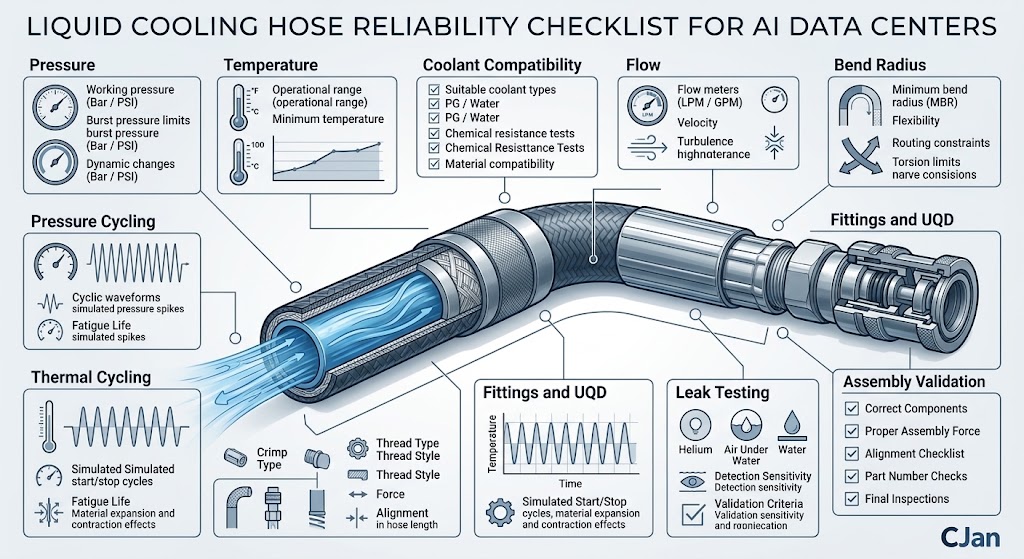
| Item | Engineering Check |
|---|---|
| Operating pressure | Defined |
| Maximum pressure | Defined |
| Operating temperature | Defined |
| Maximum temperature | Defined |
| Pressure cycling | Evaluated if applicable |
| Thermal cycling | Evaluated if applicable |
| Coolant compatibility | Confirmed |
| Hose ID | Checked for required flow |
| Bend radius | Confirmed |
| Fittings and UQDs | Evaluated as an assembly |
| Validation | Defined according to application |
Conclusion
Liquid cooling hose reliability in an AI data center depends on more than a single pressure or temperature specification.
The hose needs to operate within the actual combination of pressure, temperature, coolant, flow and mechanical conditions expected during service.
Pressure fluctuations and thermal cycling deserve particular attention when the system is expected to operate continuously or experience changing workloads.
The hose, fittings, seals and UQDs should also be evaluated as a complete fluid-handling assembly.
CJAN's LCH, LCH-SD and LCH-SDS configurations provide options for liquid cooling applications where pressure, temperature, flexibility and connection requirements need to be considered together.
For AI data center projects, the most effective starting point is to define the complete operating envelope before selecting the final hose configuration.
For more information, visit the CJAN Liquid Cooling Solutions page or review the CJAN LCH Liquid Cooling Hose.