
BLOG
2026/07/16Clicks:596
Industrial 3D printers are increasingly used in applications requiring continuous operation, high-temperature processing, and complex internal mechanical structures.
Compared with desktop 3D printers, industrial systems usually contain multiple pneumatic circuits used for:
For these systems, the internal tubing is often installed close to heat-generating areas. Although the air tube itself may not directly contact the heat source, long-term exposure to elevated temperatures and mechanical friction can affect service reliability.
A customer specializing in industrial 3D printing equipment required an additional protective layer for existing silicone and TPU pneumatic tubes.
The objective was clear:
Industrial 3D Printer Manufacturer
Inside machine structure / equipment chamber
| Parameter | Requirement |
|---|---|
| Maximum temperature | Approximately 200°C |
| Heat exposure | Local heat/flame area nearby |
| Vacuum requirement | None |
| Installation | External protection over existing tube |
| Flexibility | Required |
| Surface requirement | Smooth and abrasion resistant |
In industrial equipment, protective solutions must balance several factors.
A rigid metal shield may provide heat resistance, but it creates installation limitations:
A soft protective sleeve is often preferred when tubing needs to follow curved paths inside compact equipment.
The challenge was selecting a material that could provide:
Based on the application conditions, CJAN recommended:
Transparent Silicone Cover Hose TCS
Product Link:
https://www.cjanfluid.com/products/teflon-hoses/transparent-silicone-cover-tcs.html
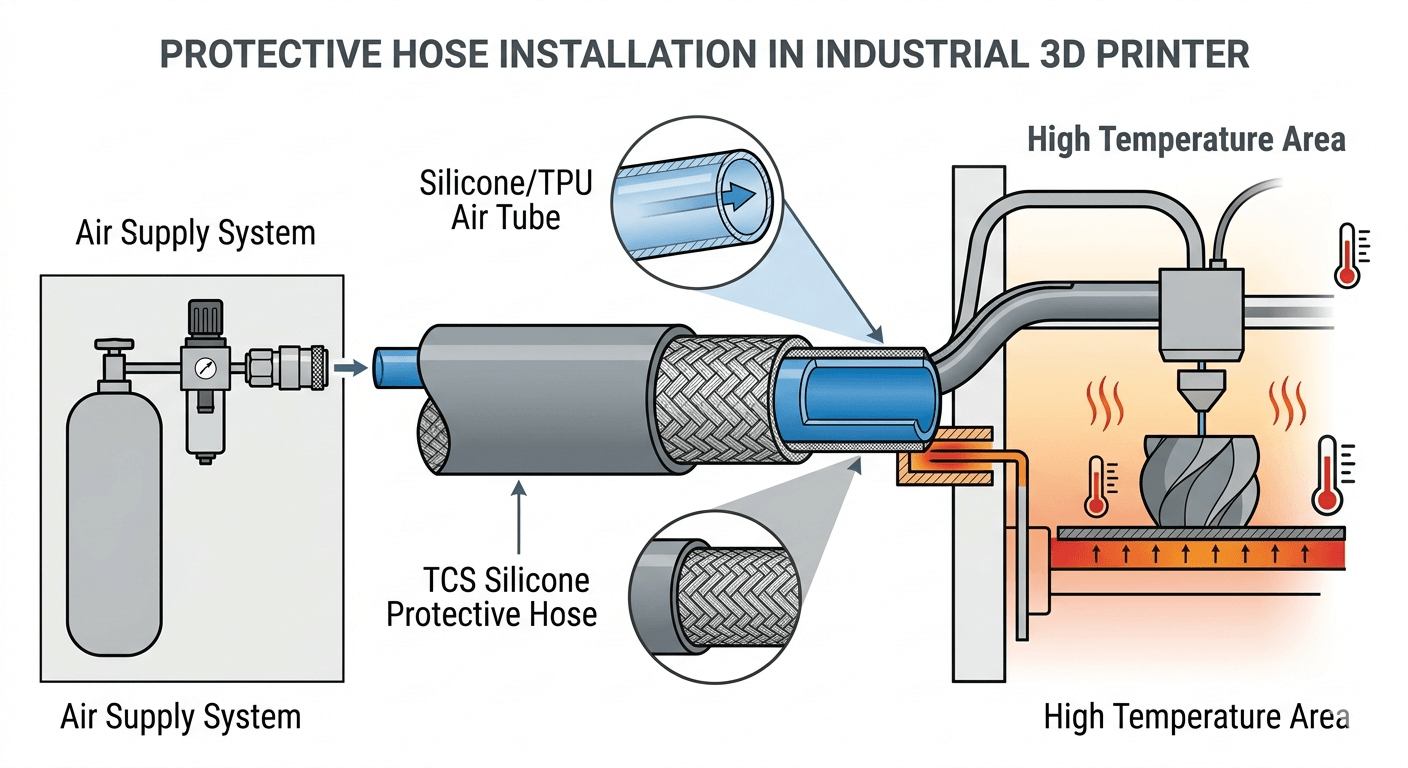
The TCS hose is installed externally over the existing silicone or TPU pneumatic tube, creating an additional protection layer.
Figure 1. Protective Structure of 3D Printer Pneumatic Tubing System
Structure:
High Temperature Area

        ↓

CJAN TCS Protective Hose
(Smooth Outer Layer)

        ↓

Silicone / TPU Pneumatic Tube

        ↓

Air Supply System
The external protective layer helps reduce direct heat exposure and mechanical damage while maintaining the flexibility required for equipment installation.
The customer did not require vacuum resistance. The main requirement was protection from nearby heat sources.
TCS provides a practical solution for applications where:
Inside industrial equipment, tubing may experience contact with:
A smooth external surface helps reduce friction and improves durability during operation.
Instead of replacing the original silicone or TPU tube, adding an external protective hose provides:
Industrial equipment often requires complex tube routing.
Flexible protective tubing allows engineers to:
When selecting a protective hose for 3D printing equipment, engineers should evaluate:
| Factor | Consideration |
|---|---|
| Temperature | Actual exposure temperature |
| Heat source distance | Direct contact or nearby radiation |
| Movement | Static or dynamic routing |
| Tube material | Silicone, TPU, PU, etc. |
| Installation space | Minimum bending radius |
| Surface requirement | Friction and wear conditions |
For this application, the customer required protection rather than pressure transportation, making a flexible protective cover hose an efficient solution.
| Customer Requirement | CJAN Solution |
|---|---|
| Protect internal pneumatic tubes | External protective layer |
| Temperature around 200°C | Silicone-based protective material |
| Smooth surface | Reduced external friction |
| Flexible installation | Suitable for curved routing |
| Existing silicone/TPU tube reuse | No major system redesign |
For industrial 3D printer manufacturers, internal tubing protection is often overlooked during equipment development.
A properly selected protective hose can improve system reliability by reducing the impact of:
CJAN TCS Transparent Silicone Cover Hose provides equipment designers with a flexible protection solution for silicone and TPU pneumatic tubing used in demanding industrial environments.
 Mobile


 GLOBAL


