GLOBAL
EPDM Liquid Cooling Hose: Applications, Benefits and Selection Factors
EPDM is one of the elastomer materials engineers may consider when designing liquid cooling hose assemblies.
In data centers, industrial equipment and other thermal-management systems, the hose has to do more than carry coolant. It must remain compatible with the fluid, withstand the required pressure and temperature, accommodate installation movement and maintain reliable connections throughout its service life.
EPDM can provide a useful combination of properties for many of these requirements. But it is not a universal solution.
This article looks at where EPDM hose can fit in liquid cooling systems, the factors that influence its performance and the information engineers should review before specifying it.
1. What Is EPDM?
EPDM stands for ethylene propylene diene monomer. It is a synthetic elastomer used in a range of sealing and fluid-handling applications.
For liquid cooling, EPDM can be used as the fluid-contact material or as part of a multilayer hose construction, depending on the product design.
A reinforced EPDM liquid cooling hose can combine an elastomeric inner tube with reinforcement and an outer protective layer.
The final characteristics of the hose depend on this complete construction rather than EPDM alone.
2. Why Is EPDM Considered for Liquid Cooling?
EPDM is considered for liquid cooling because it can provide a practical combination of flexibility, temperature capability and resistance to selected fluid environments.
Depending on the formulation and hose construction, EPDM can be used in applications involving water-based cooling fluids and other thermal-management conditions where the material has been verified as compatible.
Typical considerations include:
- Coolant compatibility
- Temperature range
- Pressure capability
- Flexibility
- Mechanical durability
- Installation requirements
3. Coolant Compatibility Comes First
The most important question when evaluating an EPDM liquid cooling hose is whether the actual coolant is compatible with the hose construction.
Cooling fluids may contain water, glycol and various additives. The concentration and operating temperature can also influence long-term material behavior.
Engineers should therefore provide the hose supplier with the actual coolant formulation whenever possible.
Important parameters include:
- Coolant type
- Water-to-glycol ratio
- Additive package
- Operating temperature
- Maximum temperature
- Expected exposure duration
For a broader material-selection framework, see How Coolant Compatibility Affects Liquid Cooling Hose Selection for AI Data Centers.
4. EPDM and Water-Based Cooling Fluids
Many liquid cooling systems use water-based fluids, sometimes combined with glycol or other additives.
EPDM is commonly considered in applications involving water and certain water-based fluid environments, but the exact formulation still matters.
It is not sufficient to specify "water-based coolant" without identifying the actual fluid.
For long-term applications, compatibility should be considered together with temperature, pressure and expected service duration.
5. Flexibility and Hose Routing
Liquid cooling installations frequently require hoses to route around equipment.
In an AI server rack, hoses may connect cold plates, manifolds and other components within a limited space. A flexible hose can simplify routing and reduce the need for rigid pipe sections in some designs.
EPDM hose can provide useful flexibility, particularly when the construction is designed for fluid-transfer applications.
However, flexibility is not unlimited. The actual minimum bend radius should be used during installation.
For more information, see Liquid Cooling Hose Bend Radius: Why Flexibility Matters in AI Server Racks.
6. Temperature Capability
Temperature is another important factor in EPDM hose selection.
A cooling system can experience normal operating temperatures, short-term peaks and repeated thermal cycling.
The hose therefore needs to remain suitable across the expected temperature range.
Engineers should avoid using a single material temperature figure as the final selection criterion. The temperature rating of the finished hose can depend on its formulation, reinforcement, dimensions, fittings and other construction details.
The normal and maximum operating temperatures should be provided to the hose manufacturer before final selection.
7. Pressure Rating Depends on the Construction
EPDM itself does not determine the pressure rating of a liquid cooling hose.
Pressure capability depends on the complete hose construction, including:
- Internal diameter
- Wall thickness
- Reinforcement
- Temperature
- Manufacturing construction
- Fittings and connections
A reinforced EPDM hose can provide substantially different pressure performance from an unreinforced tube.
For AI data center applications, the pressure rating should therefore be checked for the actual hose and assembly configuration.
See Liquid Cooling Hose Pressure Rating: How Much Pressure Does an AI Data Center Hose Need?.
8. EPDM Hose Size and Coolant Flow
Material compatibility is only one part of hose selection.
The internal diameter of an EPDM hose directly affects coolant velocity and contributes to pressure loss along the hose.
A hose that is too small can increase pressure drop and may require additional pump capacity.
A hose that is larger than necessary can increase size, weight and installation requirements.
The appropriate diameter should therefore be determined from the required flow rate, allowable pressure loss and connection dimensions.
See How to Select the Right Liquid Cooling Hose Size for AI Data Centers.
9. EPDM in AI Data Center Cooling
AI data centers are placing increasing demands on liquid cooling infrastructure.
As rack power increases, cooling loops may need to transfer larger amounts of heat while maintaining controlled flow and reliable connections.
Hoses can appear at several points in the cooling architecture, including connections around CDUs, manifolds, cold plates and rack-level distribution systems.
EPDM may be considered for selected sections of these systems when the coolant, temperature, pressure and mechanical requirements are compatible with the hose construction.
For a system-level overview, see How Does Liquid Cooling Work in AI Data Centers?.
10. EPDM for CDU-to-Rack Connections
CDU-to-rack connections can involve relatively long flexible hose runs and multiple connection points.
In these areas, hose flexibility and routing can be important because equipment may need to be installed, removed or serviced.
The hose assembly should accommodate the required movement without placing excessive loads on the connection points.
Hose length should also be controlled. Excessive length can add unnecessary pressure loss and create additional routing challenges.
See CDU to Rack Connections: Designing Reliable Liquid Cooling Hose Assemblies for AI Data Centers.
11. EPDM vs Silicone Liquid Cooling Hose
EPDM and silicone are both considered for liquid cooling, but their application characteristics are different.
| Selection Factor | EPDM | Silicone |
|---|---|---|
| Flexibility | Good, construction dependent | Generally very good |
| Temperature Capability | Application dependent | Broad, application dependent |
| Coolant Compatibility | Must be verified | Must be verified |
| Permeability | Application dependent | Can be a consideration |
| Pressure Capability | Construction dependent | Construction dependent |
| Typical Selection Consideration | Coolant and overall system requirements | Flexibility and temperature requirements |
There is no universal material choice. The actual coolant and operating envelope should determine which construction is evaluated.
See EPDM Liquid Cooling Hose vs. Silicone Hose: Which Is Better for AI Data Centers?.
12. EPDM vs Fluoropolymer Hose
Fluoropolymer materials such as PTFE and PFA are often considered when chemical resistance, fluid-contact requirements or other demanding conditions are important.
EPDM can be a practical alternative when its compatibility and mechanical performance meet the application requirements.
The choice should be made by comparing the actual operating envelope rather than selecting a material based on its general reputation.
For more information, see When Should You Use a Fluoropolymer Hose in Liquid Cooling Systems?.
13. EPDM Hose and Pressure Drop
Pressure drop is a system-level issue, but hose selection can have a significant influence on it.
The main variables include:
- Internal diameter
- Hose length
- Coolant viscosity
- Flow rate
- Number of bends
- Connection geometry
Increasing the hose diameter can reduce pressure loss in many operating conditions, while smaller diameters can increase resistance to flow.
For AI data center cooling, hose pressure drop should be evaluated together with the rest of the hydraulic circuit.
See Liquid Cooling Hose Pressure Drop: How to Calculate and Control It in AI Data Centers.
14. Reinforcement Is Important for Liquid Cooling
Liquid cooling hoses may need to operate under continuous pressure while remaining flexible.
Reinforcement helps balance these requirements.
Depending on the hose design, reinforcement can improve pressure resistance, dimensional stability and resistance to deformation.
For an EPDM hose, engineers should therefore review the complete construction instead of evaluating the inner rubber layer alone.
15. Bend Radius and Installation Stress
A hose can be compatible with the coolant and correctly rated for pressure but still experience problems if it is installed incorrectly.
Common installation issues include:
- Excessive bending
- Twisting
- Sharp routing
- Unsupported hose weight
- Excessive tension at fittings
Proper routing should allow the hose to follow a smooth path without forcing the assembly into a tighter radius than specified.
16. Connection and UQD Selection
Many liquid cooling systems use quick disconnect connections to simplify equipment installation and maintenance.
When UQD couplings are used, the hose and coupling need to be treated as one assembly.
Important considerations include:
- Hose internal diameter
- Coupling size
- Coolant compatibility
- Pressure rating
- Temperature range
- Sealing system
- Expected connection cycles
See Liquid Cooling Hose Quick Disconnects: How to Choose UQD Couplings for AI Servers.
17. EPDM Hose Service Life
Hose service life cannot be determined from material type alone.
Long-term performance depends on the combined effects of:
- Coolant exposure
- Temperature
- Pressure
- Mechanical movement
- Bending
- Installation quality
- Connection design
A hose operating within its specified limits and installed correctly can have a very different service history from one exposed continuously to conditions outside its design envelope.
For more information, see Key Factors Affecting Liquid Cooling Hose Service Life.
18. What About Cleanliness?
Cleanliness can be an important consideration in liquid cooling systems, particularly where coolant quality and equipment contamination need to be controlled.
The cleanliness of a finished hose assembly depends on more than the EPDM material.
Manufacturing environment, cutting, assembly, flushing, packaging and storage can all affect the condition of the finished product.
When cleanliness is a defined project requirement, it should be communicated to the hose supplier at the beginning of the project.
19. When EPDM May Be a Practical Choice
EPDM can be considered when the application requires a flexible elastomeric hose and the actual coolant has been verified as compatible.
Typical evaluation conditions may include:
- Water-based cooling fluids
- Specified water-glycol formulations
- Moderate-to-demanding temperature conditions within the hose rating
- Flexible routing requirements
- Reinforced pressure applications
- Data center thermal-management systems
- Industrial equipment cooling
These are application categories, not automatic approvals. Actual compatibility and performance data should always be checked.
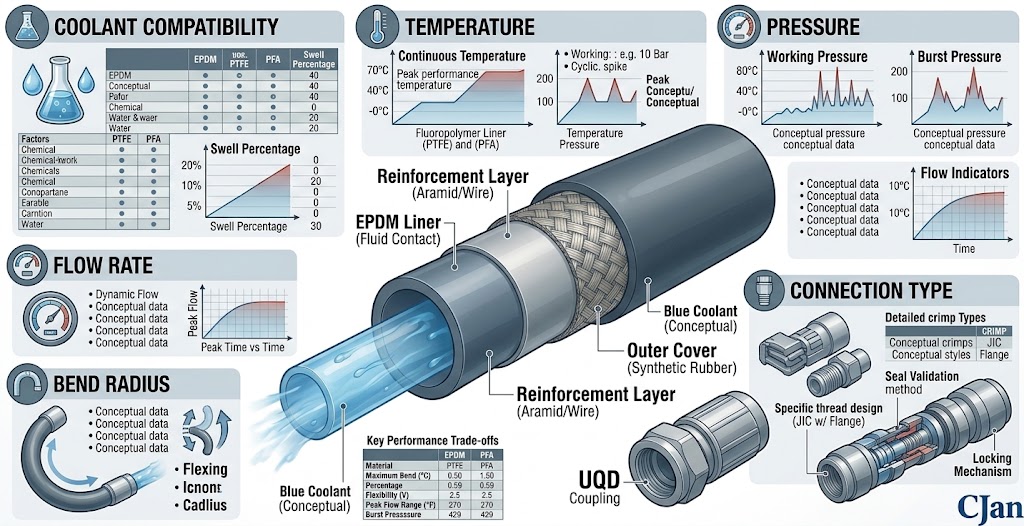
20. When EPDM Should Be Evaluated More Carefully
Engineers should conduct additional compatibility and performance evaluation when the cooling system involves unusual fluids, elevated temperatures, strict cleanliness requirements or demanding mechanical conditions.
In these situations, alternative materials such as silicone, PTFE or PFA may also need to be evaluated.
The selection process should compare the complete hose constructions against the same operating requirements.
21. EPDM Hose Selection Checklist
This workflow helps prevent the common mistake of selecting the hose material before defining the actual operating conditions.
22. What Information Should Be Sent to the Hose Supplier?
A hose supplier can provide a more appropriate recommendation when the application data is clearly defined.
- Coolant name
- Coolant concentration
- Operating temperature
- Maximum and minimum temperature
- Operating pressure
- Maximum pressure
- Required flow rate
- Required hose diameter
- Hose length
- Minimum bend radius
- Fitting type
- UQD requirements
- Cleanliness requirements
- Expected service conditions
23. How CJAN Approaches EPDM Liquid Cooling Hose
CJAN develops liquid cooling hose solutions for applications where material, construction and connection requirements need to be considered together.
The CJAN Liquid Cooling application range covers hose solutions for thermal-management systems.
Current liquid cooling hose products include LCH, LCH-SD and LCH-SDS.
For EPDM applications, the appropriate hose construction should be selected according to the coolant, temperature, pressure, flow, bend radius and connection requirements.
24. EPDM Selection Should Be Application Driven
There is no universal liquid cooling hose material.
EPDM may provide a useful combination of properties for one cooling circuit, while silicone or fluoropolymer construction may be more appropriate for another.
The engineering process should begin with the operating envelope and work toward the hose construction—not the other way around.
This approach also makes it easier to identify which requirements actually drive the material decision.
Conclusion
EPDM liquid cooling hose can be a practical option for many thermal-management applications when its material compatibility and mechanical characteristics match the system requirements.
For AI data centers, the selection process should include coolant compatibility, temperature, pressure, flow rate, pressure drop, bend radius and connection design.
EPDM should not be treated as a universal solution, just as silicone, PTFE or PFA should not be selected solely because of one material property.
The most useful specification is the one based on the actual operating conditions of the complete cooling circuit.
For more information, visit the CJAN Liquid Cooling application page.