GLOBAL
Liquid Cooling Hose Fittings: How to Select the Right Connection Type
In a liquid cooling system, the hose is only one part of the fluid connection.
The fitting connects the flexible hose to a manifold, cold plate, CDU, valve, pipe or other cooling component. Its dimensions, sealing method, material and connection type can all affect how the completed hose assembly performs.
This is particularly important in AI servers and data centers, where cooling connections may need to operate continuously while fitting into compact spaces.
This article explains the main engineering factors to consider when selecting fittings for liquid cooling hose assemblies.
1. What Is a Liquid Cooling Hose Fitting?
A liquid cooling hose fitting is a connection component used to join a flexible hose with another part of the cooling circuit.
A simplified liquid cooling connection can be represented as:
Depending on the system architecture, the fitting may be permanently assembled to the hose or may form part of a removable connection such as a quick-disconnect coupling.
In a complete hose assembly, the fitting and hose should therefore be evaluated as one engineered connection.
2. Why Fitting Selection Matters in AI Cooling Systems
AI server cooling systems can contain numerous fluid connections within a relatively small installation space.
Each connection needs to maintain the intended coolant path while accommodating pressure, temperature, mechanical movement and maintenance requirements.
A fitting that is poorly matched to the hose or system can introduce problems such as:
- Leakage
- Excessive pressure loss
- Installation difficulty
- Mechanical stress
- Insufficient sealing performance
- Maintenance problems
For this reason, fitting selection should be part of the hose assembly design process rather than an afterthought.
See How to Design Reliable Liquid Cooling Hose Assemblies for AI Servers.
3. Start With the Hose Construction
The first question is whether the selected fitting is compatible with the hose construction.
Liquid cooling hoses may use different inner tube materials and construction methods, including EPDM, silicone, PTFE, PFA and reinforced multi-layer designs.
A fitting designed for one hose construction should not automatically be assumed to be suitable for another.
The connection method needs to provide sufficient mechanical retention without damaging the hose.
Important hose parameters include:
- Inside diameter
- Outside diameter
- Wall thickness
- Reinforcement structure
- Material
- Operating pressure
See Liquid Cooling Hose Materials for AI Data Centers.
4. Match the Fitting to the Hose Dimensions
Nominal hose size alone is not always sufficient for selecting a fitting.
The actual hose inside diameter and outside diameter should be confirmed against the fitting specification and assembly method.
This is especially important for reinforced hoses because reinforcement changes the outside dimensions and can affect the connection method.
A practical fitting selection should therefore verify:
| Hose Parameter | Why It Matters |
|---|---|
| Inside diameter | Influences flow and connection geometry |
| Outside diameter | Determines fitting compatibility and retention |
| Wall thickness | Affects connection design |
| Reinforcement | Can affect assembly method and mechanical strength |
5. Consider the Connection Type
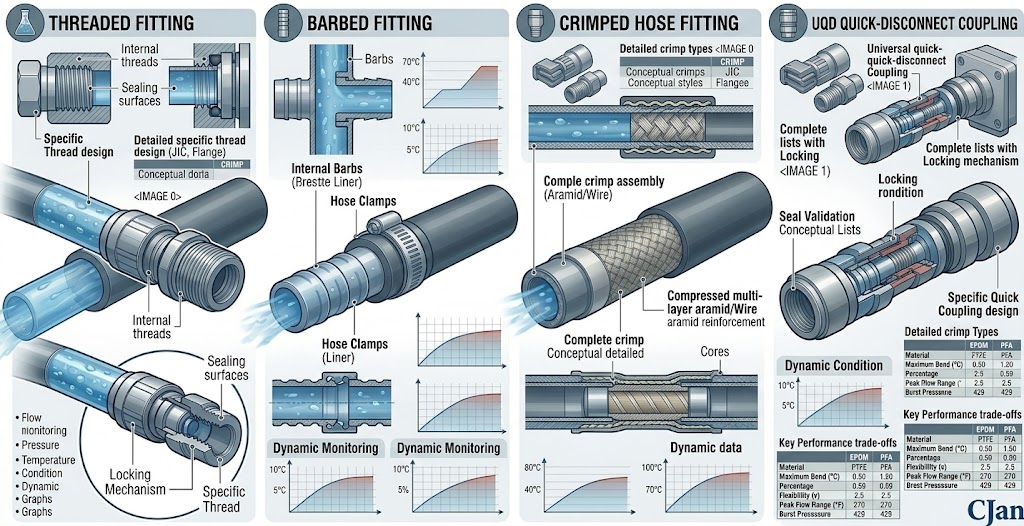
Liquid cooling systems can use several types of hose connections depending on the application.
Common approaches include:
- Threaded connections
- Barbed connections
- Crimped hose assemblies
- Clamped connections
- Quick-disconnect couplings
The appropriate connection type depends on the equipment interface, hose construction, operating conditions and service requirements.
There is no single connection method that is appropriate for every liquid cooling application.
6. Threaded Connections
Threaded fittings are commonly used when a hose assembly needs to connect to a threaded port, manifold or other equipment interface.
The fitting selection should account for the applicable thread standard and sealing method.
Engineers should verify:
- Thread type
- Thread size
- Connection orientation
- Sealing method
- Available installation space
Thread compatibility should be confirmed rather than assumed from nominal size alone.
7. Barbed Connections
Barbed fittings use a shaped connection surface to retain the hose.
They may be suitable for certain hose constructions and operating conditions, particularly where the assembly method is properly controlled.
However, the fitting geometry, hose material, clamp method and operating pressure all need to be considered together.
A hose should not be selected solely because its nominal diameter appears to match the barb size.
8. Crimped Hose Connections
Crimped assemblies mechanically secure the hose to the fitting using a controlled crimping process.
For applications requiring consistent assembly quality, controlled crimping can provide a repeatable connection method when the hose, fitting and crimp specification are properly matched.
The crimping process should follow the hose and fitting manufacturer's specified requirements.
Incorrect crimp dimensions can affect the mechanical retention and sealing performance of the finished assembly.
9. Clamped Connections
Clamped connections use a clamp or similar mechanical component to secure the hose to the fitting.
The suitability of this method depends on the hose construction, operating pressure, temperature, coolant and applicable installation requirements.
Clamp selection should also consider whether the clamping force is appropriate for the hose without causing damage.
10. Quick-Disconnect Couplings
Quick-disconnect couplings can be useful when the cooling circuit needs to be separated during equipment installation, replacement or maintenance.
In AI data center applications, quick-disconnect connections may be used at locations where repeated service access is expected.
Important selection parameters include:
- Flow capacity
- Pressure rating
- Temperature range
- Coolant compatibility
- Connection size
- Sealing configuration
- Available space
For UQD-specific considerations, see Liquid Cooling Hose Quick Disconnects: How to Choose UQD Couplings for AI Servers.
11. UQD vs. Other Quick-Disconnect Connections
UQD is one type of quick-disconnect solution that can be considered for liquid cooling applications.
When comparing UQD with another coupling, engineers should focus on the actual system requirements rather than the name of the connection.
Key parameters include:
- Required coolant flow
- Pressure drop
- Operating pressure
- Temperature
- Coolant compatibility
- Connection size
- Service frequency
A separate comparison of UQD and traditional quick-disconnect solutions is covered in UQD vs. Traditional Quick Disconnects for AI Data Center Cooling.
12. Consider Coolant Compatibility
The fitting material and sealing components are part of the wetted fluid path and therefore need to be compatible with the coolant.
Compatibility should be considered for:
- Fitting body material
- Seal material
- Hose inner tube
- Coolant formulation
- Operating temperature
Compatibility should be evaluated using the actual coolant formulation and operating conditions whenever possible.
See How Coolant Compatibility Affects Liquid Cooling Hose Selection for AI Data Centers.
13. Pressure Rating of the Fitting
The fitting should be capable of operating at the required system pressure.
Engineers should consider both normal operating pressure and maximum pressure conditions.
The completed hose assembly should be evaluated as a system because the pressure capability of the hose and fitting must be compatible.
See Liquid Cooling Hose Pressure Rating: How Much Pressure Does an AI Data Center Hose Need?.
14. Temperature Rating
Temperature can affect hose materials, seals and fitting components.
The fitting should therefore be suitable for the same operating temperature range as the hose assembly.
Where the cooling system experiences temperature cycling, engineers should also consider repeated expansion and contraction during operation.
For a broader discussion, see How Pressure and Temperature Affect Liquid Cooling Hose Reliability in AI Data Centers.
15. Pressure Drop Through the Fitting
A fitting can contribute to the hydraulic resistance of a liquid cooling circuit.
Changes in internal diameter, flow direction and connection geometry can affect pressure loss.
For systems with high coolant flow requirements, the pressure drop of fittings and couplings should therefore be considered together with the pressure drop of the hose.
The complete hydraulic path may include:
For more information about hose pressure loss, see Liquid Cooling Hose Pressure Drop: How to Calculate and Control It in AI Data Centers.
16. Connection Size and Flow Rate
A connection should not create an unnecessary restriction in an otherwise correctly sized cooling circuit.
For example, a hose may have an appropriate internal diameter while the connection contains a substantially smaller flow passage.
Engineers should therefore evaluate the effective flow path through the complete connection.
This is particularly relevant in high-flow AI server cooling systems.
17. Consider Installation Space
AI servers and rack-level cooling systems can have limited space around fluid connections.
The physical dimensions of the fitting should therefore be considered before finalizing the assembly.
Important dimensions can include:
- Overall fitting length
- Connection diameter
- Required tool clearance
- Rotation space
- Adjacent component clearance
A fitting that meets the hydraulic requirements may still be difficult to install if there is insufficient physical clearance.
18. Fitting Orientation
Fitting orientation can have a direct effect on hose routing.
For example, a straight fitting and a 90-degree fitting can produce very different routing geometries within a server rack.
Where space is restricted, selecting an appropriate fitting orientation can help reduce unnecessary bending and hose length.
19. Avoid Forcing the Hose Into Position
The fitting should allow the hose to reach the connection without excessive force.
If the hose needs to be pulled, twisted or sharply bent to reach the fitting, the connection geometry should be reconsidered.
Forcing the assembly into position can create mechanical loads that remain present during operation.
See Liquid Cooling Hose Bend Radius: Why Flexibility Matters in AI Server Racks.
20. Sealing Method
Different connection types use different sealing mechanisms.
Depending on the fitting design, sealing may rely on an elastomer seal, gasket, O-ring, threaded sealing method or another engineered interface.
The sealing material should be compatible with the coolant and operating temperature.
During assembly, seals should also be installed according to the applicable manufacturer requirements.
21. Material Selection for Fittings
Fitting materials should be selected according to the application environment.
Potential considerations include:
- Coolant compatibility
- Corrosion resistance
- Temperature
- Pressure
- Mechanical strength
- Weight
- Installation requirements
The fitting material should also be evaluated together with the hose and other wetted components.
22. Hose-to-Fitting Mechanical Retention
A reliable connection requires sufficient mechanical retention between the hose and fitting.
The exact retention method depends on the hose and fitting design.
Engineers should avoid assuming that a generic clamp, barb or fitting will provide the required retention simply because the nominal dimensions appear compatible.
The finished connection should follow the manufacturer's assembly requirements.
23. Fittings in Multi-Layer Liquid Cooling Hoses
Multi-layer liquid cooling hoses can contain an inner tube, reinforcement layer and outer cover.
The fitting needs to engage with the appropriate hose structure without compromising the fluid barrier or reinforcement.
This is one reason why fitting selection should be based on the actual hose construction rather than simply the nominal hose size.
24. Fitting Selection for EPDM Hoses
EPDM hoses are used in various water-based and thermal-management applications.
When selecting fittings for EPDM liquid cooling hoses, engineers should verify dimensional compatibility, coolant compatibility, temperature range and the required assembly method.
For EPDM-specific considerations, see EPDM Liquid Cooling Hose: Applications, Benefits and Selection Factors.
25. Fitting Selection for Silicone Hoses
Silicone hoses are valued in many applications for their flexibility and temperature characteristics.
However, the fitting design still needs to match the hose dimensions and operating conditions.
Particular attention should be paid to the mechanical retention method and installation requirements.
See Silicone Liquid Cooling Hose: Key Advantages and Limitations.
26. Fitting Selection for PTFE and PFA Hoses
PTFE and PFA hoses are fluoropolymer-based solutions that may be selected where chemical resistance and specific temperature or cleanliness requirements are important.
The fitting system should be compatible with the construction and dimensional characteristics of the selected fluoropolymer hose.
For a material comparison, see PTFE vs. PFA Liquid Cooling Hose: What Is the Difference?.
27. Fittings for CDU-to-Rack Connections
CDU-to-rack connections may require fittings that combine sufficient flow capability with practical service access.
The connection geometry should support the intended hose routing while avoiding unnecessary bends and excessive mechanical loading.
For larger cooling circuits, the fitting should also be evaluated as part of the total pressure-loss calculation.
See CDU to Rack Connections: Designing Reliable Liquid Cooling Hose Assemblies for AI Data Centers.
28. Fittings for High-Density AI Server Cooling
High-density GPU servers can require multiple fluid connections in a compact area.
In these applications, fitting selection should consider not only pressure and flow but also physical access and hose routing.
A compact fitting can reduce installation space, but its internal flow path and connection characteristics still need to satisfy the hydraulic requirements.
See How to Choose the Right Liquid Cooling Hose for High-Density AI Servers.
29. Common Fitting Selection Mistakes
| Common Mistake | Potential Problem |
|---|---|
| Selecting by nominal size only | Actual hose dimensions may not match |
| Ignoring coolant compatibility | Material or sealing concerns |
| Ignoring fitting pressure rating | Connection may not meet system requirements |
| Using an unnecessarily restrictive connection | Additional pressure loss |
| Ignoring installation clearance | Difficult assembly or maintenance |
| Forcing hose alignment | Additional mechanical stress |
| Using an incompatible assembly method | Reduced connection reliability |
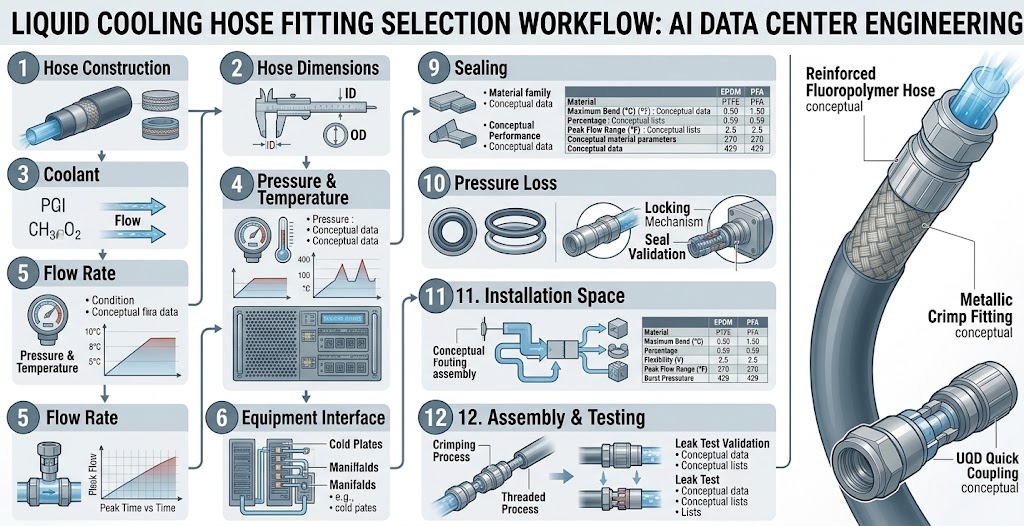
30. A Practical Fitting Selection Process
A practical engineering workflow can be organized as follows:
31. How to Specify a Liquid Cooling Hose Fitting
When requesting a fitting or complete hose assembly from a supplier, engineers should provide enough information to avoid assumptions.
A useful specification may include:
- Hose model
- Hose inside diameter
- Hose outside diameter
- Coolant
- Operating pressure
- Operating temperature
- Required flow rate
- Connection standard
- Fitting orientation
- Required hose length
- UQD requirement, if applicable
- Testing requirements
This information allows the hose and fitting to be evaluated as a complete assembly.
32. CJAN Liquid Cooling Hose and Fitting Solutions
CJAN provides flexible liquid cooling hose solutions for thermal-management applications where hose material, construction and connection requirements need to be considered together.
The CJAN Liquid Cooling application range covers solutions for cooling systems used in demanding thermal-management environments.
Relevant hose products include LCH, LCH-SD and LCH-SDS.
For a complete hose assembly, fitting selection should be based on the actual coolant, flow, pressure, temperature, hose construction, connection interface and installation environment.
Conclusion
Selecting a liquid cooling hose fitting is not simply a matter of matching two nominal connection sizes.
The fitting must work with the hose construction and the complete cooling system. Coolant compatibility, pressure, temperature, flow, sealing, mechanical retention, installation space and service requirements all need to be considered.
For AI data centers and high-density GPU servers, the most reliable approach is to treat the hose and fitting as one engineered assembly.
When these factors are evaluated together, the resulting connection can be easier to install, maintain and integrate into the overall liquid cooling system.
For more information about liquid cooling hose solutions, visit the CJAN Liquid Cooling application page.