
BLOG
2026/08/12Clicks:475
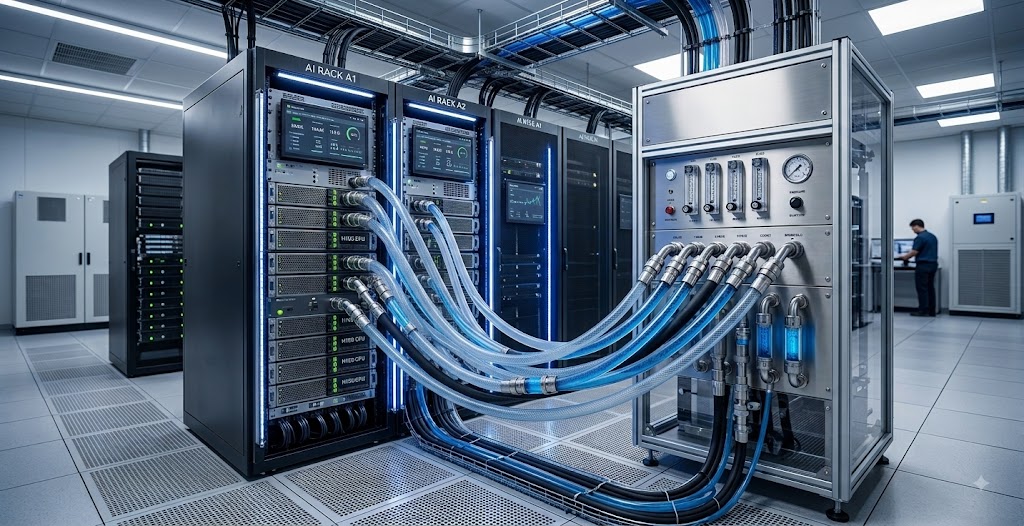
As AI computing continues to accelerate, data center cooling systems are facing increasingly demanding operating conditions.
High-performance GPU servers generate significant heat, requiring efficient liquid cooling solutions capable of operating continuously under controlled conditions.
Within these systems, liquid cooling hoses are responsible for transporting coolant between:
One of the most important technical parameters when selecting a cooling hose is:
Pressure performance.
A hose must maintain reliable operation under continuous coolant pressure while also handling temporary pressure fluctuations.
Selecting a hose only by size or connection type may create risks such as:
Therefore, understanding pressure ratings is essential for designing reliable AI cooling infrastructure.
Pressure specifications usually include several important values:
Working Pressure

↓

Maximum Recommended Operating Pressure

↓

Burst Pressure
Each value represents a different performance limit.
Working pressure refers to the maximum pressure a hose can safely withstand during continuous operation.
This is the most important value for system design.
For AI liquid cooling systems, engineers should evaluate:
The selected hose should operate comfortably below its maximum working pressure.
Burst pressure refers to the pressure at which a hose may fail structurally.
It is usually much higher than the working pressure.
However:
Burst pressure is not a normal operating target.
A reliable design should always maintain sufficient safety margin between operating pressure and burst pressure.
AI cooling systems operate continuously.
Unlike occasional industrial applications, data center cooling loops experience:
A hose that performs well during short testing may not provide reliable long-term performance.
Pressure stability affects:
Pressure performance depends on multiple design factors.
A liquid cooling hose usually consists of several layers:
Inner Tube

↓

Reinforcement Layer

↓

Outer Protective Layer
Each layer contributes to pressure resistance.
The inner tube directly contacts coolant.
Important requirements:
The reinforcement layer provides structural strength.
It helps resist:
Common reinforcement materials include:
The outer layer protects against:
Pressure capability can change with temperature.
Higher temperatures may affect:
Therefore, pressure specifications should always be evaluated together with operating temperature.
Example:
A hose may have different pressure capability at:
Hose diameter affects pressure and flow characteristics.
A larger diameter:
Advantages:
Considerations:
A smaller diameter:
Advantages:
Considerations:
The correct diameter depends on the complete cooling system design.
Long hose assemblies may experience:
Routing also influences pressure performance.
Avoid:
When selecting a cooling hose, engineers should consider:
What pressure does the cooling loop normally operate at?
What happens during:
A reliable design does not operate close to the hose limit.
The recommended approach:
System Pressure

↓

Safety Margin

↓

Hose Working Pressure Rating 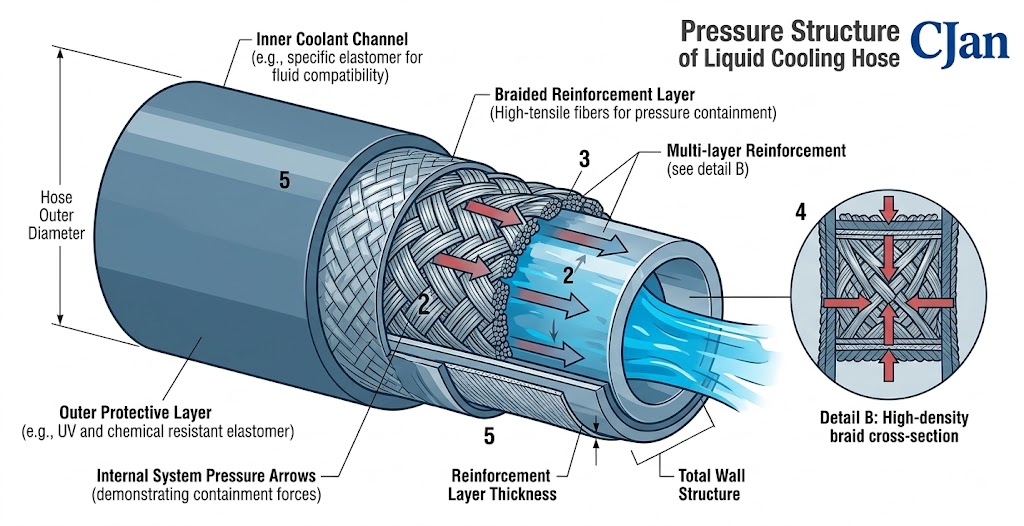
A correct diameter does not guarantee pressure reliability.
Burst pressure is a failure limit, not a working condition.
Pressure capability changes with operating temperature.
The hose may be strong, but fittings can become the weak point.
Continuous operation requires evaluating durability, not only short-term strength.
Before deployment, professional hose assemblies may require:
Checks structural integrity.
Verifies:
Confirms:
Engineers should evaluate:
| Parameter | Consideration |
|---|---|
| Working pressure | Normal operating condition |
| Maximum pressure | System peak condition |
| Temperature | Operating environment |
| Coolant | Fluid compatibility |
| Hose structure | Reinforcement design |
| Installation | Routing and bending |
CJAN develops liquid cooling hose solutions for applications requiring reliable coolant transportation.
The LCH product family supports:
Suitable for:
Features:
| Part no. | ID | OD | Bending radius | Work pressure | Bursting pressure | Length | |
| inch | mm | mm | mm | PSI | PSI | m | |
| LCH006 | 1/4" | 6. 4 | 15 | 50 | 300 | 1200 | 100 |
| LCH008 | 3/8" | 9.6 | 18.5 | 65 | 300 | 1200 | 100 |
|
LCH013 |
1/2" | 12.7 | 22 | 75 | 300 | 1200 | 100 |
|
LCH025 |
1" |
25. 4 |
36.8 |
150 |
300 |
1200 |
60 |
Designed for applications requiring enhanced safety considerations.
Suitable for:
| Part No. | ID | OD | Bending Radius | Working Pressure | Bursting Pressure | Lenth | |
| inch | mm | mm | mm | MPa | MPa | m | |
| LCH032-SDS | 1-1/4" | 32 | 42 | 45 | 1 | 4 | 30/60 |
| LCH038-SDS | 1-1/2" | 38 | 49.5 | 55 | 1 | 4 | 30/60 |
| LCH051-SDS | 2" | 51 | 61 | 76 | 1 | 4 | 30/60 |
| LCH076-SDS | 3" | 76 | 87.5 | 76 | 1 | 4 | 30/60 |
| LCH0102-SDS | 4" | 102 | 113 | 102 | 1 | 4 | 30/60 |
Designed for:
| Part No. | ID | OD | Bending Radius | Working Pressure | Bursting Pressure | Lenth | |
| inch | mm | mm | mm | MPa | MPa | m | |
| LCH032-SD | 1-1/4" | 32 | 44 | 160 | 1.6 | 6.4 | 40 |
| LCH038-SD | 1-1/2" | 38 | 51 | 190 | 1 | 4 | 40 |
| LCH051-SD | 2" | 51 | 64 | 250 | 1 | 4 | 40 |
| LCH064-SD | 2-1/2" | 64 | 78 | 315 | 1 | 4 | 40 |
| LCH076-SD | 3" | 76 | 90 | 350 | 1 | 4 | 40 |
Pressure performance is one of the key factors determining liquid cooling hose reliability.
A suitable hose selection requires evaluating:
For AI data centers, reliability is more important than simply achieving the highest pressure rating.
The best cooling hose solution is one that matches the actual system requirements and provides stable long-term operation.
As AI infrastructure continues to evolve, properly engineered liquid cooling hose assemblies will play an increasingly important role in maintaining thermal management reliability.
Liquid Cooling Hose Installation Guide: Best Practices for AI Data Centers
 Mobile


 GLOBAL


