GLOBAL
How to Choose the Right Liquid Cooling Hose for AI Servers
Choosing a liquid cooling hose for an AI server is not simply a matter of matching hose diameter to a fitting.
Modern AI servers can place significant thermal loads on the cooling system. The hose has to work as part of a complete coolant circuit that may include cold plates, manifolds, CDUs, fittings and UQDs.
That makes hose selection a system engineering decision.
A practical selection process should consider the coolant, required flow rate, operating pressure, temperature range, internal diameter, bend radius, hose length, mechanical environment and connection configuration.
For an introduction to the overall operating principle of AI data center liquid cooling, see How Does Liquid Cooling Work in AI Data Centers?
1. Start With the Cooling System, Not the Hose
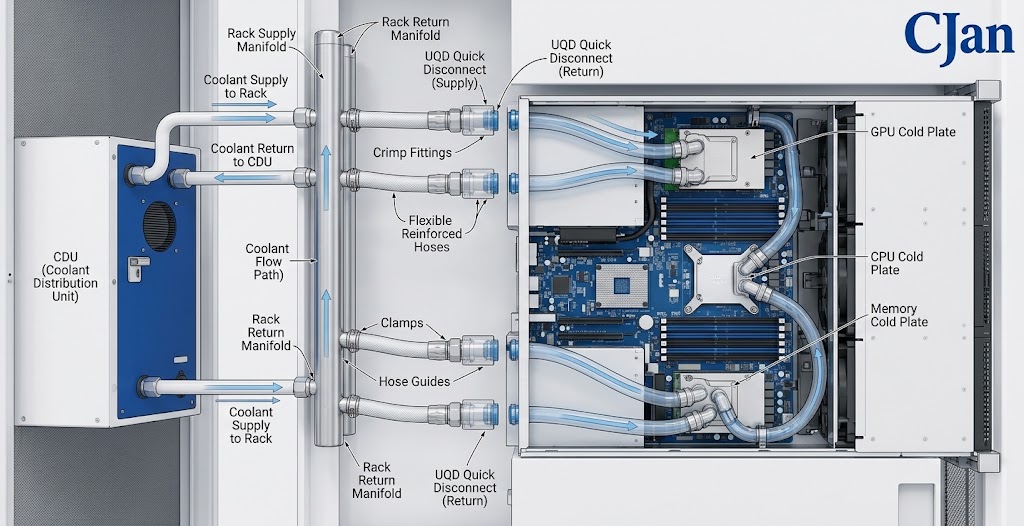
The first step is to understand where the hose sits within the cooling architecture.
A typical liquid cooling circuit may connect a CDU with a rack manifold, cold plates and other cooling components.
Each section contributes to the hydraulic and thermal performance of the complete system.
Therefore, the hose should be selected after the basic system requirements have been established.
2. Confirm the Coolant First
Coolant compatibility is one of the most important starting points for hose selection.
The inner tube remains in contact with the coolant during operation, potentially for thousands of hours.
The engineering team should identify the actual coolant formulation rather than using only a broad description such as "water-based coolant."
Relevant information can include:
- Coolant type
- Water concentration
- Glycol or other additives
- Operating temperature
- Expected service duration
- Required cleanliness level
Material compatibility should then be evaluated under the actual operating conditions.
This is particularly important when a cooling system uses a coolant formulation that differs from standard water or water-glycol mixtures.
3. Determine the Required Coolant Flow
The required flow rate is closely related to the heat load that the cooling system must remove.
For a given cooling architecture, the engineering team normally needs to establish the target coolant flow before selecting the hose diameter.
A hose with a suitable connection size may still be unsuitable if its internal passage creates excessive hydraulic resistance at the required flow rate.
4. Select the Internal Diameter Based on Flow
Internal diameter is one of the most visible hose specifications, but it should not be selected in isolation.
For the same flow rate, reducing the internal diameter generally increases fluid velocity and hydraulic resistance.
Increasing the diameter reduces velocity and can reduce pressure drop, but a larger hose also requires more installation space and may require larger connection components.
| Selection Approach | Potential Result |
|---|---|
| Undersized hose | Higher flow velocity and pressure drop |
| Correctly sized hose | Balanced hydraulic and mechanical performance |
| Oversized hose | More installation space and potentially larger fittings |
The objective is to select a hose ID that fits the system's flow and pressure-drop requirements while remaining practical for installation.
5. Check Working and Maximum Pressure
Pressure requirements should be defined before selecting the hose construction.
At minimum, engineers should distinguish between normal working pressure and maximum expected pressure.
Transient conditions should also be considered where relevant.
- Normal operating pressure
- Maximum working pressure
- Startup conditions
- Pump-related pressure changes
- Applicable pressure test requirements
The hose should provide an appropriate safety margin based on the manufacturer's technical specifications.
6. Consider the Complete Pressure Drop
Pressure loss does not come from the hose alone.
The cooling loop may contain multiple hydraulic restrictions.
- Hose
- Fittings
- UQDs
- Manifolds
- Valves
- Cold plates
The total pressure drop determines the hydraulic demand placed on the pump.
For this reason, engineers should evaluate hose pressure drop at the actual target flow rate whenever the data is available.
The relationship between hose diameter and hydraulic resistance is also discussed in the related article What Are the Key Requirements for AI Data Center Liquid Cooling Hoses?
7. Check the Operating Temperature Range
Liquid cooling hoses may experience different temperatures during startup, normal operation and shutdown.
Important temperature inputs include:
- Minimum operating temperature
- Normal coolant temperature
- Maximum operating temperature
- Potential temperature cycling
Temperature should be considered together with pressure and coolant chemistry.
A hose that performs well under one temperature condition should not automatically be assumed to have the same pressure capability across the entire temperature range.
8. Evaluate Flexibility and Bend Radius
One of the main reasons to use flexible hose in server cooling is installation flexibility.
AI server racks can contain dense arrangements of GPUs, cold plates, manifolds, cables and power components.
A flexible hose can simplify routing around these components.
However, the hose still needs to remain within its specified minimum bend radius.
Forcing a hose into an excessively tight bend can deform the internal passage and place additional mechanical stress on the connection.
9. Consider Hose Length Carefully
Hose length should be determined from the actual installation layout.
A hose that is too short can create tension at the fittings.
A hose that is unnecessarily long can add routing complexity and additional hydraulic resistance.
The final length should allow for:
- Normal routing
- Required bend radius
- Equipment movement
- Assembly tolerance
- Maintenance access
10. Connection Type Must Match the Cooling Architecture
The hose is only one part of the connection.
The final assembly may connect to cold plates, manifolds, CDUs or UQDs.
Therefore, engineers should define the connection configuration at the beginning of the selection process.
Relevant parameters can include:
- Connection size
- Connection type
- Hose ID
- Fitting configuration
- UQD type
- Available installation space
11. Why UQD Selection Should Be Included in Hose Design
UQDs are commonly used where cooling lines need to be disconnected during service or equipment replacement.
However, the UQD is also part of the hydraulic path.
Its internal flow passage can contribute to pressure drop.
Therefore, the hose and UQD should be considered as a connected assembly rather than two completely independent components.
When specifying a liquid cooling hose assembly, the following should be checked:
- Hose compatibility
- UQD compatibility
- Flow requirement
- Pressure rating
- Temperature range
- Connection dimensions
12. Check the Mechanical Environment
Data center cooling hoses can experience mechanical conditions that are different from those of a stationary industrial hose.
Potential factors include:
- Repeated installation and removal
- Movement of server modules
- Contact with surrounding components
- Vibration
- Limited routing space
- Repeated bending
The hose construction should therefore match the actual installation environment.
13. Do Not Ignore the Fitting Area
In a hose assembly, the connection area can experience concentrated mechanical loads.
Improper routing can create bending or pulling forces near the fitting.
Good installation practice should avoid:
- Sharp bends directly behind the fitting
- Twisting during installation
- Excessive axial pulling
- Forced misalignment
A properly routed hose should have enough space to follow a natural bend without transferring excessive load to the connection.
14. Compare Hose Materials According to the Application
Different hose materials can offer different combinations of flexibility, temperature resistance, chemical compatibility and mechanical properties.
| Material Family | Selection Consideration |
|---|---|
| EPDM | Often considered for water-based cooling applications where flexibility and durability are important. |
| Silicone | Can be considered where flexibility and temperature capability are important. |
| Fluoropolymer | Can be considered where specific chemical compatibility or cleanliness requirements are important. |
| Other engineered elastomers | Selected according to coolant, pressure, temperature and mechanical requirements. |
There is no single hose material that is optimal for every liquid cooling system.
The actual coolant and operating environment should determine the final material selection.
15. Evaluate the Hose Construction
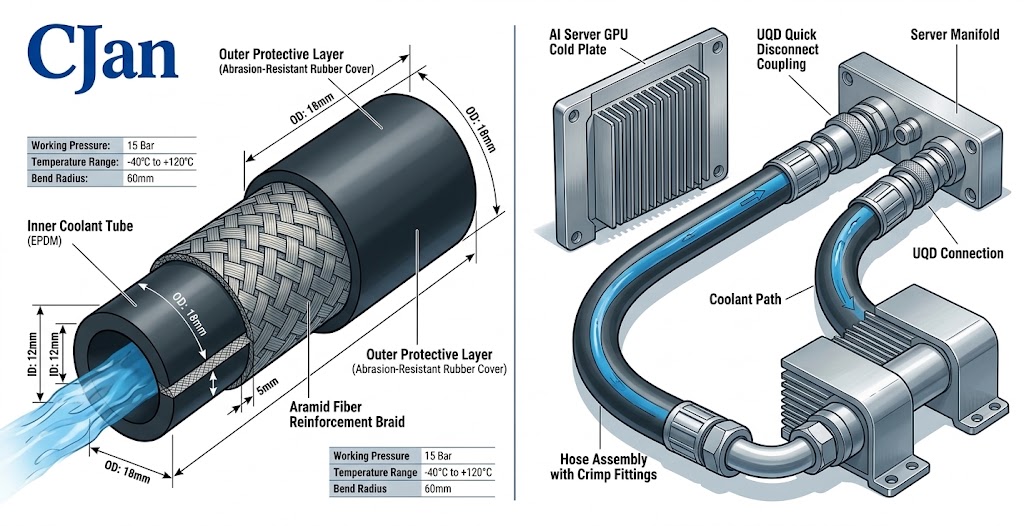
A liquid cooling hose can contain multiple functional layers.
Depending on the product construction, these may include an inner fluid-contact layer, reinforcement layer and outer protective layer.
Each layer can have a different function.
The inner layer manages coolant contact, reinforcement can contribute to pressure and dimensional stability, while the outer layer can provide mechanical protection.
16. Leakage Performance Should Be Evaluated at Assembly Level
Leakage control is fundamental to liquid cooling reliability.
A cooling assembly can have multiple potential leak points, including the hose body, fitting interface, crimped connection and UQD.
For critical applications, testing only the hose material may not provide enough information about the finished assembly.
The complete hose assembly should be evaluated according to the actual project requirements.
17. Cleanliness Requirements Depend on the Application
Not every data center cooling system has identical cleanliness requirements.
Some applications may place greater emphasis on internal particulate control, manufacturing residues or fluid cleanliness.
When cleanliness is important, the hose manufacturing and handling process should be considered as part of supplier evaluation.
18. Consider Long-Term Material Stability
Liquid cooling systems are intended for extended operation.
The hose therefore needs to maintain its required performance after prolonged exposure to the coolant and operating environment.
Long-term evaluation may include:
- Material stability
- Dimensional changes
- Coolant compatibility
- Mechanical performance
- Temperature exposure
The actual significance of each factor depends on the coolant and system design.
19. Build a Hose Selection Checklist
A structured checklist can make supplier communication much more efficient.
| Parameter | Required Information |
|---|---|
| Coolant | Exact coolant formulation |
| Flow Rate | Target and expected flow range |
| Pressure | Working and maximum pressure |
| Temperature | Minimum and maximum operating temperature |
| Hose ID | Required internal diameter |
| Length | Finished assembly length |
| Bend Radius | Available routing space |
| Connection | Fitting and UQD requirements |
| Environment | Mechanical and installation conditions |
20. When Should You Choose a Reinforced Liquid Cooling Hose?
Reinforced construction may be appropriate when the application requires a combination of pressure resistance, flexibility and mechanical stability.
The decision should be based on the actual pressure, temperature and routing requirements rather than simply assuming that reinforced construction is always better.
For applications requiring a dedicated liquid cooling hose solution, engineers can review the CJAN LCH Liquid Cooling Hose.
21. Comparing CJAN Liquid Cooling Hose Options
CJAN provides several liquid cooling hose options that can be evaluated according to different system requirements.
| Product | Recommended Evaluation |
|---|---|
| CJAN LCH | General liquid cooling hose selection according to application requirements. |
| CJAN LCH-SD | Alternative liquid cooling hose construction for specific system requirements. |
| CJAN LCH-SDS | Alternative hose configuration for liquid cooling applications requiring specific construction characteristics. |
The product specifications should be reviewed against the actual coolant, pressure, temperature, flow and connection requirements before selection.
22. Why Application Data Is Important When Requesting a Hose
A supplier can provide a more useful recommendation when the application information is complete.
Instead of asking only for "an AI cooling hose," provide the following information whenever possible:
- Coolant name and formulation
- Target flow rate
- Working pressure
- Maximum pressure
- Temperature range
- Required hose ID
- Required hose length
- Connection type
- UQD requirements
- Installation environment
This information allows the hose to be evaluated as part of the complete cooling circuit.
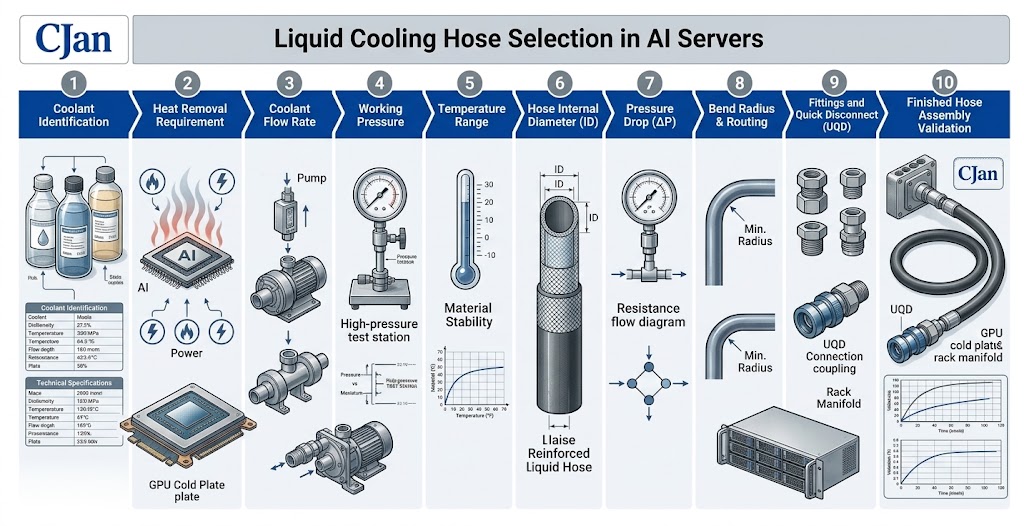
23. A Practical AI Server Hose Selection Process
This process helps prevent a common mistake: selecting the hose first and trying to adapt the cooling system around it later.
24. What Makes a Good AI Data Center Liquid Cooling Hose?
A suitable hose should provide a balanced combination of hydraulic, thermal and mechanical performance.
In practical terms, the selection should satisfy the following conditions:
- The material is compatible with the coolant.
- The hose supports the required operating pressure.
- The hose can operate within the required temperature range.
- The internal diameter supports the required coolant flow.
- The pressure drop is acceptable for the system.
- The hose can be routed within the available space.
- The minimum bend radius can be respected.
- The connection matches the selected fittings and UQDs.
- The finished assembly can meet the required leakage performance.
25. CJAN Liquid Cooling Hose Solutions
CJAN develops and supplies hose products for liquid cooling applications, including the LCH, LCH-SD and LCH-SDS product families.
The dedicated CJAN Liquid Cooling Solutions page provides an overview of the company's liquid cooling application focus.
For the current LCH product, visit CJAN LCH Liquid Cooling Hose.
For additional hose configurations, engineers can also review CJAN LCH-SD and CJAN LCH-SDS.
Final product selection should be based on the actual application conditions and the latest technical specifications.
Conclusion
Selecting a liquid cooling hose for an AI server should start with the cooling system rather than with the hose itself.
Coolant compatibility, flow rate, pressure, temperature, internal diameter, pressure drop, flexibility, bend radius, hose length and connection configuration all influence the final selection.
UQDs and fittings should also be considered because they form part of the same hydraulic and mechanical assembly.
For AI data center projects, the most reliable approach is to define the operating conditions first and then select the hose construction that satisfies those requirements.
CJAN's liquid cooling hose portfolio provides LCH, LCH-SD and LCH-SDS options for evaluating different cooling system requirements.
For project-specific hose selection, providing the coolant, flow rate, pressure, temperature, dimensions and connection requirements is the most effective starting point.