
CJan Fluid Technology Co., Ltd.

BLOG

Liquid Cooling Hose Materials for AI Data Centers: EPDM, Silicone, PTFE and Beyond

2026/08/13Clicks:4

Liquid Cooling Hose Materials for AI Data Centers: EPDM, Silicone, PTFE and Beyond

Introduction

The rapid expansion of artificial intelligence infrastructure is creating new challenges for thermal management.

Modern AI servers equipped with high-performance GPUs can generate extremely high heat density. Traditional air cooling solutions are becoming increasingly difficult to maintain efficiency, leading many data centers toward direct liquid cooling technologies.

Within these systems, the liquid cooling hose plays a critical role by transporting coolant between:

  • Coolant Distribution Units (CDU)
  • Rack manifolds
  • Cold plates
  • Heat exchangers
  • Cooling loops

Although the hose is a relatively small component, the material selection directly affects:

  • Cooling system reliability
  • Leakage risk
  • Service life
  • Chemical compatibility
  • Maintenance requirements

Choosing the right hose material is therefore an important engineering decision.
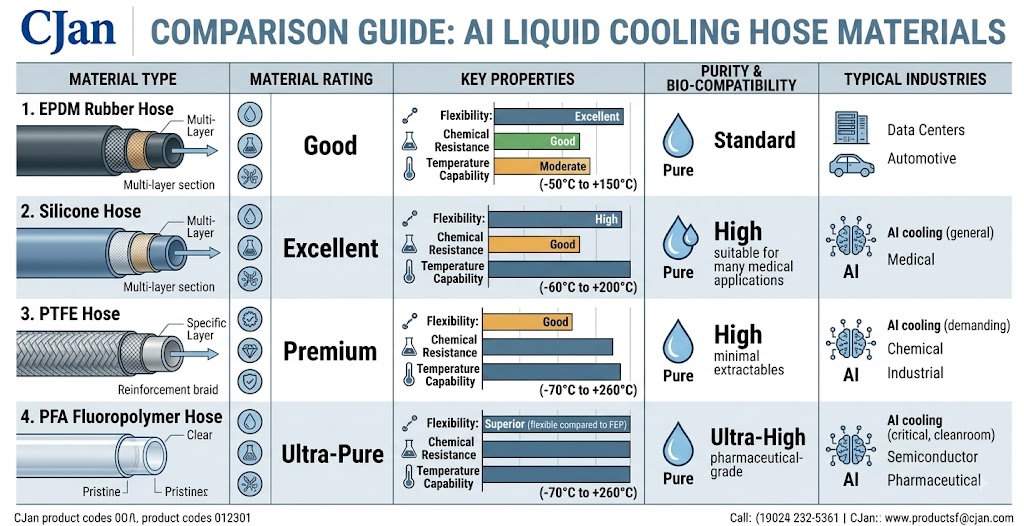
Professional engineering infographic comparing different liquid cooling hose materials and application scenarios.


Why Hose Material Selection Matters in AI Cooling Systems

A liquid cooling hose operates under multiple stresses simultaneously:

  • Continuous coolant contact
  • Pressure fluctuations
  • Temperature cycling
  • Mechanical bending
  • Long-term operation

Different materials respond differently to these conditions.

A suitable material should provide:

✓ Coolant compatibility
✓ Stable mechanical performance
✓ Long service life
✓ Low leakage risk
✓ Reliable installation performance

There is no single material suitable for every application.

The correct choice depends on:

  • Cooling fluid
  • Temperature range
  • Pressure requirements
  • Cleanliness requirements
  • Application environment

Overview of Common Liquid Cooling Hose Materials

Material Main Characteristics Typical Applications
EPDM Balanced performance, flexible, coolant compatible AI data centers, GPU cooling
Silicone Excellent flexibility and temperature resistance Specialized cooling systems
PTFE Chemical resistance and high purity Semiconductor, chemical systems
PFA High purity fluoropolymer performance Advanced semiconductor applications
Metal High strength and durability Extreme environments

EPDM Liquid Cooling Hose: The Practical Choice for AI Data Centers

What Is EPDM?

EPDM (Ethylene Propylene Diene Monomer) is a synthetic rubber widely used in thermal management applications.

It has become one of the preferred materials for water-based liquid cooling systems because it provides a strong balance between:

  • Flexibility
  • Durability
  • Cost efficiency
  • Coolant compatibility

Advantages of EPDM Cooling Hose

1. Excellent Compatibility with Water-Based Coolants

Many AI cooling systems use:

  • Deionized water
  • Water-glycol mixtures
  • Thermal management fluids

EPDM performs well in these environments.


2. Good Flexibility for Rack Installation

AI server environments require compact routing.

EPDM hoses allow:

  • Easier installation
  • Reduced bending stress
  • Better connection reliability

3. Long-Term Aging Resistance

AI data centers often operate continuously.

EPDM maintains performance under:

  • Continuous coolant circulation
  • Temperature changes
  • Long operating periods

Typical EPDM Applications

EPDM hoses are commonly used in:

  • AI data center liquid cooling
  • GPU server cooling
  • CDU connection systems
  • Industrial cooling loops

For mainstream AI liquid cooling systems, EPDM is often the most practical solution.


Silicone Liquid Cooling Hose: Flexibility and Temperature Performance

What Is Silicone?

Silicone rubber is known for its excellent flexibility and temperature resistance.

It is often selected where installation flexibility is a primary concern.


Advantages of Silicone Hose

1. Excellent Flexibility

Silicone provides:

  • Small bending radius
  • Easy installation
  • Reduced assembly difficulty

2. Wide Temperature Capability

Suitable for applications involving:

  • Temperature fluctuations
  • Higher temperature environments
  • Thermal cycling

3. Visual Inspection Options

Some silicone hoses can be manufactured with transparency, allowing:

  • Coolant observation
  • Visual inspection

Limitations of Silicone

Engineers should also consider:

  • Different mechanical strength compared with reinforced rubber hoses
  • Permeation characteristics
  • Fluid compatibility requirements

Silicone is not automatically the best choice for every cooling system.


PTFE Liquid Cooling Hose: Chemical Resistance and High Purity

What Is PTFE?

PTFE (Polytetrafluoroethylene) is a fluoropolymer known for:

  • Excellent chemical resistance
  • Low friction characteristics
  • Wide temperature capability

Advantages of PTFE Hose

1. Superior Chemical Resistance

PTFE performs well with many aggressive fluids.


2. High Temperature Capability

Suitable for demanding thermal environments.


3. Low Contamination Performance

PTFE is commonly selected for applications requiring:

  • High purity
  • Low particle generation
  • Stable fluid quality

PTFE Typical Applications

Common applications include:

  • Semiconductor equipment
  • Chemical systems
  • High-purity cooling
  • Advanced industrial equipment

PFA Hose: The High-Purity Fluoropolymer Option

What Is PFA?

PFA (Perfluoroalkoxy alkane) is another fluoropolymer material with characteristics similar to PTFE.

It provides:

  • Excellent chemical resistance
  • High purity
  • Good transparency
  • High temperature capability

Why PFA Is Important for Semiconductor Cooling

Semiconductor manufacturing requires strict control of:

  • Chemical contamination
  • Particle generation
  • Material stability

PFA hoses are commonly considered for:

  • Semiconductor process cooling
  • Ultra-pure fluid systems
  • Advanced manufacturing equipment

Metal Cooling Tubes: Maximum Strength Applications

Metal tubing provides:

  • High mechanical strength
  • Excellent durability
  • High pressure capability

However:

Compared with flexible hoses, metal tubes have limitations:

  • Lower flexibility
  • More complex installation
  • Higher routing constraints

They are typically used where mechanical strength is prioritized.

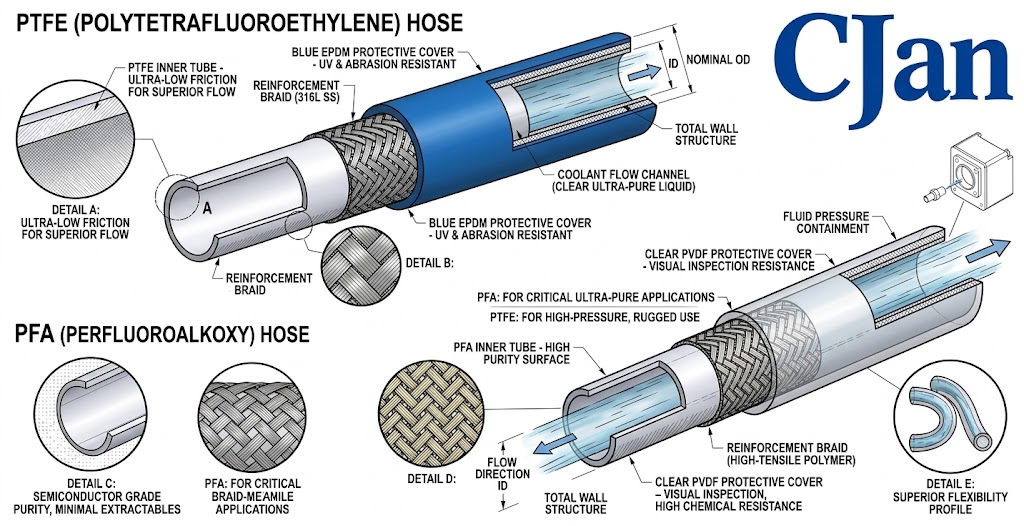
Cross-section illustration showing fluoropolymer hose construction.

Material Comparison for Liquid Cooling Applications

Performance EPDM Silicone PTFE PFA Metal
Flexibility ★★★★★ ★★★★★ ★★★ ★★★ ★★
Chemical Resistance ★★★★ ★★★ ★★★★★ ★★★★★ ★★★★
Temperature Resistance ★★★★ ★★★★★ ★★★★★ ★★★★★ ★★★★★
Purity Performance ★★★ ★★★ ★★★★★ ★★★★★ ★★★★
AI Cooling Suitability Excellent Good Application Specific Application Specific Special Cases

How Engineers Should Select Liquid Cooling Hose Materials

Step 1: Identify Coolant Type

Determine:

  • Water-based coolant
  • Glycol solution
  • Chemical fluid
  • High-purity fluid

Step 2: Define Operating Conditions

Evaluate:

  • Temperature
  • Pressure
  • Flow rate
  • Operating time

Step 3: Consider Application Requirements

AI data center:

→ EPDM usually preferred

Semiconductor:

→ PTFE / PFA often preferred

High temperature:

→ Silicone / fluoropolymer

Extreme mechanical environment:

→ Metal


Material Selection Mistakes to Avoid

Mistake 1: Choosing Only Based on Temperature Rating

Temperature capability alone does not determine suitability.


Mistake 2: Ignoring Coolant Compatibility

A material may tolerate temperature but fail chemically.


Mistake 3: Selecting the Most Expensive Material

Higher cost does not always mean better performance.


Mistake 4: Ignoring Installation Requirements

Flexibility and routing are critical in compact systems.


CJAN Liquid Cooling Hose Material Solutions

CJAN provides liquid cooling hose solutions covering different thermal management requirements.


LCH Series

Recommended for:

  • AI data centers
  • GPU liquid cooling
  • Industrial thermal management

Features:

  • Flexible structure
  • Reliable coolant transfer
  • Designed for continuous operation

LCH-SD Series

Suitable for:

  • High-density cooling systems
  • Applications requiring additional safety considerations

LCH-SDS Series

Designed for:

  • Complex routing environments
  • Limited installation space
  • Flexible connection requirements

Conclusion

Selecting the right liquid cooling hose material is a balance between performance requirements and application conditions.

For AI data centers:

  • EPDM provides the best overall balance.
  • Silicone provides excellent flexibility and temperature performance.
  • PTFE and PFA provide advanced chemical resistance and high-purity performance.
  • Metal tubing serves specialized high-strength applications.

The correct material choice improves:

  • Cooling system reliability
  • Service life
  • Maintenance efficiency
  • Operational stability

As AI infrastructure continues to evolve, liquid cooling hose materials will become an increasingly important factor in next-generation thermal management systems.

Liquid Cooling Hose Pressure Rating: How to Select the Right Hose for AI Cooling Systems

Frequently Asked Questions (FAQ)

Related Articles
back to the top