GLOBAL
Liquid Cooling Hose Routing: How to Avoid Kinks and Excessive Bending
Liquid cooling hose selection does not end when the hose material, diameter and pressure rating have been chosen.
The way the hose is installed can have just as much practical importance.
In an AI data center, cooling hoses may connect CDUs, manifolds, cold plates and other components inside a relatively compact rack environment. Space is limited, equipment may be moved during maintenance, and the hose may need to accommodate tight installation paths without being forced into an unsuitable shape.
A hose that is technically suitable on paper can still perform poorly if it is routed with excessive bending, twisting, compression or mechanical loading.
Good routing therefore has two objectives:
- Maintain the required coolant flow path.
- Keep the hose within its mechanical installation limits.
1. Why Hose Routing Matters in AI Data Centers
Liquid cooling systems operate as connected hydraulic circuits.
The hose is only one part of that circuit, but its routing affects several system-level factors.
Poor routing can contribute to:
- Excessive bending
- Kinking
- Twisting
- Mechanical stress at fittings
- Surface abrasion
- Restricted flow area
- Higher pressure loss
- More difficult maintenance
These problems are particularly relevant in high-density AI server environments where many coolant connections may be installed within a small physical space.
2. Start With the Complete Cooling Circuit
Hose routing should be considered as part of the complete cooling circuit rather than as an isolated tube path.
A typical liquid cooling loop may include:
- Coolant distribution unit (CDU)
- Manifold
- Supply line
- Server-side connections
- Cold plates
- Return line
The hose path should be planned around the position and movement requirements of these components.
For example, forcing a hose to compensate for poor alignment between a manifold and a cold plate can create unnecessary mechanical stress.
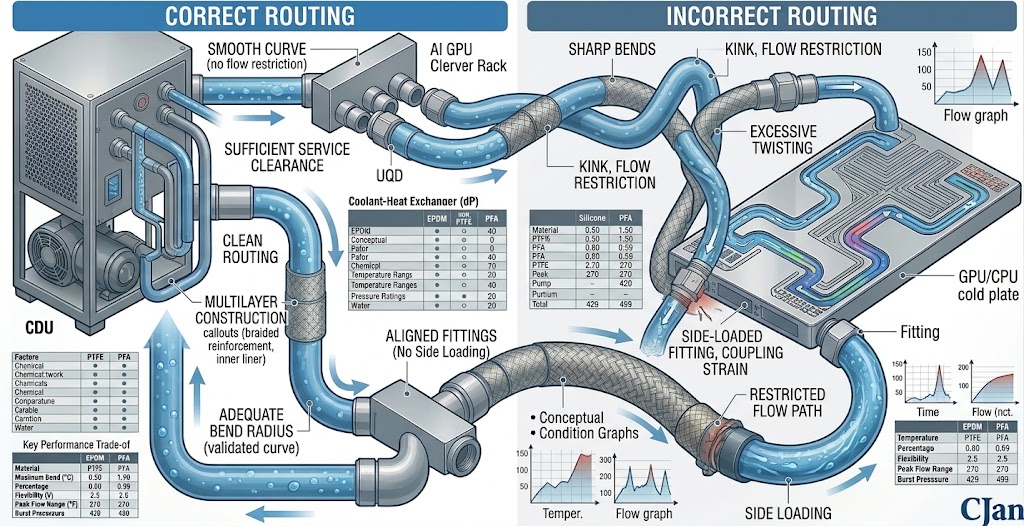
3. Avoid Sharp Bends
One of the simplest routing principles is to avoid sharp changes in direction.
A flexible hose can bend, but flexibility does not mean that the hose should be folded into the smallest possible space.
A sharp bend may reduce the effective flow area and increase local mechanical stress.
Instead of creating a tight angle, use a smooth curve that remains within the hose manufacturer's specified minimum bend radius.
4. Respect the Minimum Bend Radius
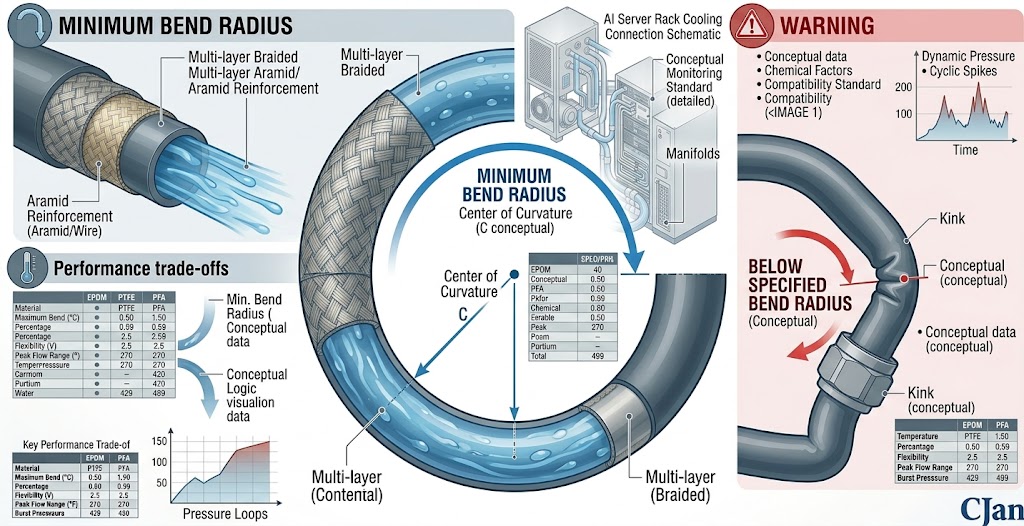
Every flexible hose has a minimum bend radius associated with its construction.
The minimum bend radius should be treated as an installation requirement rather than a suggestion.
When a hose is bent below its specified limit, the hose construction can experience additional mechanical stress.
The effect depends on the hose material, reinforcement, construction and operating conditions.
For a more detailed discussion, see:
Liquid Cooling Hose Bend Radius: Why Flexibility Matters in AI Server Racks .
5. Do Not Confuse Flexibility With Unlimited Bending Capability
Flexible hoses are often selected because they are easier to install than rigid tubing.
However, flexibility has practical limits.
A hose may be flexible enough to route around a server component while still requiring a relatively large bending radius.
This distinction is important when designing compact AI server cooling assemblies.
6. Avoid Kinking
A kink occurs when the hose bends in a way that causes a localized collapse or severe deformation of its normal cross-section.
Kinking is undesirable for two reasons.
First, it can change the internal flow passage.
Second, it can create a concentrated mechanical deformation in the hose structure.
Potentially problematic locations include:
- Immediately behind fittings
- Near rack penetrations
- At manifold connections
- Near cold plates
- At sharp cabinet corners
7. Avoid Twisting the Hose
Bending and twisting are not the same thing.
A hose can follow a curved path while remaining correctly oriented. It can also become twisted around its longitudinal axis while being routed between two connection points.
Unnecessary torsion can place additional stress on the hose and its connections.
During installation, the hose should be positioned naturally between the two connection points rather than rotated into place simply to achieve a particular visual orientation.
8. Keep the Hose Naturally Aligned With the Connection
A hose should not normally be used to force two misaligned components into position.
Consider a simple example:
The actual acceptable configuration depends on the hose and fitting design, but unnecessary side loading should be avoided.
The connection should be positioned so that the hose can approach it without excessive bending or twisting.
9. Avoid Bending Immediately at the Fitting
The transition between a flexible hose and a rigid fitting deserves particular attention.
If the hose begins bending immediately after the fitting, mechanical stress can become concentrated near the connection.
Where the assembly design permits it, a smoother transition into the hose bend is preferable.
This is especially important in compact server cooling assemblies where connection spacing can be limited.
10. Provide Enough Installation Space
Hose routing should be designed around the actual available space.
A common mistake is to select the hose first and then discover that the required bend radius cannot be achieved within the cabinet.
Before finalizing the assembly, check:
- Available routing space
- Connection locations
- Minimum bend radius
- Nearby components
- Maintenance access
- Equipment movement
11. Do Not Route Against Sharp Edges
Cabinet structures and brackets may contain edges that can gradually damage the hose surface.
Repeated contact can cause abrasion even when there is no immediate visible problem.
Where contact cannot be avoided, appropriate protective measures should be considered according to the installation design.
The preferred approach, however, is to route the hose so that unnecessary contact does not occur.
12. Prevent Hose-to-Hose Contact Where Practical
Multiple hoses may run through the same rack or manifold area.
If hoses repeatedly rub against one another because of movement or vibration, their outer surfaces may experience wear.
Routing should therefore consider not only contact with rigid components but also interaction between adjacent hoses.
13. Avoid Excessive Compression
A hose should not be compressed between equipment, brackets or cabinet structures.
Compression can change the hose geometry and may reduce the available internal flow area.
It can also create a permanent mechanical load that remains even when the cooling system is operating normally.
14. Keep Unnecessary Hose Length Under Control
Longer is not automatically better.
Excessive hose length can create:
- Additional pressure loss
- Unnecessary loops
- More potential contact points
- More difficult maintenance
- Additional installation space requirements
At the same time, the hose should not be made so short that it becomes stretched or sharply bent during installation.
The practical objective is an appropriate length with enough allowance for installation and service.
15. Use the Shortest Practical Routing
A useful engineering principle is:
Use the shortest practical hose routing that still allows safe installation, proper bending and maintenance access.
This approach balances hydraulic and mechanical considerations.
For pressure-drop considerations, see:
Liquid Cooling Hose Pressure Drop: How to Calculate and Control It in AI Data Centers .
16. Consider Hose Movement
Not every AI cooling hose is completely static.
Server maintenance, component replacement and rack movement can change the position of connected components.
If movement is expected, the routing should provide sufficient flexibility without placing the hose under excessive tension or compression.
A hose that works perfectly in the initial position may experience a very different mechanical condition after equipment movement.
17. Leave Adequate Service Access
Routing should also consider what happens during maintenance.
Technicians may need to:
- Disconnect a UQD coupling
- Remove a cold plate
- Access a manifold
- Replace a server component
- Inspect a fitting
A routing arrangement that is efficient during initial installation may become inconvenient if there is no room to access the connection later.
Serviceability should therefore be included in the original routing design.
18. UQD Connections Need Particular Attention
UQD connections are useful in liquid cooling systems because they can simplify equipment service and connection management.
However, the hose routing should not place unnecessary side loads on the UQD connection.
The coupling should be positioned so that the hose naturally approaches the connection.
For more information, see:
Liquid Cooling Hose Quick Disconnects: How to Choose UQD Couplings for AI Servers .
19. Routing Can Affect Pressure Drop
Hose routing itself does not determine pressure loss, but routing decisions can indirectly affect the hydraulic performance of the system.
For example, an unnecessarily long hose increases the length of the flow path.
A kink or severe deformation can also reduce the effective flow area.
Therefore, hydraulic calculations and physical routing should be considered together.
For hose sizing, see:
How to Select the Right Liquid Cooling Hose Size for AI Data Centers .
20. Hose Diameter and Routing Work Together
A larger hose may provide greater flow capacity, but it can also require more physical space and a larger bending radius.
A smaller hose may be easier to fit into a compact area, but it can produce higher flow velocity and pressure loss for the same flow requirement.
Routing design therefore cannot be separated completely from hose diameter selection.
21. Do Not Design Around the Hose Alone
If the hose routing is difficult, the solution is not always to select a more flexible hose.
Sometimes the better solution is to reconsider:
- Component positioning
- Fitting orientation
- Manifold location
- Connection height
- Hose length
This system-level approach can reduce unnecessary mechanical stress before the hose is even installed.
22. Support Long or Heavy Hose Runs Appropriately
Long hose runs may require appropriate support depending on the hose construction and installation environment.
Support should not introduce sharp compression points or create a bend smaller than the hose's specified minimum bend radius.
The support arrangement should also allow for the expected thermal and mechanical movement of the assembly.
23. Avoid Hanging Loads on Connections
A hose should not be allowed to place unnecessary weight or mechanical load directly on a fitting, manifold or cold plate connection.
Where a long hose run has significant weight, the installation should be designed so that the connection is not carrying an avoidable mechanical load.
24. Check Routing After Maintenance
A cooling system can be installed correctly and still develop routing problems after maintenance.
For example, a server component may be removed and reinstalled slightly differently.
A manifold may be repositioned.
A hose may be pushed behind another component to create temporary working space.
These changes can alter the original bend radius and routing condition.
After maintenance, inspect the hose routing before returning the system to normal operation.
25. Check Routing After Moving an AI Server Rack
Equipment movement can change the geometry of the cooling loop.
After moving a rack, inspect:
- Hose length and tension
- Bend radius
- Connection orientation
- Contact points
- UQD engagement
- Potential abrasion
A routing configuration that was acceptable before movement may no longer be suitable afterward.
26. Watch for Permanent Deformation
If a hose remains sharply bent for an extended period, it may develop a permanent deformation depending on the hose construction and operating environment.
During inspection, look for:
- Flattened sections
- Localized bends
- Twisting
- Bulging
- Unusual changes in shape
Any significant deformation should be evaluated against the hose specification and service conditions.
27. Routing and Hose Material Selection
Hose material and construction can affect routing flexibility.
Different materials and reinforcement structures can have different mechanical characteristics.
For example, the flexibility required for a compact rack connection may influence whether an engineer considers a rubber hose, silicone hose or fluoropolymer hose construction.
Material selection should still begin with coolant compatibility and operating requirements rather than flexibility alone.
See:
How Coolant Compatibility Affects Liquid Cooling Hose Selection for AI Data Centers .
28. Routing Should Match the Hose Construction
A reinforced hose may provide advantages in pressure capability and mechanical strength, but its bending behavior depends on the specific construction.
Likewise, a highly flexible hose still needs to remain within its specified installation limits.
Engineers should therefore use the manufacturer's actual technical data when defining routing requirements.
29. A Practical Hose Routing Checklist
| Routing Item | What to Check |
|---|---|
| Minimum bend radius | Confirm the installed bend remains within the hose specification |
| Kinks | Check for localized flattening or collapse |
| Twisting | Ensure the hose is not rotated unnecessarily around its axis |
| Connection alignment | Avoid forcing the hose to compensate for misaligned components |
| Sharp edges | Prevent unnecessary abrasion or cutting |
| Hose length | Avoid excessive slack and excessive tension |
| UQD connection | Check engagement and avoid side loading |
| Service access | Leave enough room for inspection and maintenance |
| Adjacent components | Prevent compression and unwanted contact |
| Movement | Consider rack movement and maintenance-related changes |
30. A Simple Routing Design Sequence
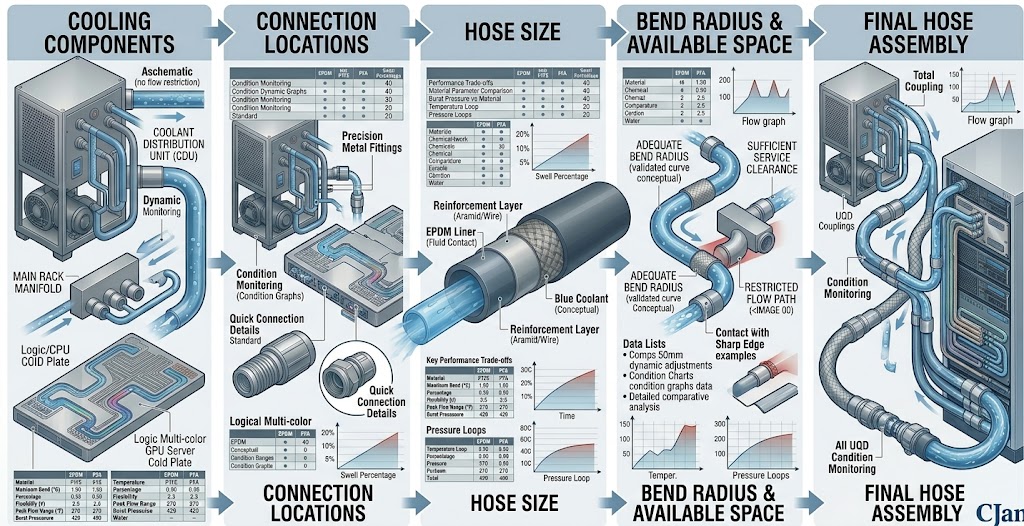
A practical routing process can follow this sequence:
This sequence helps prevent routing problems from being discovered only after the hose has already been installed.
31. Route the Hose Before Finalizing the Assembly
For custom hose assemblies, routing should be considered before final hose length and fitting orientation are finalized.
A hose assembly that looks correct on a workbench may behave differently once installed inside an AI server rack.
Whenever possible, the actual installation geometry should be considered during assembly design.
32. Routing Is Part of Hose Selection
Hose routing should be included in the initial hose selection process.
The key relationship can be summarized as:
This prevents the common mistake of selecting a hose based only on pressure and temperature and trying to solve the routing problem afterward.
33. How CJAN Approaches Liquid Cooling Hose Applications
CJAN provides liquid cooling hose solutions for applications where coolant flow, flexibility, connection reliability and installation requirements need to work together.
Relevant CJAN liquid cooling hose products include:
The appropriate product should be selected according to the actual coolant, pressure, temperature, flow requirement, routing space and connection configuration.
See the full application overview:
CJAN Liquid Cooling Hose Solutions .
34. The Most Important Routing Principle
Good hose routing is not simply about making the installation look neat.
It is about controlling mechanical stress while maintaining the required hydraulic and service conditions.
A well-routed hose should:
- Maintain the required bend radius
- Avoid kinking
- Avoid unnecessary twisting
- Maintain connection alignment
- Avoid excessive abrasion
- Provide adequate service access
- Support the required coolant flow
35. Conclusion
Liquid cooling hose routing is an engineering consideration, not simply an installation detail.
In AI data centers, hoses often operate in compact spaces where bends, connections and nearby components are closely packed together. Poor routing can create unnecessary mechanical stress, restrict the flow path, increase pressure loss or make maintenance more difficult.
The basic principles are straightforward:
- Respect the manufacturer's minimum bend radius.
- Avoid kinks and sharp bends.
- Do not twist the hose unnecessarily.
- Keep the hose naturally aligned with its connections.
- Avoid sharp edges, compression and abrasion.
- Use a practical hose length.
- Consider UQD orientation and maintenance access.
- Recheck routing after maintenance or equipment movement.
The most reliable approach is to design the hose route together with the cooling system rather than treating routing as the final installation step.
Learn more about CJAN liquid cooling hose solutions .