
BLOG
2026/08/05Clicks:293
The rapid expansion of artificial intelligence is driving unprecedented demand for high-performance computing infrastructure.
Modern AI servers equipped with advanced GPUs are capable of delivering enormous computing power, but they also generate significant amounts of heat.
A single high-performance GPU can consume several hundred watts of power, while an AI rack populated with multiple accelerators can exceed 100 kW. At these power levels, traditional air cooling becomes increasingly difficult to implement efficiently.
As a result, liquid cooling has become the preferred thermal management solution for many AI data centers.
While GPUs, cold plates, and CDUs often receive most of the attention during system design, coolant hoses are equally important. A well-designed hose assembly ensures stable coolant circulation, minimizes maintenance risks, and contributes to long-term system reliability.
This article explores the key factors engineers should consider when selecting a coolant hose for GPU cooling applications.
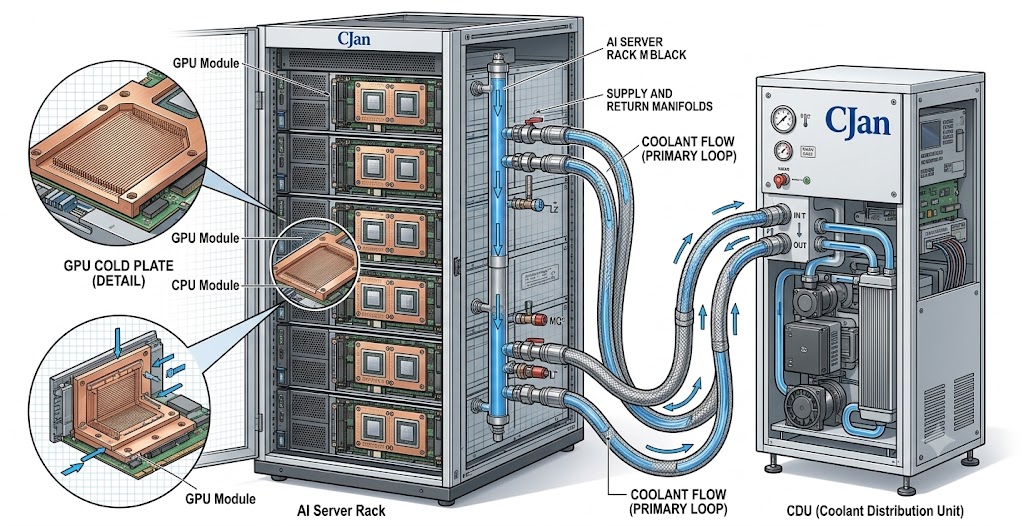
GPU cooling systems differ from traditional industrial cooling applications in several important ways.
They typically require:
Unlike many industrial systems that operate intermittently, AI servers often run continuously for months or years.
This means every component in the cooling loop must be designed for long-term performance.
A typical direct liquid cooling architecture follows this flow path:
CDU
↓
Manifold
↓
Cooling Hose
↓
Cold Plate
↓
GPU
↓
Return Cooling Hose
↓
CDU
The coolant absorbs heat from the GPU through the cold plate and transports it away from the server.
The hose functions as the circulation pathway connecting all major cooling components.
If coolant flow is interrupted, cooling efficiency can drop rapidly, potentially affecting server performance and uptime.
The first step in hose selection is understanding the coolant used in the system.
Common GPU cooling fluids include:
Different hose materials respond differently to prolonged exposure.
Potential issues include:
Before selecting a hose, engineers should verify long-term compatibility between the hose material and the coolant.
Modern GPU racks are highly compact.
Within a single rack, cooling hoses may need to navigate around:
A hose with poor flexibility can create installation challenges and increase stress on fittings.
Key considerations include:
A smaller bend radius enables easier routing.
Flexible hoses simplify installation and future maintenance.
Reduced stress helps extend fitting service life.
For high-density AI infrastructure, flexibility directly contributes to operational reliability.
GPU cooling systems rely on stable coolant circulation.
When evaluating a hose, engineers should consider:
The goal is not simply to withstand pressure but to maintain efficient coolant delivery throughout the cooling loop.
Proper hose sizing is also critical.
An oversized or undersized hose can negatively affect:
GPU temperatures can fluctuate significantly depending on workload.
Although the coolant maintains controlled temperatures, hoses may still experience:
Engineers should evaluate:
Materials that maintain flexibility and integrity over time are generally preferred.
Reliability is often the most important requirement in AI data centers.
A hose failure may result in:
When selecting a coolant hose, engineers should prioritize:
The cost of downtime often exceeds the cost of the hose itself.
EPDM has become one of the most widely used materials for GPU cooling applications.
Benefits include:
Supports complex routing inside AI racks.
Suitable for common coolant formulations.
Resists aging under continuous operation.
Balances reliability and operating cost.
These characteristics make EPDM a common choice for:
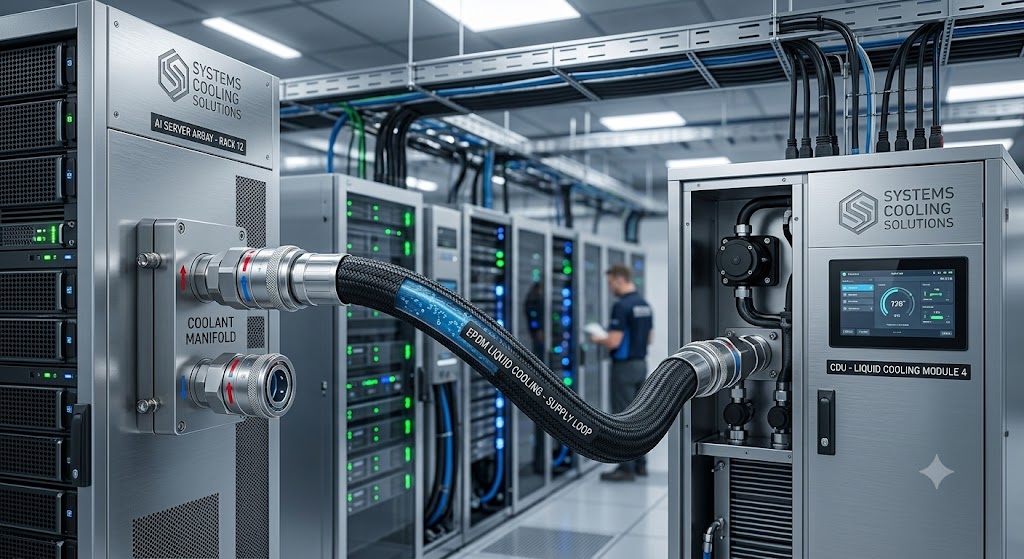
As rack power density increases, fire safety is becoming a more important design consideration.
Many operators now evaluate:
Fire-resistant cooling hose solutions can help support overall infrastructure resilience.
Applications include:
Before finalizing a hose specification, engineers should confirm:
| Parameter | Evaluation Item |
|---|---|
| Coolant | Compatibility |
| Temperature | Continuous and peak conditions |
| Pressure | Working and surge pressure |
| Flow Rate | System requirements |
| Flexibility | Bend radius and routing |
| Safety | Fire resistance requirements |
| Reliability | Expected service life |
A structured evaluation process helps reduce long-term risks.
GPU cooling systems place unique demands on liquid cooling infrastructure.
Selecting the right coolant hose requires more than matching size and pressure specifications. Engineers must consider coolant compatibility, flexibility, thermal performance, reliability, and safety requirements as part of a complete cooling system design.
As AI workloads continue to increase power density, the importance of reliable coolant hose solutions will only grow.
A properly selected hose supports stable coolant circulation, reduces maintenance risks, and helps maximize the long-term reliability of GPU cooling systems.
 Mobile


 GLOBAL


