GLOBAL
When Should You Use a Fluoropolymer Hose in Liquid Cooling Systems?
Not every liquid cooling system needs a fluoropolymer hose.
For many water-based cooling loops, conventional elastomeric hose materials can provide the flexibility, pressure capability and service life required by the application. But some cooling circuits operate under conditions where material compatibility, temperature, cleanliness or permeation become more important.
That is where fluoropolymer hose construction deserves consideration.
PTFE and PFA are two commonly considered fluoropolymers for demanding fluid-handling applications. They offer characteristics that can be useful in specialized cooling systems, but selecting them simply because they are chemically resistant is not enough.
This article explains when engineers should consider fluoropolymer hoses and when a conventional liquid cooling hose may be the more practical choice.
1. What Is a Fluoropolymer Hose?
A fluoropolymer hose uses a fluoropolymer as part of its fluid-contact construction. Depending on the design, the fluoropolymer may form the inner tube while reinforcement and an outer protective layer provide the mechanical properties needed for the application.
PTFE and PFA are examples of fluoropolymers used in demanding fluid-handling environments.
The important point is that the performance of a finished hose is determined by its complete construction—not by the polymer name alone.
2. Why Are Fluoropolymers Considered for Liquid Cooling?
The main reason engineers consider fluoropolymers is that they can provide a combination of properties that may be difficult to achieve with a conventional elastomer in certain applications.
Typical considerations include:
- Strong chemical resistance
- Broad temperature capability
- Low surface reactivity
- Fluid-contact performance
- Potentially useful permeation characteristics
- Suitability for demanding fluid environments
These characteristics are particularly relevant when the coolant formulation or operating conditions are more demanding than a standard water-glycol loop.
3. The First Question: What Coolant Are You Using?
Material selection should begin with the coolant.
A cooling system may use water, water-glycol mixtures or specially formulated dielectric and thermal-management fluids. The formulation can also contain additives intended to control corrosion, biological growth or other system properties.
Two fluids that appear similar on a basic specification sheet may interact differently with a hose material under actual operating conditions.
For that reason, compatibility should be evaluated using the actual coolant formulation, concentration and operating temperature.
This is also why a material should not be selected solely from a generic statement such as "chemical resistant."
4. When Chemical Compatibility Becomes the Main Driver
Fluoropolymer hose becomes more attractive when the coolant chemistry creates concerns for conventional hose materials.
In these cases, the engineer should evaluate:
- Coolant composition
- Additive package
- Concentration
- Operating temperature
- Continuous exposure time
- Expected service life
The objective is not to choose the most chemically resistant material available. It is to choose a material that remains stable under the actual conditions of the cooling loop.
For a deeper discussion, see How Coolant Compatibility Affects Liquid Cooling Hose Selection for AI Data Centers.
5. When Temperature Is a Concern
Temperature is another reason to consider fluoropolymer construction.
Some cooling systems experience higher operating temperatures, short-duration temperature peaks or repeated thermal cycling.
Fluoropolymers are known for their broad temperature capabilities, which can make them useful in applications where the temperature envelope is outside the preferred range of some conventional hose materials.
However, the maximum temperature of the finished hose must be checked rather than assuming that the polymer's published material capability represents the hose assembly's allowable operating limit.
Reinforcement, fittings, seals and the specific hose geometry can all affect the final operating range.
6. When Cleanliness Matters
Some fluid systems place greater emphasis on maintaining coolant quality and controlling contamination.
In such systems, the inner fluid-contact surface is an important part of the design.
Fluoropolymer inner tubes can be considered where their surface and chemical characteristics fit the cleanliness requirements of the application.
But the inner material is only one part of the picture. Manufacturing cleanliness, assembly procedures, flushing, packaging and storage can also influence the condition of a finished hose assembly.
7. When Permeation Needs to Be Considered
Permeation is sometimes overlooked during hose selection.
In a closed cooling loop, long-term fluid retention can matter. Depending on the coolant and system architecture, the interaction between the fluid and hose material may become a design consideration.
Fluoropolymer materials can be attractive in applications where permeation characteristics are important, but actual performance should be evaluated using data for the specific hose construction.
A polymer datasheet alone does not necessarily predict the behavior of a multilayer hose under real operating conditions.
8. When Conventional Elastomeric Hoses May Be Enough
A fluoropolymer hose is not automatically the better choice.
If the cooling circuit uses a compatible coolant, operates within a moderate temperature range and has no unusual cleanliness or permeation requirements, an appropriately designed EPDM or silicone hose may be sufficient.
These materials can provide useful flexibility and are widely used in fluid-handling applications.
The decision should therefore be based on engineering requirements rather than the assumption that a more specialized material is always better.
For a material comparison, see EPDM Liquid Cooling Hose vs. Silicone Hose: Which Is Better for AI Data Centers?.
9. Fluoropolymer Hose and AI Data Centers
AI data centers are creating increasingly demanding thermal-management environments.
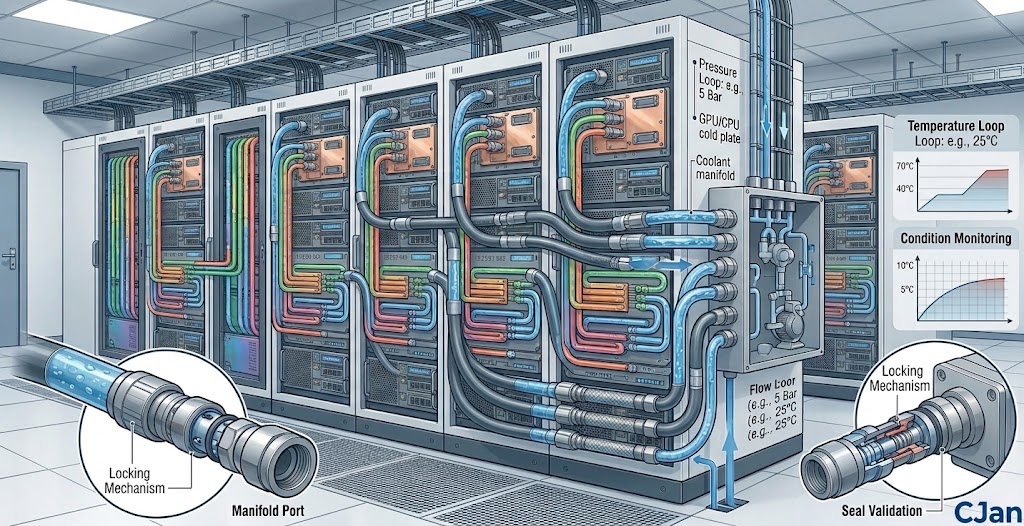
Higher rack power can increase the cooling load placed on liquid cooling infrastructure. Hoses may be required to connect cold plates, manifolds, CDUs and other components within increasingly dense equipment layouts.
In these systems, the hose needs to satisfy more than a single requirement.
- Required coolant compatibility
- Operating pressure
- Operating temperature
- Required flow rate
- Pressure drop
- Minimum bend radius
- Connection configuration
- Maintenance requirements
A fluoropolymer inner tube may address one or more of these requirements, but the complete hose assembly still needs to be evaluated.
See How to Choose the Right Liquid Cooling Hose for High-Density AI Servers for additional rack-level considerations.
10. Fluoropolymer Hose for Semiconductor Equipment Cooling
Semiconductor equipment can impose different requirements on a cooling hose compared with a conventional data center cooling loop.
Process fluids, equipment cleanliness and chemical exposure may make material compatibility a more significant consideration.
In such applications, fluoropolymer hose construction can be evaluated when the fluid-contact material needs to withstand a demanding chemical environment.
The final selection should still be based on the actual process fluid, temperature, pressure, flow and equipment connection requirements.
11. PTFE or PFA: Which Should You Consider?
PTFE and PFA are both fluoropolymers, but they are not interchangeable in every application.
PTFE is widely recognized for its chemical resistance and broad temperature capability. PFA provides similar fluoropolymer characteristics while offering different processing characteristics because it is melt-processable.
The selection should therefore consider both material properties and manufacturing requirements.
For a direct comparison, see PTFE vs. PFA Liquid Cooling Hose: What Is the Difference?.
12. Flexibility Still Matters
One common mistake is to focus heavily on chemical resistance and overlook installation requirements.
Liquid cooling hoses often need to pass through compact equipment spaces. In a server rack, the hose may need to route around cold plates, manifolds, cable paths and other hardware.
The final hose must therefore provide an appropriate bend radius without introducing excessive mechanical stress.
Flexibility depends on hose diameter, wall thickness, reinforcement and construction, not simply on whether the hose is made from a fluoropolymer.
13. Pressure Capability Depends on the Complete Hose
Another important consideration is pressure.
The pressure rating of a liquid cooling hose depends on factors including:
- Internal diameter
- Wall thickness
- Reinforcement
- Temperature
- Hose construction
- Fittings and assembly method
For this reason, engineers should use the manufacturer's pressure rating for the specific hose rather than estimating pressure capability from the polymer alone.
More information is available in Liquid Cooling Hose Pressure Rating: How Much Pressure Does an AI Data Center Hose Need?.
14. Hose Size Can Matter More Than Material
A chemically compatible hose can still be a poor choice if its internal diameter is too small for the required flow.
Smaller internal diameters generally increase flow velocity and can increase pressure loss. This can affect pump requirements and the overall hydraulic balance of a cooling circuit.
Hose size should therefore be established from the required flow rate, allowable pressure drop and connection dimensions.
See How to Select the Right Liquid Cooling Hose Size for AI Data Centers.
15. When a Fluoropolymer Hose May Be the Right Choice
There is no single condition that automatically requires a fluoropolymer hose.
Instead, it becomes a stronger candidate when several application requirements point in the same direction.
| Application Requirement | Why Fluoropolymer May Be Considered |
|---|---|
| Demanding coolant chemistry | Strong chemical resistance can be valuable |
| Elevated temperature | Broad temperature capability |
| Long-term fluid exposure | Material stability becomes important |
| Clean fluid-contact requirements | Fluoropolymer inner layers may be considered |
| Permeation concerns | Specific fluoropolymer constructions may offer useful characteristics |
| Specialized equipment cooling | Material compatibility may outweigh conventional hose selection |
16. When You Probably Do Not Need One
If the cooling loop uses a well-understood coolant and the operating conditions are comfortably within the capabilities of an appropriate elastomeric hose, there may be little reason to move to a fluoropolymer construction.
For example, if the application does not impose unusual chemical exposure, temperature, cleanliness or permeation requirements, EPDM or silicone may already provide the required performance.
The goal should be an appropriate hose—not the most technically sophisticated hose available.
17. Do Not Evaluate the Hose Tube in Isolation
A liquid cooling hose is part of a larger assembly.
The hose may connect to fittings, valves, manifolds, cold plates or UQD couplings. Each interface can affect reliability.
If the hose material is highly compatible but the fitting seal is unsuitable for the coolant, the complete assembly may still fail to meet the application requirement.
Material selection and connection design should therefore be considered together.
18. Installation Conditions Should Be Defined Early
Hose routing should be considered before the final hose construction is selected.
Engineers should identify:
- Available installation space
- Required hose length
- Minimum bend radius
- Movement during installation or maintenance
- Potential contact with surrounding equipment
- Fitting orientation
A hose that performs well in laboratory conditions may still be unsuitable if it cannot be routed correctly in the actual equipment.
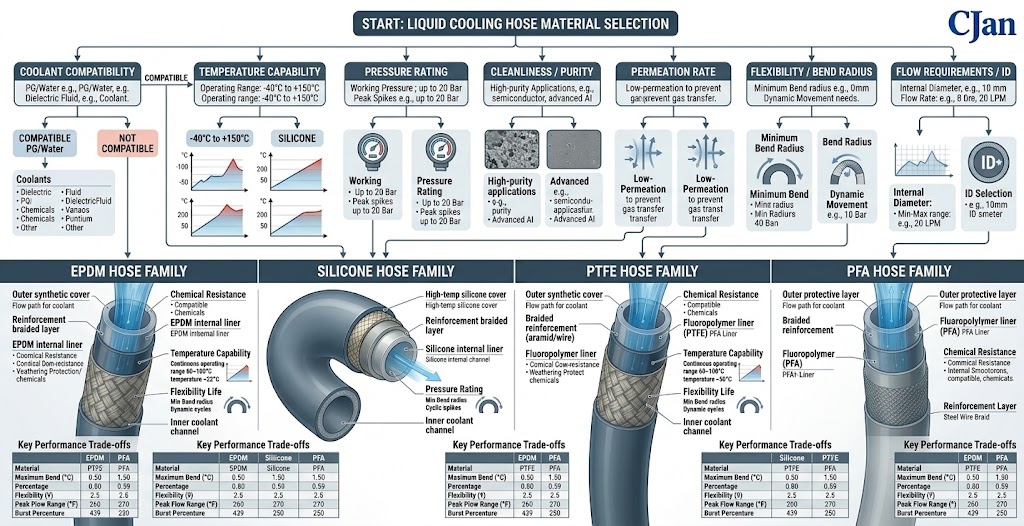
19. A Practical Fluoropolymer Hose Selection Workflow
This sequence helps prevent material selection from becoming disconnected from the actual cooling system.
20. What Data Should Be Sent to a Hose Supplier?
When requesting a fluoropolymer liquid cooling hose, providing application data upfront can significantly improve the quality of the recommendation.
- Coolant name and formulation
- Coolant concentration
- Normal operating temperature
- Maximum and minimum temperature
- Operating pressure
- Maximum pressure
- Required flow rate
- Required internal diameter
- Hose length
- Minimum bend radius
- Fitting type
- UQD requirements
- Cleanliness requirements
- Expected service conditions
21. How CJAN Approaches Liquid Cooling Hose Selection
CJAN's liquid cooling hose solutions cover different material and construction requirements for thermal-management applications.
The CJAN Liquid Cooling range is intended for applications where hose material, construction and connection requirements need to be evaluated together.
Available liquid cooling hose products include LCH, LCH-SD and LCH-SDS.
For projects requiring fluoropolymer construction, the appropriate material and hose configuration should be evaluated against the actual coolant, temperature, pressure, flow and installation conditions.
22. A Simple Decision Framework
| Question | If Yes | If No |
|---|---|---|
| Is coolant compatibility demanding? | Evaluate fluoropolymer options | Continue comparing conventional materials |
| Is temperature unusually demanding? | Review fluoropolymer capability | Compare all suitable hose materials |
| Are cleanliness or fluid-contact properties critical? | Evaluate fluoropolymer inner layers | Consider application-proven alternatives |
| Are permeation characteristics important? | Compare specific hose constructions | Focus on other selection factors |
| Is flexibility critical? | Compare actual bend-radius data | Use standard routing criteria |
23. The Best Material Is Application Dependent
There is a tendency in technical discussions to search for a single "best" hose material.
Liquid cooling does not work that way.
EPDM, silicone, PTFE and PFA each have different characteristics. A material that is ideal for one cooling circuit may be unnecessary or impractical for another.
The better engineering approach is to define the operating envelope first and then select the hose construction that meets it.
Conclusion
A fluoropolymer hose should be considered when the actual cooling application creates requirements that justify its characteristics.
Chemical compatibility, temperature capability, cleanliness and permeation can all be reasons to investigate fluoropolymer construction. But these factors should be considered alongside pressure, flow, bend radius, fittings and installation conditions.
For AI data centers and other demanding thermal-management applications, the most reliable approach is to evaluate the complete hose assembly rather than choosing a material based on a single property.
When the application does not require fluoropolymer performance, a properly selected EPDM or silicone hose may remain the more practical solution.
For more information, visit the CJAN Liquid Cooling application page.