
BLOG
2026/08/03Clicks:433
The rapid development of artificial intelligence is changing the design requirements of data centers.
Traditional data centers were mainly designed around airflow management. Servers generated heat, cooling units supplied cold air, and heat was removed through circulation.
However, the increasing power consumption of AI processors has created a new challenge.
Modern GPU-based servers can generate significantly higher heat loads than previous-generation systems. In high-density AI clusters, simply increasing airflow is no longer an efficient or practical solution.
This is why liquid cooling has become one of the most important technologies supporting next-generation computing infrastructure.
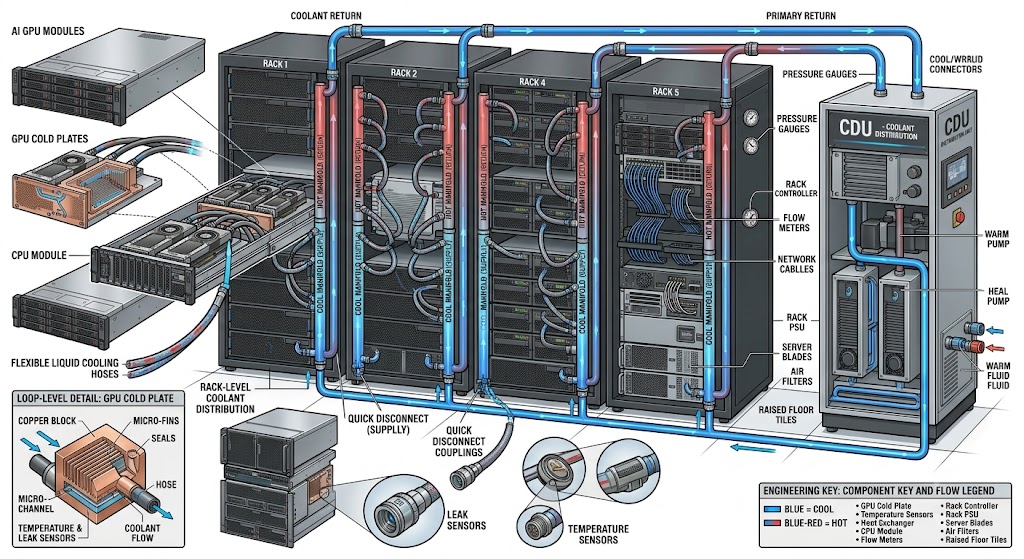
A complete liquid cooling system is not just a cooling device. It is an integrated thermal management architecture consisting of:
Each component works together to continuously transfer heat away from high-performance processors.
Air has traditionally been the primary cooling medium in data centers because it is simple, reliable, and easy to maintain.
However, air has limitations.
The heat transfer capability of air is much lower compared with liquid. As processor power increases, larger airflow volumes and more powerful cooling equipment are required.
This creates several challenges:
Large fans and air-conditioning systems consume significant power.
High-power GPU systems require more cooling capacity per rack.
More airflow management equipment means higher operational complexity.
Liquid cooling addresses these limitations by bringing coolant directly closer to the heat source.
A typical AI data center liquid cooling system follows this process:
Heat Generation
GPU / CPU

↓

Cold Plate

↓

Liquid Cooling Hose

↓

Manifold

↓

CDU

↓

Heat Exchanger

↓

Facility Cooling System
The coolant absorbs heat from processors through cold plates and transfers that heat away through the liquid loop.
The process is continuous:
The cold plate is the component directly attached to the heat-generating processor.
Its main function is:
Cold plate performance directly affects cooling efficiency.
The CDU is the control center of the liquid cooling system.
It manages:
In large AI data centers, CDUs help isolate the server cooling loop from the facility water system.
This improves system control and reliability.
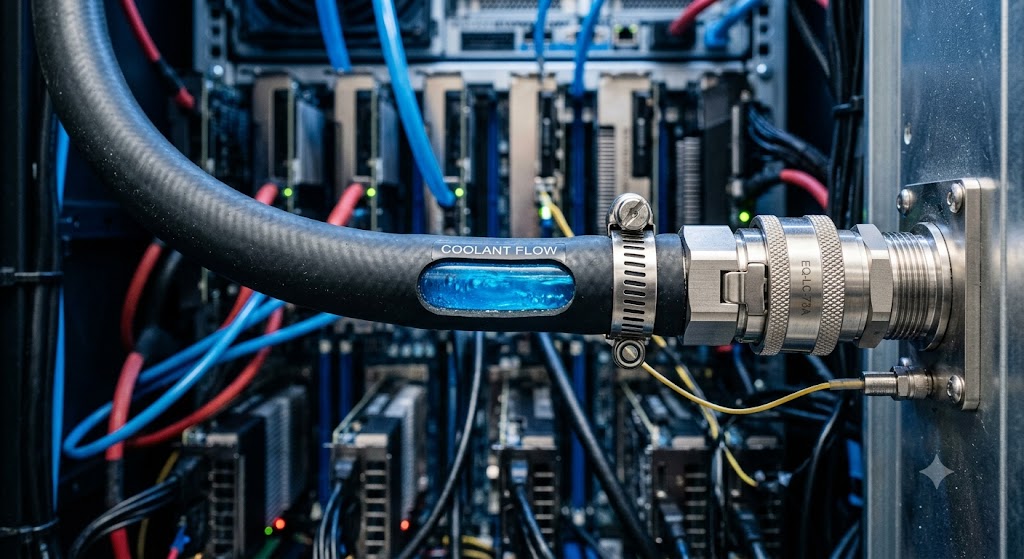
Although hoses are smaller components compared with CDUs or cold plates, they perform a critical function.
They provide flexible connections between:
A reliable cooling hose must maintain:
In practical applications, hose failure can interrupt the entire cooling loop.
The choice of coolant depends on system design.
Common cooling fluids include:
Widely used because of:
Used when high thermal efficiency is required.
Used for specific thermal or electrical requirements.
The coolant and hose material must always be evaluated together.
This is currently the most common approach for AI servers.
The coolant directly removes heat from processors through cold plates.
Advantages:
A cooling unit installed at the rear of the server rack.
Advantages:
Limitations:
Servers are submerged in dielectric fluid.
Advantages:
Challenges:
For mainstream AI data centers, direct liquid cooling remains the most widely adopted approach.
A liquid cooling system may contain hundreds or thousands of connection points.
Every hose assembly becomes part of the reliability chain.
Important hose design factors include:
Different applications require different materials.
Examples:
Poor hose routing can create:
Flexible hose designs help simplify installation.
AI data centers are designed for continuous operation.
A cooling component must perform reliably over years, not just during initial testing.
Liquid cooling has become a fundamental technology for supporting the next generation of AI infrastructure.
A successful liquid cooling system depends on the interaction of every component:
While cooling hoses represent a small part of the overall system, they directly influence reliability, maintenance requirements, and operational stability.
As AI server power density continues to increase, selecting reliable liquid cooling components will become increasingly important for data center designers and operators.
For engineers developing AI cooling infrastructure, understanding the complete liquid cooling system architecture is the first step toward building efficient and reliable facilities.
 Mobile


 GLOBAL


