GLOBAL
Liquid Cooling Hoses for AI GPU Servers: Engineering Considerations
AI GPU servers are changing the thermal requirements of modern data centers.
As GPU computing density increases, the amount of heat that must be removed from each server can become difficult to manage with conventional air cooling alone. Direct liquid cooling provides a way to move heat away from high-power processors more efficiently, but the performance of the cooling loop depends on more than the cold plate or coolant distribution unit.
The liquid cooling hose is also part of the thermal-management system.
It connects components, carries coolant, accommodates equipment movement and provides the flexibility needed inside a dense server environment. If the hose is incorrectly specified or poorly routed, the resulting problem may appear as a hydraulic, mechanical or maintenance issue rather than as an obvious hose problem.
1. Why GPU Servers Require Careful Hose Selection
Modern AI servers can contain multiple high-power GPUs operating within a relatively small physical volume.
This creates several engineering requirements for the cooling system:
- Sufficient coolant flow
- Controlled pressure loss
- Reliable heat transfer
- Stable connections
- Compact routing
- Service accessibility
The hose has to function within all of these constraints.
A hose that meets the pressure requirement but creates excessive pressure loss may not be appropriate. Similarly, a hose with suitable chemical resistance may still be difficult to install if its bend radius is too large for the server layout.
2. Start With the Cooling Architecture
Before choosing a hose, engineers should understand how the GPU server is integrated into the liquid cooling system.
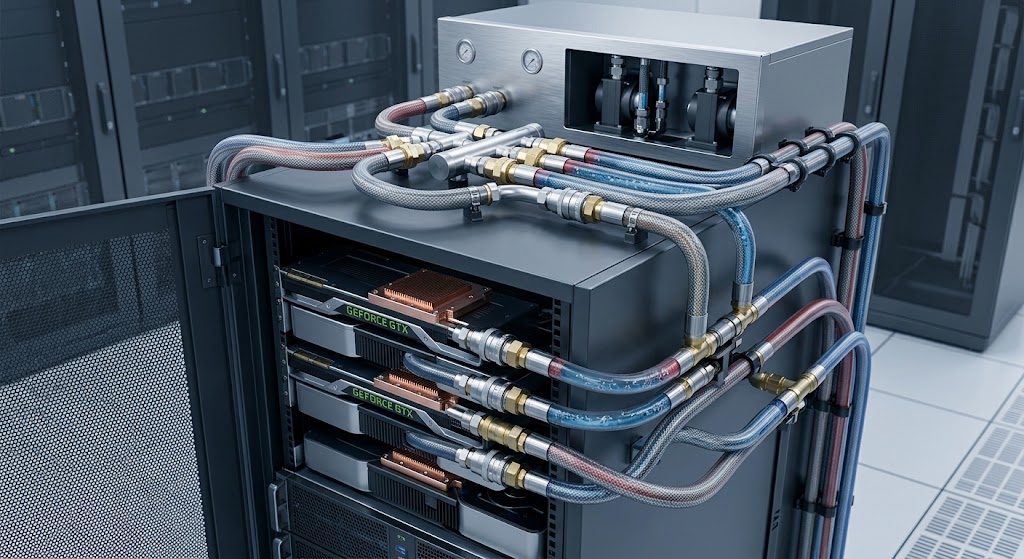
A typical architecture may include a CDU, manifold, supply and return lines, cold plates and quick-disconnect connections.
The hose can appear at several points in this system.
Understanding the exact location helps determine the required hose diameter, pressure rating, material, length, flexibility and connection configuration.
For a broader explanation of system operation, see:
How Does Liquid Cooling Work in AI Data Centers? .
3. Coolant Flow Is a Primary Design Requirement
The first question is not simply “Which hose should be used?”
It is:
How much coolant must pass through the hose to remove the required heat?
The required flow depends on the thermal load, coolant properties, allowable temperature rise and cooling-system design.
Once the required flow is established, engineers can evaluate hose internal diameter and hydraulic resistance.
A hose that is too small may create unnecessary pressure loss, while a much larger hose may increase installation space and bending requirements.
4. Hose Inner Diameter and GPU Cooling Flow
Internal diameter directly affects the available flow area.
For a given flow rate, reducing the hose internal diameter generally increases flow velocity and can increase pressure loss.
This is why hose size should be selected from the required hydraulic conditions rather than simply matching an existing connection size.
See:
Liquid Cooling Hose Inner Diameter vs. Flow Rate: What Engineers Need to Know .
5. Pressure Drop Matters in GPU Cooling Loops
Every component in the cooling loop contributes some resistance to coolant flow.
The hose is one of those components.
Pressure loss can be influenced by:
- Internal diameter
- Hose length
- Flow rate
- Coolant properties
- Temperature
- Internal surface characteristics
- Bends and fittings
For a detailed calculation approach, see:
Liquid Cooling Hose Pressure Drop: How to Calculate and Control It in AI Data Centers .
6. Do Not Treat the Hose as a Passive Component
In an AI GPU cooling loop, the hose is not simply a flexible section of pipe.
Its material and construction can influence pressure capability, flexibility, chemical compatibility and installation behavior.
The hose also has to accommodate the physical relationship between components.
This becomes particularly important in dense GPU servers where connections may be located close to memory modules, cold plates, manifolds and other hardware.
7. Material Compatibility With the Coolant
Coolant compatibility should be evaluated before finalizing the hose material.
Depending on the system, engineers may consider materials such as EPDM, silicone, PTFE or PFA-based constructions.
The appropriate choice depends on the actual coolant chemistry and operating conditions.
Material selection should consider more than the chemical name of the coolant. Temperature, concentration, exposure time and system cleanliness requirements can also matter.
See:
How Coolant Compatibility Affects Liquid Cooling Hose Selection for AI Data Centers .
8. EPDM Hoses for GPU Cooling Applications
EPDM is commonly considered for applications where flexibility, temperature resistance and coolant compatibility are important.
Its suitability depends on the actual coolant and operating environment.
For applications where rubber construction is appropriate, EPDM can provide a practical balance between flexibility and mechanical performance.
More detailed material selection should always be based on the actual system requirements rather than material name alone.
9. Silicone Hoses for AI GPU Servers
Silicone hoses can offer useful flexibility for compact routing environments.
This can be valuable where hose paths need to accommodate limited installation space or frequent equipment access.
However, silicone should not be selected solely because it is flexible.
Engineers should also evaluate pressure, temperature, coolant compatibility, permeability and the specific construction of the hose.
10. PTFE and PFA for More Demanding Applications
Fluoropolymer hoses such as PTFE and PFA can be considered when chemical resistance and cleanliness are important selection factors.
Their mechanical characteristics differ from conventional rubber hoses, so routing and assembly design must take the specific construction into account.
For a direct comparison, see:
PTFE vs. PFA Liquid Cooling Hose: What Is the Difference? .
11. Temperature Is Not the Only Thermal Consideration
When selecting a GPU cooling hose, engineers should consider the complete temperature range rather than only the normal operating temperature.
The relevant range may include:
- Normal operating temperature
- Startup conditions
- Shutdown conditions
- Transient temperature changes
- Potential abnormal operating conditions
Material properties can change with temperature, so the applicable hose specification should cover the actual operating range.
12. Pressure Rating Must Match the Real System
Nominal system pressure is not necessarily the only pressure value that matters.
Engineers should consider operating pressure, pressure fluctuations and the applicable safety margin.
The hose assembly—including the hose, fittings and connection method—should be evaluated as a complete assembly.
For more information:
Liquid Cooling Hose Pressure Rating: How Much Pressure Does an AI Data Center Hose Need? .
13. Hose Reinforcement Can Affect GPU Cooling Performance
Reinforcement is an important part of hose construction.
Depending on the design, reinforcement can influence pressure capability, dimensional stability and mechanical behavior.
However, stronger reinforcement does not automatically mean a better hose for every application.
The reinforcement must be appropriate for the pressure, flexibility and routing requirements of the GPU cooling loop.
See:
How Hose Reinforcement Affects Liquid Cooling System Performance .
14. Bend Radius Is Critical in Dense GPU Servers
GPU server interiors can leave limited space for hose routing.
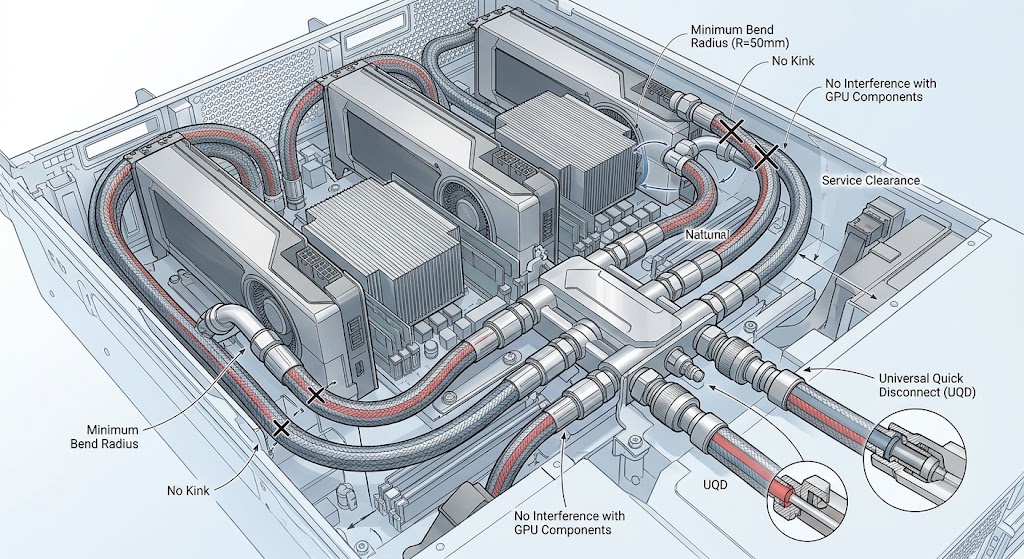
A hose may need to turn around a cold plate, manifold or other component without exceeding its minimum bend radius.
Forcing the hose into a tighter bend can create localized deformation and may affect both mechanical integrity and coolant flow.
See:
Liquid Cooling Hose Bend Radius: Why Flexibility Matters in AI Server Racks .
15. Avoid Kinks and Excessive Bending
A kink is more than a cosmetic problem.
It can reduce the effective internal flow area and introduce a concentrated mechanical deformation.
Routing should therefore use smooth curves and avoid forcing the hose into sharp turns.
Additional guidance is available in:
Liquid Cooling Hose Routing: How to Avoid Kinks and Excessive Bending .
16. Connection Configuration Matters
The hose itself is only one part of the connection.
A complete GPU cooling hose assembly may include:
- Hose
- End fittings
- Quick-disconnect coupling
- Sealing elements
- Crimp or mechanical attachment system
The compatibility of these components should be considered together.
A properly selected hose can still have an unreliable connection if the fitting or assembly method is inappropriate.
17. UQD Connections in AI GPU Cooling
UQD connections can be useful where frequent equipment service or modular connection is required.
They can simplify the process of disconnecting cooling circuits during server maintenance.
However, the hose routing must not impose unnecessary side loads or sharp bending directly at the coupling.
See:
Liquid Cooling Hose Quick Disconnects: How to Choose UQD Couplings for AI Servers .
18. Hose Length Should Be Deliberate
A hose that is too short may be placed under tension during installation.
A hose that is excessively long can create unnecessary loops, pressure loss and maintenance difficulties.
The preferred length should provide enough allowance for the actual routing geometry and equipment service requirements.
19. Routing Around Cold Plates
Cold plate connections often sit in a highly constrained area.
The hose should approach the connection without creating excessive bending or twisting.
Where several cold plates are connected in the same area, routing should also consider hose-to-hose contact and access for future maintenance.
20. Manifold-to-Server Connections
Manifold connections can concentrate multiple hoses in a small area.
This creates a need for organized routing.
The design should account for:
- Connection spacing
- Hose diameter
- Bend radius
- UQD orientation
- Service access
- Potential hose movement
21. Hose Routing Should Not Interfere With Airflow Components
Even in a liquid-cooled server, air movement may still be required for other components.
Hose routing should therefore avoid unnecessary obstruction of fans, vents and other airflow paths where these remain part of the server architecture.
22. Keep the Cooling Path Serviceable
AI GPU servers require maintenance and component replacement.
A hose route should therefore provide enough access to disconnect, inspect and reinstall the cooling connection.
A compact route that cannot be serviced safely is not necessarily an efficient design.
23. Consider Maintenance-Related Movement
When a GPU server is opened or a component is removed, connected hoses may move temporarily.
The assembly should tolerate the expected service procedure without forcing the hose into a sharp bend or excessive tension.
Where movement is significant, the hose length and routing should be designed accordingly.
24. Cleanliness Requirements
Liquid cooling systems can have specific cleanliness requirements depending on the application and coolant loop.
Hose material, manufacturing process, assembly and packaging may all be relevant.
For applications where contamination control is important, engineers should obtain appropriate product and manufacturing information from the hose supplier.
25. Hose Construction Should Match the Application
There is no single hose construction that is ideal for every GPU cooling system.
Selection may involve a balance between:
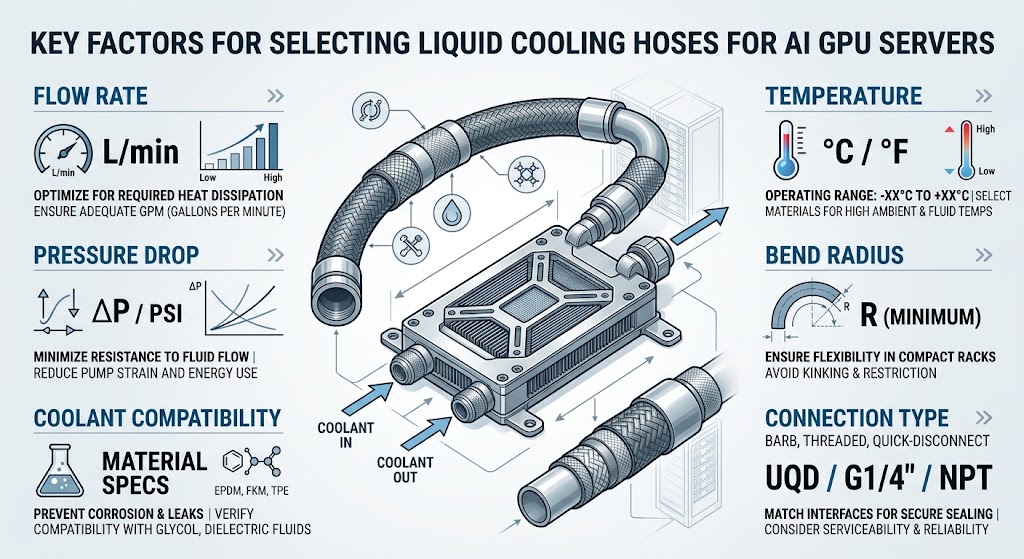
| Requirement | Engineering Consideration |
|---|---|
| Flow | Internal diameter and hydraulic resistance |
| Pressure | Hose construction and reinforcement |
| Temperature | Material operating range |
| Coolant | Chemical compatibility |
| Routing | Flexibility and minimum bend radius |
| Connections | Fitting and UQD compatibility |
| Maintenance | Service access and connection design |
26. Do Not Select a Hose From Diameter Alone
Matching the hose ID to the connection size is only the starting point.
The selected hose must also satisfy the flow requirement, pressure requirement, coolant compatibility and installation geometry.
This is particularly important when a GPU cooling system has high flow demand or tight routing constraints.
27. Consider the Complete Hose Assembly
For many AI server applications, the practical product is not simply a length of hose.
It is a complete hose assembly.
The assembly may include specific end fittings, UQD couplings, bends, orientation and defined lengths.
Therefore, engineering review should consider the complete assembly rather than evaluating the hose tube independently.
28. Pressure and Flow Should Be Verified After Assembly
When a custom assembly is produced, the final configuration should be evaluated against the applicable engineering requirements.
Depending on the application, this can include pressure testing, leak testing and dimensional inspection.
Testing requirements should be defined according to the cooling-system specification and applicable quality procedures.
See:
Liquid Cooling Hose Assembly Testing: Pressure, Leak and Performance Checks .
29. A Practical Selection Checklist for AI GPU Servers
| Parameter | Questions to Confirm |
|---|---|
| Coolant | What fluid will the hose carry? |
| Flow rate | What coolant flow is required? |
| Internal diameter | Can the hose provide the required flow without excessive pressure loss? |
| Pressure | Does the hose assembly meet the required pressure conditions? |
| Temperature | Does the material cover the actual operating range? |
| Material | Is the hose compatible with the coolant and system requirements? |
| Bend radius | Can the hose be routed within the available space? |
| Connections | Are fittings and UQD couplings compatible? |
| Length | Is the hose long enough without excessive slack? |
| Maintenance | Can technicians access and service the connections? |
30. Common Hose Selection Mistakes
Several mistakes can be avoided by evaluating the cooling system before purchasing the hose.
- Selecting the hose based only on connection diameter
- Ignoring pressure loss
- Ignoring coolant compatibility
- Using an unsuitable bend radius
- Choosing excessive hose length
- Ignoring fitting compatibility
- Failing to consider maintenance access
- Evaluating the hose but not the complete assembly
More examples are discussed in:
Common Mistakes When Selecting Liquid Cooling Hoses for AI Data Centers .
31. How CJAN Liquid Cooling Hoses Fit AI GPU Applications
CJAN develops and supplies flexible hose solutions for liquid cooling applications where material compatibility, flow requirements, pressure performance, routing flexibility and connection configuration need to be considered together.
Relevant CJAN liquid cooling hose products include:
The appropriate product and construction should be determined from the actual coolant, pressure, temperature, flow, routing and connection requirements.
See the application overview:
CJAN Liquid Cooling Solutions .
32. AI GPU Cooling Requires a System-Level Approach
The cooling hose should be considered together with the cold plate, manifold, CDU, fittings and coolant.
Changing one component can affect the requirements of the others.
For example, increasing the required coolant flow may influence hose diameter. A larger diameter may affect routing space. A different coolant may affect material selection. A different connection arrangement may affect hose length and bend radius.
This is why hose selection is best handled as an engineering exercise rather than as a simple product lookup.
33. Conclusion
Liquid cooling hoses play an important role in AI GPU server thermal management.
The correct hose needs to carry the required coolant flow while operating within the specified pressure and temperature conditions. It must also be compatible with the coolant and suitable for the physical installation environment.
For AI GPU servers, engineers should evaluate:
- Coolant compatibility
- Required flow rate
- Internal diameter
- Pressure drop
- Pressure rating
- Operating temperature
- Hose material
- Reinforcement
- Minimum bend radius
- Hose length
- Fitting and UQD compatibility
- Maintenance access
- Assembly testing requirements
In high-density AI infrastructure, a reliable cooling hose is not simply a flexible tube between two components. It is part of the hydraulic, mechanical and service architecture of the cooling system.
Learn more about CJAN liquid cooling hose solutions .