
BLOG
2026/08/11Clicks:459
As liquid cooling becomes increasingly important in AI data centers, semiconductor equipment, electric vehicles, and high-performance industrial systems, selecting the correct hose material has become a critical engineering decision.
A liquid cooling hose is exposed to:
The wrong material choice may lead to:
Among available materials, EPDM, silicone, and PTFE are three commonly evaluated options.
However, each material has different advantages and limitations.
The best choice depends on:
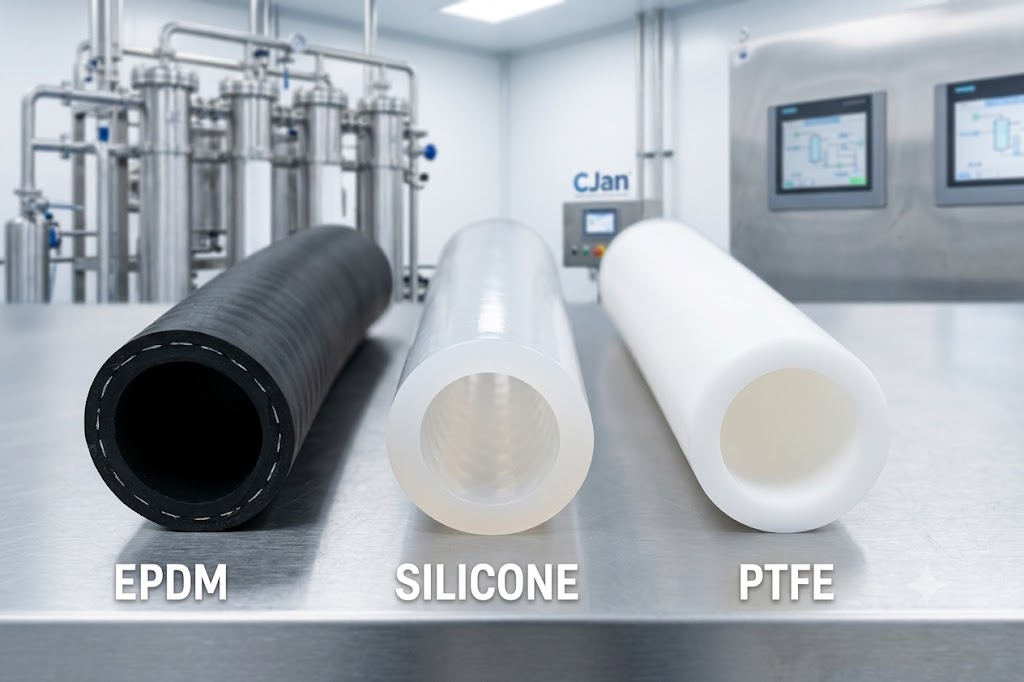
Before selecting a hose, engineers should understand the characteristics of each material.
| Material | Main Advantage | Typical Application |
|---|---|---|
| EPDM | Balanced performance and coolant compatibility | AI data centers, GPU cooling |
| Silicone | Excellent flexibility and temperature resistance | Equipment cooling, special systems |
| PTFE | Superior chemical resistance and purity | Semiconductor, chemical applications |
There is no universal “best” material.
The correct selection depends on the actual system requirements.
EPDM (Ethylene Propylene Diene Monomer) is a synthetic rubber widely used in water-based thermal management systems.
It has become one of the most common materials for liquid cooling applications because it provides a strong balance between:
EPDM performs well with many commonly used cooling fluids:
This makes it suitable for many AI cooling systems.
AI server racks contain limited installation space.
EPDM hoses provide:
For data center applications, hoses must operate continuously.
EPDM maintains performance under:
Common applications include:
For most water-based AI cooling systems, EPDM is often a practical first choice.
Silicone rubber is known for its excellent temperature resistance and flexibility.
It is often selected when installation flexibility or temperature capability is the primary requirement.
Silicone hoses are very flexible.
Advantages include:
Silicone performs well in applications requiring:
Some silicone hoses can provide visual monitoring of coolant flow.
This can be useful in:
Although silicone offers excellent flexibility, engineers should consider:
For demanding industrial applications, validation testing is recommended.
Common applications include:
PTFE (Polytetrafluoroethylene) is a fluoropolymer known for outstanding chemical resistance.
It is widely used where fluid purity and chemical stability are critical.
PTFE performs well against many aggressive chemicals.
PTFE can operate across a wide temperature range.
PTFE is often selected for applications requiring:
Common applications include:
Compared with rubber hoses:
For general AI data center cooling, EPDM is often more economical.
| Performance Factor | EPDM | Silicone | PTFE |
|---|---|---|---|
| Flexibility | ★★★★★ | ★★★★★ | ★★★ |
| Coolant Compatibility | ★★★★★ | ★★★★ | ★★★★★ |
| Chemical Resistance | ★★★★ | ★★★ | ★★★★★ |
| Temperature Resistance | ★★★★ | ★★★★★ | ★★★★★ |
| Mechanical Strength | ★★★★★ | ★★★ | ★★★★ |
| Cost Efficiency | ★★★★★ | ★★★★ | ★★★ |
| AI Data Center Cooling | Excellent | Good | Application dependent |
| Semiconductor Use | Good | Limited | Excellent |
Determine whether the system uses:
Consider:
Evaluate:
For AI infrastructure, prioritize:
| Application | Recommended Material |
|---|---|
| AI data center liquid cooling | EPDM |
| GPU cooling loop | EPDM |
| Flexible equipment cooling | Silicone |
| Semiconductor cooling | PTFE |
| Chemical cooling system | PTFE |
| High-temperature application | Silicone/PTFE |
CJAN provides liquid cooling hose solutions designed for different thermal management requirements.
Recommended for:
Advantages:
Designed for applications requiring enhanced safety performance.
Suitable for:
Designed for:
EPDM, silicone, and PTFE each provide unique advantages for liquid cooling applications.
The selection should be based on system requirements:
For AI liquid cooling systems, the most important consideration is not choosing the most advanced material, but choosing the material that matches the actual operating environment.
A properly selected hose material improves:
 Mobile


 GLOBAL


