GLOBAL
Silicone Liquid Cooling Hose: Key Advantages and Limitations
Silicone hose is widely used in applications where flexibility, temperature capability and clean fluid handling are important. These characteristics also make silicone a practical material to consider for some liquid cooling systems.
But silicone is not automatically the right choice for every cooling circuit.
The coolant formulation, operating temperature, pressure, flow rate, permeation requirements and hose construction all affect whether a silicone liquid cooling hose is appropriate.
This article examines where silicone liquid cooling hoses can be useful, what limitations engineers should consider and how silicone compares with other hose materials.
1. Why Silicone Is Considered for Liquid Cooling
Liquid cooling systems often require a hose that can be routed through limited installation space without creating excessive mechanical stress.
Silicone is naturally flexible and can accommodate many routing requirements more easily than some rigid or less flexible materials.
It can also provide useful temperature capability and is available in different hose constructions, including reinforced designs.
For these reasons, silicone can be considered for applications such as:
- AI server liquid cooling
- Data center thermal management
- Industrial equipment cooling
- Thermal-management equipment
- Other closed-loop fluid systems
2. The Construction Matters More Than the Material Name
A silicone liquid cooling hose is not simply a piece of silicone tubing.
A finished hose can contain multiple layers designed to provide different functions.
The inner layer provides the fluid-contact surface, while reinforcement can improve pressure capability and dimensional stability. The outer layer provides additional protection against the surrounding environment.
Consequently, two silicone hoses with similar dimensions can have significantly different performance characteristics.
3. Advantage: Flexibility
Flexibility is one of silicone hose's most useful characteristics for liquid cooling.
Cooling components are rarely arranged in a perfectly straight line. Hoses may need to route around server hardware, manifolds, cold plates, cable paths and structural components.
A flexible hose can make installation easier and can reduce the need for rigid piping sections in certain designs.
However, flexibility should not be confused with unlimited bending capability.
The manufacturer's minimum bend radius should always be respected.
4. Advantage: Temperature Capability
Silicone materials can operate across a relatively broad temperature range compared with many conventional rubber materials.
This can be useful when a cooling system experiences elevated temperatures or repeated thermal cycling.
However, engineers should distinguish between the temperature capability of silicone as a material and the allowable temperature of a finished hose assembly.
Reinforcement, fittings, seals and the hose construction can affect the final operating limit.
5. Advantage: Suitable for Complex Hose Routing
Modern liquid cooling systems can contain many connection points.
In a high-density server rack, the available space around cooling components can be limited. A hose that can be routed cleanly without sharp deformation can simplify installation.
Silicone can be attractive in these situations because of its inherent flexibility.
The design objective should nevertheless be controlled routing—not simply selecting the softest hose available.
6. Advantage: Availability in Reinforced Constructions
Silicone hoses can be manufactured with reinforcement to improve mechanical performance.
Depending on the construction, reinforcement can help the hose withstand internal pressure and maintain its dimensional stability during operation.
Possible reinforcement approaches include textile or other engineered reinforcement structures.
The actual pressure capability must always be taken from the specification of the finished hose.
7. Limitation: Coolant Compatibility Must Be Checked
Silicone should not be selected simply because it has been used successfully in another cooling application.
Different coolant formulations can behave differently when exposed to hose materials for long periods.
Engineers should consider:
- Coolant composition
- Additives
- Concentration
- Operating temperature
- Exposure duration
- Expected service life
Compatibility should be evaluated against the actual fluid rather than relying only on a generic material description.
See How Coolant Compatibility Affects Liquid Cooling Hose Selection for AI Data Centers for a more detailed discussion.
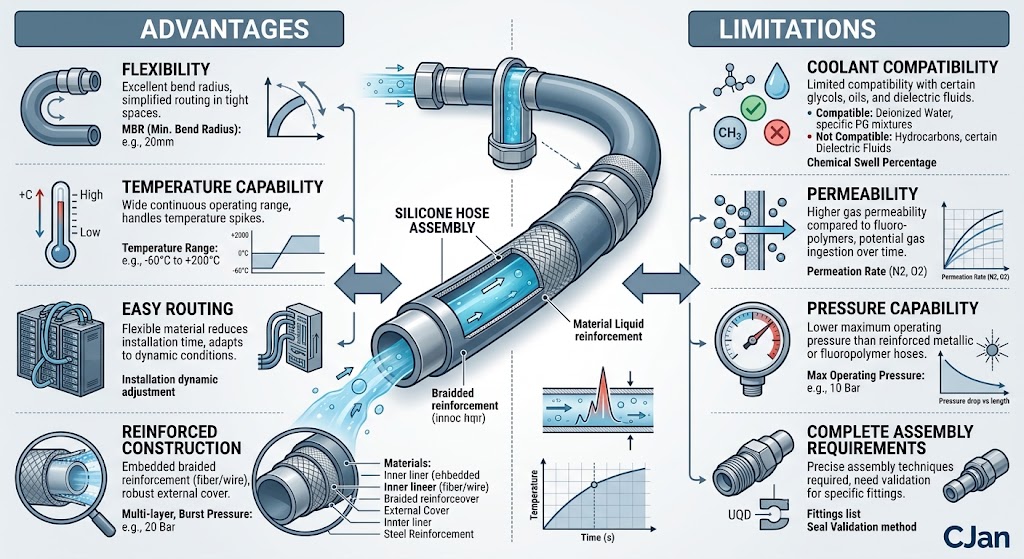
8. Limitation: Permeability Can Be Important
Permeability is another factor that deserves attention in closed-loop liquid cooling.
A cooling system may need to maintain coolant composition over an extended service period. Depending on the fluid and system design, interaction between the coolant and hose material can become an engineering consideration.
Silicone can have higher gas and vapor permeability than some fluoropolymer materials.
This does not make silicone unsuitable for liquid cooling, but it means permeability should be evaluated when fluid retention or environmental interaction is important.
For demanding applications, engineers should compare data from the actual hose construction rather than relying solely on general material properties.
9. Limitation: Pressure Capability Depends on Hose Construction
Silicone itself should not be treated as a pressure rating.
The pressure capability of a finished silicone hose depends on:
- Internal diameter
- Wall thickness
- Reinforcement
- Operating temperature
- Hose construction
- Fittings
For liquid cooling applications, engineers should therefore use the rated pressure of the specific hose rather than assuming that all silicone hoses have the same pressure capability.
See Liquid Cooling Hose Pressure Rating: How Much Pressure Does an AI Data Center Hose Need?.
10. Limitation: Softness Is Not the Same as Reliability
A very flexible hose can be convenient to install, but excessive flexibility can create its own engineering concerns.
If a hose is unsupported, it may sag or move during installation and maintenance.
Repeated movement can also place additional loads on fittings.
Good hose design therefore balances flexibility with adequate reinforcement, support and routing control.
11. Silicone vs. EPDM for Liquid Cooling
Silicone and EPDM are both important elastomer options for liquid cooling applications, but their properties differ.
| Factor | Silicone | EPDM |
|---|---|---|
| Flexibility | Generally very good | Good, construction dependent |
| Temperature Capability | Broad, application dependent | Broad, application dependent |
| Coolant Compatibility | Must be verified | Must be verified |
| Permeability | Can be a consideration | Application dependent |
| Pressure Capability | Construction dependent | Construction dependent |
| Typical Selection Driver | Flexibility and temperature requirements | Coolant compatibility and overall system requirements |
Neither material is universally better. The correct choice depends on the actual cooling conditions.
See EPDM Liquid Cooling Hose vs. Silicone Hose: Which Is Better for AI Data Centers?.
12. Silicone vs. PTFE and PFA
Fluoropolymers such as PTFE and PFA are often considered when chemical resistance, fluid-contact properties or other demanding requirements are important.
Silicone, on the other hand, can be attractive when flexibility and temperature capability are major priorities.
The decision should therefore begin with the application requirements rather than a simple material ranking.
For more information about fluoropolymer selection, see When Should You Use a Fluoropolymer Hose in Liquid Cooling Systems?.
13. Silicone Hose in AI Data Center Cooling
AI data center cooling introduces a combination of hydraulic and mechanical requirements.
Higher cooling loads can require substantial coolant flow, while high-density rack layouts can make hose routing more difficult.
For a silicone hose, engineers should consider:
- Coolant compatibility
- Required flow rate
- Internal diameter
- Pressure drop
- Operating temperature
- Pressure rating
- Minimum bend radius
- Connection configuration
The hose should be selected as part of the complete cooling circuit rather than as an isolated component.
For high-density rack applications, see How to Choose the Right Liquid Cooling Hose for High-Density AI Servers.

14. Silicone Hose and Coolant Flow
Material selection does not determine hydraulic performance by itself.
Internal diameter and hose length can have a significant effect on pressure loss.
If a silicone hose is too small for the required flow rate, the resulting pressure drop may increase pump requirements and affect system balance.
Engineers should therefore calculate flow requirements before finalizing hose dimensions.
See Liquid Cooling Hose Pressure Drop: How to Calculate and Control It in AI Data Centers.
15. Silicone Hose Bend Radius
Flexible routing is one of the reasons silicone is considered for liquid cooling, but the minimum bend radius still needs to be respected.
A hose that is bent too tightly can experience local stress, deformation or additional loading at the fittings.
Routing should provide a smooth bend rather than forcing the hose around a sharp corner.
This is especially important where multiple hoses are installed close together.
For more information, see Liquid Cooling Hose Bend Radius: Why Flexibility Matters in AI Server Racks.
16. Connection Design Matters
A silicone hose is only one part of a cooling connection.
Fittings, seals, clamps or crimped connections and quick disconnects all influence the reliability of the finished assembly.
When UQD couplings are used, the hose, coupling and sealing components should be evaluated as a complete connection.
See Liquid Cooling Hose Quick Disconnects: How to Choose UQD Couplings for AI Servers.
17. How Silicone Hose Can Support Maintenance
Liquid cooling systems need to be accessible for inspection and maintenance.
A flexible hose can simplify access to components in some equipment layouts, particularly where rigid piping would restrict movement.
However, maintenance access should not result in repeated bending or twisting of the hose.
If a connection is frequently disconnected, the fitting and UQD design should be selected for the expected maintenance cycle.
18. Signs That a Silicone Hose May Not Be the Right Choice
Silicone may deserve reconsideration when the application has requirements such as:
- Highly demanding coolant chemistry
- Strict permeation limits
- Very specific fluid-contact requirements
- Pressure requirements beyond the selected construction
- Installation conditions outside the hose bend-radius specification
- Compatibility concerns that cannot be resolved through testing
In these situations, engineers may need to compare EPDM, PTFE, PFA or other specialized hose constructions.
19. A Practical Silicone Hose Selection Checklist
This sequence helps ensure that material selection does not become disconnected from the actual operating conditions.
20. What Information Should Be Provided to the Hose Supplier?
For a silicone liquid cooling hose project, the following information is useful:
- Coolant type
- Coolant concentration
- Operating temperature
- Maximum and minimum temperature
- Operating pressure
- Maximum pressure
- Required flow rate
- Hose internal diameter
- Required length
- Minimum bend radius
- Fitting type
- UQD requirements
- Cleanliness requirements
- Expected service conditions
21. How CJAN Approaches Liquid Cooling Hose Selection
CJAN develops liquid cooling hose solutions for applications where material, construction and connection requirements need to be considered together.
The CJAN Liquid Cooling application range covers hose solutions for thermal-management systems.
Current liquid cooling products include LCH, LCH-SD and LCH-SDS.
For silicone hose applications, the appropriate construction should be selected according to the coolant, pressure, temperature, flow and installation conditions.
22. Silicone Hose Selection: A Balanced Approach
The strongest case for silicone usually comes from a combination of requirements rather than one isolated property.
| Requirement | Silicone Consideration |
|---|---|
| Flexible routing | Often a strong candidate |
| Thermal cycling | Evaluate the actual hose construction |
| Demanding coolant chemistry | Compatibility testing required |
| Permeation-sensitive system | Requires careful evaluation |
| High pressure | Review reinforced hose specifications |
| Compact rack routing | Evaluate bend radius and reinforcement |
23. Silicone Is a Tool, Not a Universal Answer
The most useful way to evaluate silicone liquid cooling hose is to treat it as one option within a broader material selection process.
Silicone can provide a valuable combination of flexibility and temperature capability. At the same time, other materials may provide advantages in chemical resistance, permeability or other specialized requirements.
The final choice should reflect the actual cooling system rather than a general preference for one material.
Conclusion
Silicone liquid cooling hose can be a practical solution where flexibility, temperature capability and installation requirements are important.
Its limitations should also be understood. Coolant compatibility, permeability, pressure capability and complete hose construction all need to be considered before the hose is specified.
For AI data centers, industrial thermal management and other liquid cooling applications, the right approach is to match the hose construction to the complete operating envelope.
Silicone may be the right choice for one system, while EPDM, PTFE, PFA or another construction may be better suited to another.
For more information, visit the CJAN Liquid Cooling application page.