GLOBAL
How Does Liquid Cooling Work in AI Data Centers?
AI servers are changing the way data centers think about heat.
As GPU and accelerator systems become more powerful, more heat is concentrated inside the same rack footprint. Traditional air cooling can still handle many workloads, but high-density AI infrastructure increasingly requires a more direct way to move heat away from the electronics.
Liquid cooling addresses this problem by using a circulating coolant to collect heat close to the source and transport it through a dedicated cooling loop.
At a basic level, the process is straightforward:
The engineering challenge lies in making every part of that loop work together reliably.
For the flexible connection portion of the system, the liquid cooling hose is a small component with a very important job. It must carry coolant while dealing with pressure, temperature changes, tight routing, vibration and repeated maintenance.
1. What Is Liquid Cooling in an AI Data Center?
Liquid cooling is a thermal management method that uses a liquid coolant to transport heat away from electronic equipment.
In an AI server, the primary heat sources are often GPUs, CPUs or other high-performance accelerators.
Instead of transferring most of that heat into surrounding air, a liquid cooling system places a cooling interface close to the heat-generating component.
In direct-to-chip cooling, this interface is typically a cold plate.
The coolant flows through the cold plate, absorbs heat and then leaves the server through the return side of the cooling circuit.
2. Why Is Liquid Cooling Important for AI Servers?
The main reason is heat density.
AI computing systems can place substantial processing capability into a relatively small physical space. This creates a thermal problem that is different from simply cooling a conventional server.
As rack power increases, the cooling system has to remove more heat without allowing component temperatures to move outside their intended operating range.
Liquid is attractive because water-based coolants can transport considerably more heat per unit volume than air.
This means the cooling system can move a large amount of thermal energy through relatively compact fluid pathways.
3. The Basic Direct-to-Chip Cooling Loop
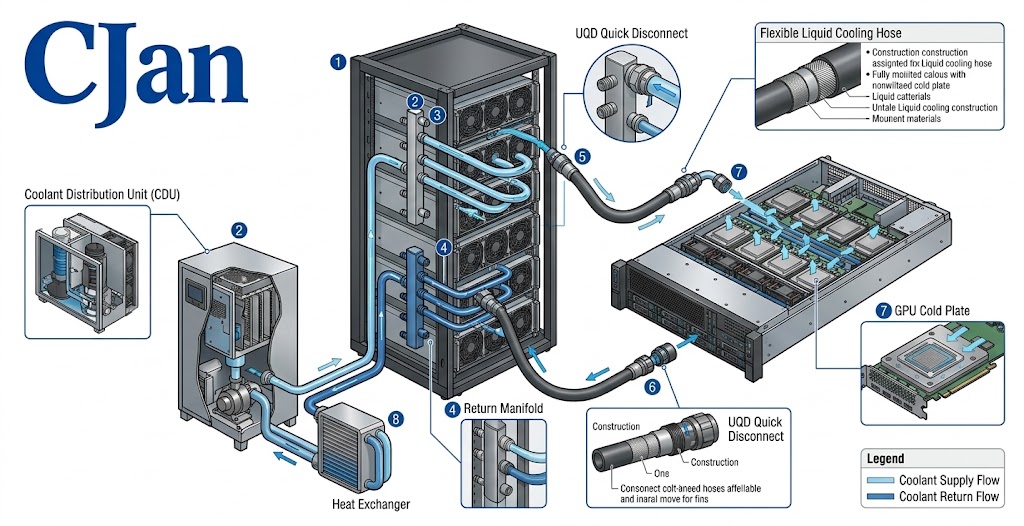
A simplified direct-to-chip liquid cooling system can be represented as follows:
The exact architecture varies from one data center to another, but the principle remains the same: coolant circulates through the thermal path and carries heat away from the computing hardware.
4. What Does the CDU Do?
CDU stands for Coolant Distribution Unit.
The CDU is an important interface between the facility cooling infrastructure and the technology cooling loop.
Depending on the system architecture, the CDU may provide functions such as:
- Coolant circulation
- Temperature management
- Pressure management
- Flow distribution
- Heat exchange
- System monitoring
In some installations, the facility water and IT-side coolant are kept in separate circuits. The CDU provides the thermal interface between those circuits.
This arrangement gives the IT cooling loop a controlled environment suited to the requirements of the servers.
5. What Does a Cold Plate Do?
The cold plate is positioned directly at or very close to the heat-generating component.
For GPU cooling, the cold plate is designed to receive thermal energy from the GPU and transfer it into the coolant flowing through its internal channels.
The cold plate therefore represents the point where heat enters the liquid cooling loop.
Its performance depends on its internal design, coolant flow, thermal interface and operating conditions.
6. Where Does the Liquid Cooling Hose Fit?
The hose connects the different parts of the cooling circuit.
Depending on the architecture, hoses may be used between:
- CDU and manifold
- Manifold and server
- Server and cold plate
- Cold plate and return manifold
This makes the hose a flexible link between otherwise rigid components.
In a dense AI rack, that flexibility can be valuable because the available routing space is limited.
7. Why Flexible Routing Matters
Inside an AI server rack, cooling components share space with electrical and mechanical infrastructure.
A hose may need to route around:
- GPU trays
- Cold plates
- Manifolds
- Rack structures
- Power components
- Electrical cables
- Other cooling lines
A hose therefore needs to be flexible enough for installation while remaining within its specified minimum bend radius.
Good routing is not simply about making the hose bend.
It is about maintaining the intended flow path without creating unnecessary mechanical stress.
8. What Happens Inside a Liquid Cooling Hose?
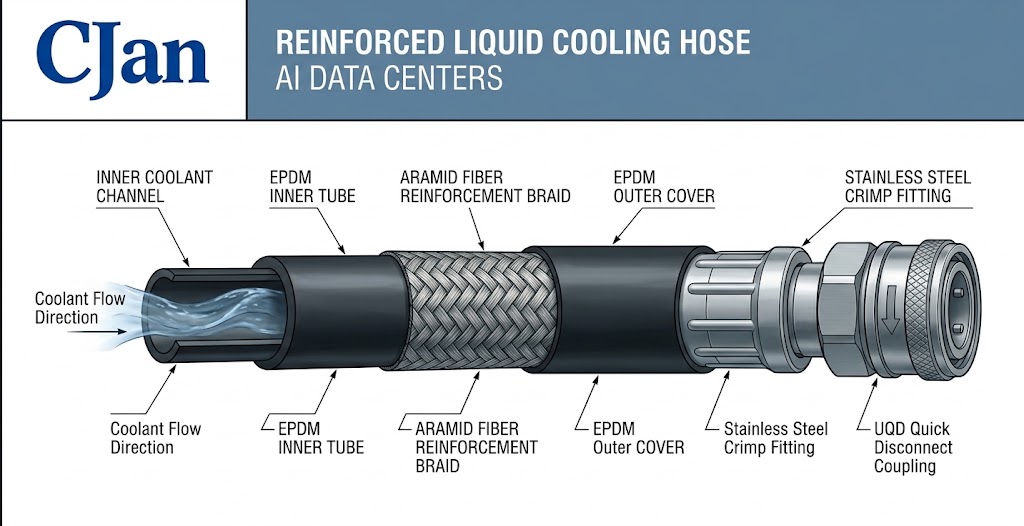
A reinforced liquid cooling hose can contain several functional layers.
The inner tube contacts the coolant.
The reinforcement provides mechanical support and can increase pressure capability.
The outer layer protects the hose from the surrounding environment.
The actual construction depends on the hose design and intended application.
9. Why Does Hose Material Matter?
The inner hose material is in direct contact with the coolant for extended periods.
Material selection should therefore consider the actual coolant formulation rather than relying only on a general description such as "water-based coolant."
Common flexible hose materials considered for liquid cooling include:
- EPDM
- Silicone
- PTFE and other fluoropolymers
- Other application-specific elastomers
EPDM can be a practical option for many water-based cooling applications where flexibility and mechanical durability are important.
Silicone may be considered where flexibility and temperature capability are key requirements.
Fluoropolymer hoses may be considered where chemical compatibility or specific cleanliness requirements are more demanding.
10. How Does Coolant Carry Heat?
The principle is simple: the coolant enters the cold plate, absorbs heat and leaves at a higher temperature.
The relationship can be described using the basic heat-transfer equation:
Q = ṁ × Cp × ΔT
where:
- Q = heat removed
- ṁ = coolant mass flow rate
- Cp = specific heat capacity of the coolant
- ΔT = coolant temperature rise
This is why flow rate and coolant properties are central to liquid cooling design.
The actual system calculation should use the properties of the selected coolant and the thermal requirements of the equipment.
11. Why Is Coolant Flow Important?
Insufficient flow can limit the amount of heat that the coolant can carry away for a given temperature rise.
However, increasing flow is not free.
Higher flow can increase hydraulic resistance and pump requirements.
The cooling system therefore needs an appropriate balance between:
- Heat removal
- Coolant temperature rise
- Flow rate
- Pressure drop
- Pumping power
This is one reason why liquid cooling hose selection needs to be considered as part of the complete hydraulic system.
12. How Does Hose Diameter Affect the Cooling Loop?
The internal diameter of the hose directly affects the flow passage.
For a given flow rate, reducing the internal diameter generally increases fluid velocity and hydraulic resistance.
Choosing a hose is therefore not simply a matter of matching the outside diameter to an available fitting.
The internal diameter must be considered from the hydraulic requirements of the system.
13. What Is Pressure Drop?
Pressure drop is the pressure lost as coolant moves through a component.
In a liquid cooling loop, pressure loss can come from:
- Hoses
- Fittings
- UQDs
- Manifolds
- Cold plates
- Valves and other restrictions
The pump needs to provide enough pressure to maintain the required flow through the complete circuit.
For this reason, hose pressure-drop data is more useful when it is provided together with a defined flow rate and test condition.
14. What Is a UQD in Liquid Cooling?
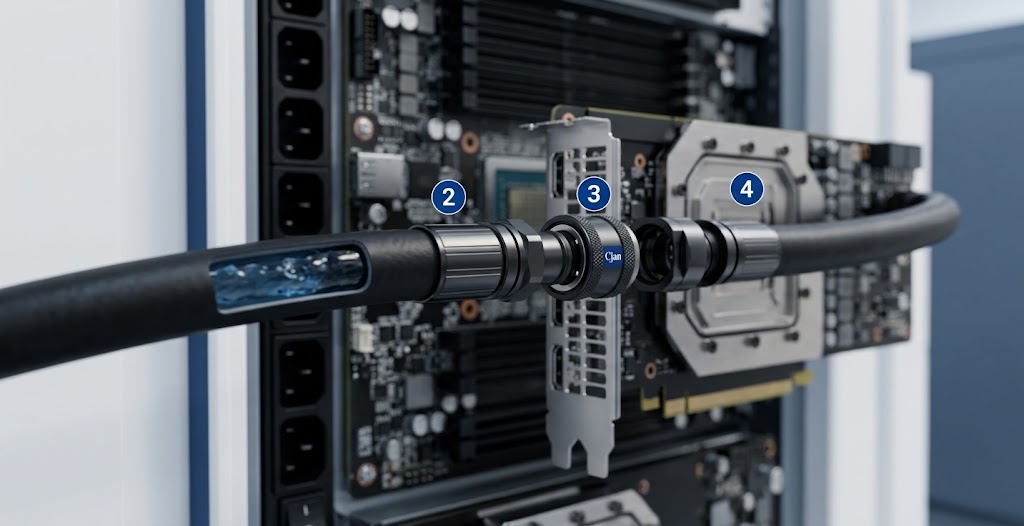
UQD refers to a Universal Quick Disconnect used to simplify the connection and disconnection of liquid cooling lines.
UQDs can be useful when servers, cold plates or other cooling components need to be serviced or replaced.
A typical connection can be represented as:
The UQD is therefore both a mechanical connection and part of the coolant flow path.
15. Does a UQD Affect Liquid Cooling Performance?
Yes.
The internal geometry of a UQD can create hydraulic resistance.
When selecting a UQD, engineers may need to consider:
- Flow capacity
- Pressure drop
- Working pressure
- Temperature range
- Coolant compatibility
- Leakage performance
- Connection cycles
- Available installation space
A UQD should therefore be considered as part of the hydraulic design rather than simply as a connector that happens to fit the hose.
16. Supply Side and Return Side
A liquid cooling system normally contains a supply path and a return path.
The supply side delivers relatively cooler coolant toward the heat source.
The return side carries warmer coolant away from the cold plate.
Both sides are important to system performance.
The return hose should not be treated as a secondary component simply because the coolant is already carrying heat.
17. Why Does Hose Length Matter?
Longer hoses generally create more frictional resistance.
However, making a hose unnecessarily short can create installation stress.
A practical hose length should provide sufficient allowance for:
- Required bend radius
- Equipment movement
- Installation tolerance
- Maintenance access
- Connection alignment
The objective is not the shortest possible hose.
The objective is a properly routed hose with an appropriate length.
18. Why Is Minimum Bend Radius Important?
Excessive bending can deform the hose and potentially restrict coolant flow.
It can also place additional mechanical stress near the fitting or UQD.
In a dense AI rack, the minimum bend radius should therefore be treated as a real installation parameter rather than a value that exists only on the datasheet.
During system design, engineers should consider the actual three-dimensional routing of the hose.
19. What About Temperature Changes?
Liquid cooling systems do not necessarily operate at one fixed temperature.
Temperature can change with:
- IT workload
- Coolant flow
- Facility conditions
- System startup and shutdown
- Maintenance cycles
The hose material, reinforcement, fittings and seals should all be suitable for the expected operating temperature range.
For long-term applications, temperature cycling can also be relevant.
20. Leakage Control Is a System Requirement
One of the obvious differences between air cooling and liquid cooling is the presence of a circulating fluid inside the equipment infrastructure.
The objective is simple:
Keep the coolant inside the designed flow path.
Potential leakage points include:
- Hose body
- Crimped connection
- Fitting
- UQD interface
- Cold plate connection
- Manifold connection
This is why the complete hose assembly should be considered during validation.
21. Why Does Hose Construction Matter?
Two hoses made from similar base materials can behave differently because their constructions are different.
Construction can influence:
- Working pressure
- Flexibility
- Bend radius
- Mechanical durability
- Dimensional stability
- Temperature performance
For pressurized liquid cooling systems, reinforcement can be particularly important.
The correct construction depends on the application rather than simply on the name of the elastomer.
22. Why Does Installation Space Matter?
AI server racks are highly constrained environments.
A hose may meet its pressure and temperature specifications and still be difficult to install if its outside diameter, fitting length or bend radius is unsuitable.
Engineers should check:
- Hose outside diameter
- Minimum bend radius
- Fitting dimensions
- UQD dimensions
- Connection orientation
- Clearance
- Maintenance access
In a densely packed rack, installation geometry can be just as important as the nominal hose specifications.
23. How Does Maintenance Affect Hose Design?
AI servers are not permanently inaccessible components.
Servers, GPUs and cooling components may need to be serviced or replaced.
During maintenance, the hose may experience movement that does not occur during normal operation.
This makes the following factors important:
- Flexibility
- Bend radius
- Connection reliability
- UQD connection cycles
- Hose length
- Mechanical protection
A cooling hose should therefore be evaluated not only for steady-state operation but also for the maintenance conditions it is expected to experience.
24. Liquid Cooling Is a System, Not a Single Component
The cooling performance of an AI server depends on the interaction between multiple components.
| Component | Primary Function |
|---|---|
| CDU | Manage the coolant distribution and thermal interface |
| Cold Plate | Transfer heat from the GPU or CPU into the coolant |
| Manifold | Distribute and collect coolant |
| Liquid Cooling Hose | Transport coolant between system components |
| UQD | Provide serviceable coolant connections |
| Coolant | Carry thermal energy through the cooling loop |
Optimizing one component without considering the others can produce an incomplete solution.
25. What Happens When the Hose Is Undersized?
An undersized hose can increase coolant velocity and pressure loss.
Depending on the system, this can increase pump requirements or reduce the flow available to the cold plate.
At rack scale, these effects can become more important because multiple cooling branches may operate simultaneously.
Hose ID should therefore be selected from the required flow and system pressure-drop budget.
26. What Happens When the Hose Is Oversized?
Larger is not automatically better.
An unnecessarily large hose may increase:
- Installation space
- Hose weight
- Bend radius
- Material consumption
- Connection dimensions
- Overall system cost
The appropriate hose size is the one that meets the hydraulic and mechanical requirements without creating unnecessary installation problems.
27. How Should a Liquid Cooling Hose Be Validated?
For demanding applications, validation should consider the finished hose assembly.
Depending on the project, relevant tests may include:
- Pressure testing – Verify pressure integrity.
- Leakage testing – Verify sealing performance.
- Flow testing – Confirm hydraulic performance.
- Pressure-drop testing – Measure hydraulic resistance at defined flow conditions.
- Temperature testing – Evaluate performance across the operating range.
- Flexibility testing – Confirm suitability for the required routing.
- Cycle testing – Evaluate repeated connection or movement where required.
The required test program should be defined according to the actual application.
28. A Typical AI Liquid Cooling Architecture
This architecture illustrates why the hose becomes an important part of the overall infrastructure as the number of cooling branches increases.
29. Why Hose Reliability Matters at Rack Scale
A single cooling loop may contain several hose assemblies.
A rack can contain many servers.
A data center can contain many racks.
The result is a large number of individual hose and connection points.
Consistency therefore matters.
A practical liquid cooling hose solution should be suitable for repeatable manufacturing, installation and maintenance.
30. Where Does CJAN Fit Into the Liquid Cooling System?
CJAN focuses on the flexible hose portion of liquid cooling systems.
The current liquid cooling portfolio includes:
- LCH
- LCH-SD
- LCH-SDS
These products can be evaluated for different liquid cooling applications according to the actual system requirements.
The appropriate selection should consider:
- Coolant
- Flow rate
- Working pressure
- Temperature
- Hose ID
- Bend radius
- Connection configuration
- Installation environment
CJAN's liquid cooling hose portfolio is therefore better understood as part of a system-level engineering solution rather than as a group of standalone hose products.
31. LCH, LCH-SD and LCH-SDS in Liquid Cooling Applications
| Product | Application Positioning |
|---|---|
| LCH | Liquid cooling applications where the hose needs to provide reliable coolant transport and flexible routing. |
| LCH-SD | Applications requiring a reinforced liquid cooling hose construction and additional mechanical capability. |
| LCH-SDS | Applications where flexible routing and compact system integration are important. |
Final product selection should always be confirmed against the latest CJAN product specifications and the customer's actual operating conditions.
32. What Should an Engineer Provide When Selecting a Hose?
A useful liquid cooling hose inquiry should include the following information:
Application: AI server / GPU / CDU / manifold
Coolant: Specific coolant formulation
Flow: Required flow rate
Pressure: Working and maximum pressure
Temperature: Minimum and maximum operating temperature
Hose Size: Required ID or available connection size
Length: Required hose length
Bend Radius: Available routing radius
Connection: Fitting and UQD configuration
Quantity: Project or annual requirement
Providing these parameters allows the hose supplier to make a more meaningful technical recommendation.
33. The Practical Liquid Cooling Design Sequence
A useful engineering sequence is:
This process connects the thermal requirements with the mechanical requirements of the hose.
34. The Hose Is Small, but the Requirement Is Not
A liquid cooling hose may appear to be a relatively simple component compared with a GPU, cold plate or CDU.
But it operates at the intersection of several engineering requirements.
It must transport coolant reliably while fitting into a tightly constrained mechanical environment.
It also has to work with the fittings, UQDs, manifolds and cold plates around it.
That makes hose selection a system engineering decision rather than simply a purchasing decision.
35. Key Takeaway
AI data center liquid cooling works by creating a controlled path for coolant to collect heat from high-power computing components and transport that heat away from the server.
The basic process is:
Within this loop, the liquid cooling hose provides the flexible connection between system components.
Its performance depends on more than the hose material alone.
Flow rate, internal diameter, pressure drop, temperature, coolant compatibility, bend radius, reinforcement, fittings and UQDs all need to be considered together.
The most reliable liquid cooling design is not built around one "best" component. It is built around compatibility between the entire cooling loop.
For AI data centers, that system-level approach provides a practical foundation for designing reliable liquid cooling infrastructure.
Conclusion
Liquid cooling is becoming increasingly relevant as AI computing pushes rack-level thermal requirements higher.
The basic concept is simple: move heat into a liquid and transport it away.
The implementation is more detailed.
CDUs manage the cooling loop. Cold plates collect heat from the processors. Manifolds distribute coolant. UQDs provide serviceable connections. Liquid cooling hoses connect these components and allow the system to fit into the physical constraints of the server rack.
For this reason, liquid cooling hose design should be considered from both hydraulic and mechanical perspectives.
CJAN's LCH, LCH-SD and LCH-SDS liquid cooling hose families can be evaluated according to the coolant, flow, pressure, temperature, routing and connection requirements of the application.
For AI data center cooling, the right hose is not simply the one that fits. It is the one that fits the cooling system.
liquid cooling hose selectionEPDM liquid cooling hose
LCH
LCH-SD
LCH-SDS
liquid cooling solutions