
BLOG
2026/07/31Clicks:324
The rapid growth of artificial intelligence is changing the way data centers are designed.
A few years ago, a typical server rack consumed less than 20kW of power. Today, AI training clusters equipped with advanced GPUs may exceed 100kW per rack, with some high-density deployments pushing even higher. As heat generation increases, liquid cooling is becoming an essential part of modern AI infrastructure.
While much attention is often given to cold plates, CDUs, and heat exchangers, the cooling hose is one of the most important components in the cooling loop. A poorly selected hose can lead to installation difficulties, coolant compatibility issues, premature aging, or even costly downtime.
This guide explains the practical considerations engineers should evaluate when selecting a liquid cooling hose for AI server cooling systems.
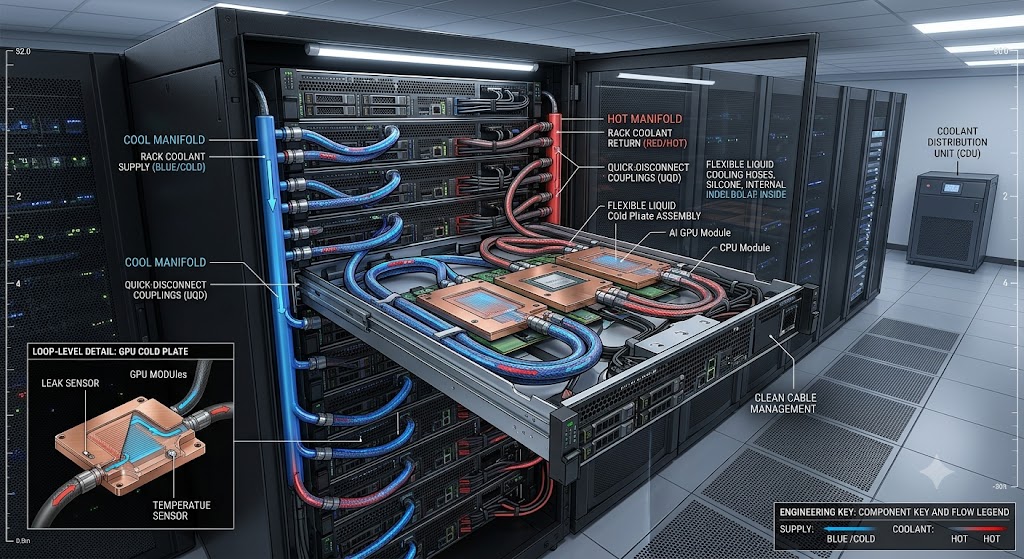
In a direct liquid cooling (DLC) architecture, cooling hoses connect key components throughout the system.
A simplified flow path typically includes:
CDU
↓
Distribution Manifold
↓
Liquid Cooling Hose
↓
Cold Plate
↓
GPU / CPU
↓
Return Loop
Although the hose may appear to be a simple connection component, it must maintain continuous coolant flow while operating reliably for years under demanding conditions.
The performance of the entire cooling loop depends on the stability of every connection point.
The first step in hose selection is understanding the cooling medium.
Common coolants used in AI data centers include:
Different hose materials react differently when exposed to these fluids over extended periods.
Long-term compatibility is often more important than short-term laboratory performance.
Before finalizing a hose specification, engineers should verify:
AI server racks continue to become denser.
As cooling loops become more complex, routing space becomes increasingly limited.
A hose that performs well in laboratory testing may become difficult to install inside a crowded rack environment.
When evaluating flexibility, consider:
Ultra-flexible cooling hoses can simplify installation and reduce stress on fittings and manifolds.
This is particularly important in modern GPU racks where multiple cooling circuits may operate within a confined area.
Pressure requirements vary between cooling systems.
Typical considerations include:
A hose should always be selected with adequate pressure capability beyond normal operating conditions.
The goal is not simply to meet pressure requirements but to maintain long-term reliability throughout the system lifecycle.
Although liquid cooling systems maintain relatively stable operating temperatures, localized temperature variations may occur near heat-generating components.
Engineers should evaluate:
Repeated heating and cooling cycles can gradually affect hose performance over time.
Selecting a material with proven thermal stability can help improve long-term reliability.
Unlike many industrial applications, AI data centers operate continuously.
Cooling infrastructure often runs:
24 hours/day
7 days/week
365 days/year
For this reason, reliability becomes one of the most important selection criteria.
Engineers should look beyond initial specifications and evaluate:
A hose replacement event inside a production AI cluster may involve significantly higher costs than the hose itself.
Among available materials, EPDM rubber has become one of the most widely used solutions for liquid cooling applications.
Benefits include:
These characteristics make EPDM suitable for:
As rack power density increases, operators are placing greater emphasis on infrastructure safety.
Modern cooling hose specifications increasingly consider:
Fire-resistant cooling hoses are becoming particularly attractive for:
Based on field experience, several issues appear repeatedly during cooling system design.
Pressure rating is important, but coolant compatibility and flexibility are equally critical.
Installation constraints often create unexpected stress points.
A hose that performs well initially may degrade under continuous exposure to coolant and temperature cycling.
Many industrial hoses were not designed specifically for liquid cooling applications.
Selecting a liquid cooling hose for AI server cooling systems involves much more than matching pressure and size specifications.
Engineers must consider coolant compatibility, flexibility, temperature resistance, long-term reliability, and installation requirements. As AI workloads continue to increase power density across data centers, cooling hose performance becomes increasingly important to overall system stability.
A properly selected cooling hose helps ensure reliable coolant flow, minimizes maintenance risks, and supports long-term operation in high-performance computing environments.
For modern AI infrastructure, hose selection should be treated as a critical engineering decision rather than a simple procurement item.
 Mobile


 GLOBAL


