GLOBAL
How to Choose the Right Liquid Cooling Hose for High-Density AI Servers
As AI servers become more powerful, cooling design is becoming less forgiving.
High-density GPU systems can place substantial thermal loads into a relatively small amount of rack space. Liquid cooling helps move heat away from these components, but the performance of the cooling loop depends on every part of the fluid path.
The hose is one of those parts.
It may appear to be a simple flexible connection, but its internal diameter, material, pressure capability, temperature range, bend radius and connection method can all affect the final system.
For an overview of how liquid cooling operates in AI infrastructure, see How Does Liquid Cooling Work in AI Data Centers?.
1. Why Hose Selection Matters in High-Density AI Servers
In a conventional air-cooled server, there is no liquid hose running directly through the cooling loop around the computing hardware.
In a liquid-cooled system, flexible hoses can become part of the primary path carrying coolant between components.
Depending on the architecture, hoses may connect:
- Cold plates
- Manifolds
- CDUs
- Server cooling modules
- UQDs
- Other fluid-handling components
That makes hose selection a system-design decision rather than simply a purchasing decision.
2. Start With the Cooling Architecture
Before selecting a hose, understand where it will be installed.
A hose used between a rack manifold and a server may have different requirements from a hose used elsewhere in the cooling infrastructure.
The first questions should be:
- Where is the hose located?
- What components does it connect?
- What coolant flows through it?
- What pressure does it experience?
- What temperature range is expected?
- How much flow is required?
- How much movement is expected?

3. Define the Coolant First
The coolant is one of the first parameters that should be identified.
Different liquid cooling systems can use different coolant formulations, and the hose material needs to be suitable for the actual fluid.
Material compatibility should be evaluated together with temperature and exposure conditions.
For a more detailed discussion, see How Coolant Compatibility Affects Liquid Cooling Hose Selection for AI Data Centers.
4. Determine the Required Flow Rate
The hose must allow the required coolant flow without creating unnecessary hydraulic resistance.
Required flow depends on the cooling load and the temperature difference allowed across the system.
A simplified relationship is:
Actual system calculations should use the parameters of the complete cooling loop.
5. Select the Internal Diameter Carefully
Internal diameter has a direct influence on fluid velocity and pressure loss.
If the hose is too small for the required flow, pressure loss can become an important design consideration.
If the hose is unnecessarily large, however, the additional size may create installation or packaging issues.
Hose sizing should therefore balance hydraulic requirements with physical installation constraints.
For more information, see How to Select the Right Liquid Cooling Hose Size for AI Data Centers.
6. Understand Pressure Requirements
Identify the normal operating pressure as well as the maximum expected pressure.
Pressure fluctuations should also be considered where the system experiences pump changes, valve operation or other transient conditions.
The hose assembly should be suitable for the actual pressure environment rather than being selected from a single nominal value.
For a deeper discussion, see How Pressure and Temperature Affect Liquid Cooling Hose Reliability in AI Data Centers.
7. Consider Operating Temperature
Temperature affects hose material behavior as well as coolant properties.
Define the expected operating range rather than using only one temperature number.
Important values may include:
- Normal operating temperature
- Maximum continuous temperature
- Short-term temperature excursions
- Thermal cycling range
Pressure and temperature should be considered together during hose selection.
8. Evaluate Thermal Cycling
AI workloads do not necessarily remain constant.
Changes in computing load can influence the thermal conditions of the cooling loop.
Where coolant temperature repeatedly rises and falls, the hose assembly may experience repeated thermal cycling.
For applications with significant thermal cycling, the qualification approach should reflect the intended operating conditions.
9. Choose the Hose Construction for the Application
Liquid cooling hoses can use different material and reinforcement constructions.
A typical reinforced hose may include:
Each layer has a different function, and the construction should be matched to the intended operating environment.
10. Match Material to the Application
There is no single hose material that is automatically ideal for every liquid cooling system.
Depending on the application, engineers may evaluate materials such as elastomeric or fluoropolymer constructions.
The selection should consider:
- Coolant compatibility
- Temperature range
- Pressure requirements
- Flexibility
- Permeation considerations
- Cleanliness requirements
- Expected service conditions
11. Flexibility Is Important in Rack-Level Cooling
High-density server environments often leave limited space for fluid routing.
The hose may need to accommodate installation tolerances, equipment movement and maintenance access.
A flexible hose can simplify routing, but flexibility should not come at the expense of pressure, temperature or compatibility requirements.
12. Check Bend Radius Before Installation
Every hose construction has a practical bending limit.
A hose should not be forced into a tighter bend simply because the available installation space is limited.
During system design, the intended hose route should be checked against the required bend radius.
13. Avoid Hose Twisting
A hose can bend while remaining in a neutral orientation, but twisting it around its longitudinal axis creates additional mechanical stress.
This can become especially important when hoses connect components that are frequently removed during server maintenance.
Routing should allow the hose to move naturally without unnecessary torsional loading.
14. Consider the Connection Method
The hose is only one part of the fluid assembly.
The connection method can include fittings, crimped ends, seals and UQDs.
The connection must be compatible with the hose construction and the intended pressure, temperature and coolant.
A hose that meets the required specification does not automatically make the complete assembly suitable.
15. Why UQD Selection Matters
UQDs can simplify maintenance by allowing cooling connections to be disconnected without rebuilding the entire fluid path.
However, UQD selection should consider the same application parameters used for the hose.
- Coolant compatibility
- Pressure capability
- Temperature range
- Connection size
- Flow requirements
- Connection and disconnection requirements
16. Calculate Pressure Drop
Pressure drop is an important hydraulic consideration when selecting a hose.
It depends on factors including hose internal diameter, length, coolant properties and flow conditions.
The goal is not necessarily to minimize hose pressure drop at any cost. The goal is to achieve the required cooling performance while keeping the hydraulic design within the capabilities of the system.
For more detail, see How to Calculate and Control Pressure Drop in AI Data Centers.
17. Hose Length Can Affect System Performance
Longer hose runs generally introduce more hydraulic resistance than shorter runs under otherwise comparable conditions.
Long hose sections can also occupy more installation space and may require additional support.
Hose length should therefore be determined from the actual routing requirement rather than simply using a convenient standard length.
18. Consider Maintenance Requirements
AI servers are not permanently inaccessible after installation.
Components may need to be inspected, replaced or serviced.
Hose routing should provide sufficient access for maintenance while avoiding unnecessary bending or pulling on the assembly.
This is particularly important around UQDs and other disconnectable connections.
19. Keep the Hose Away From Potential Damage
During installation, the hose should be protected from unnecessary contact with sharp edges or moving components.
Potential risks include:
- Abrasion
- Sharp-edge contact
- Excessive compression
- Repeated vibration
- High-temperature external surfaces
- Improper clamping
20. Do Not Select the Hose by Price Alone
The lowest purchase price does not necessarily represent the lowest system cost.
A hose that creates excessive pressure loss, is difficult to install or requires frequent replacement can increase the total cost of the cooling system.
For high-density AI infrastructure, engineers should consider the complete application rather than evaluating the hose as an isolated commodity.
21. Define a Hose Specification Sheet
A simple application specification can prevent many selection errors.
| Parameter | Information to Define |
|---|---|
| Coolant | Actual coolant / formulation |
| Flow Rate | Required operating flow |
| Internal Diameter | Required hydraulic size |
| Operating Pressure | Normal pressure |
| Maximum Pressure | Design requirement |
| Operating Temperature | Normal temperature range |
| Maximum Temperature | Expected upper condition |
| Hose Length | Required installed length |
| Bend Radius | Available routing space |
| Connections | Fittings / UQD requirements |
22. Selection Should Follow the Actual Operating Envelope
Once the basic parameters are defined, the hose can be evaluated against the complete operating envelope.
This approach is more reliable than choosing a hose from diameter alone.
23. Validate the Hose Assembly
Where project requirements call for qualification testing, testing should represent the intended application as closely as practical.
Depending on the system, evaluation may include:
- Pressure testing
- Leak testing
- Flow testing
- Temperature exposure
- Pressure cycling
- Thermal cycling
- Connection inspection
The exact validation procedure should be established according to the application and applicable requirements.
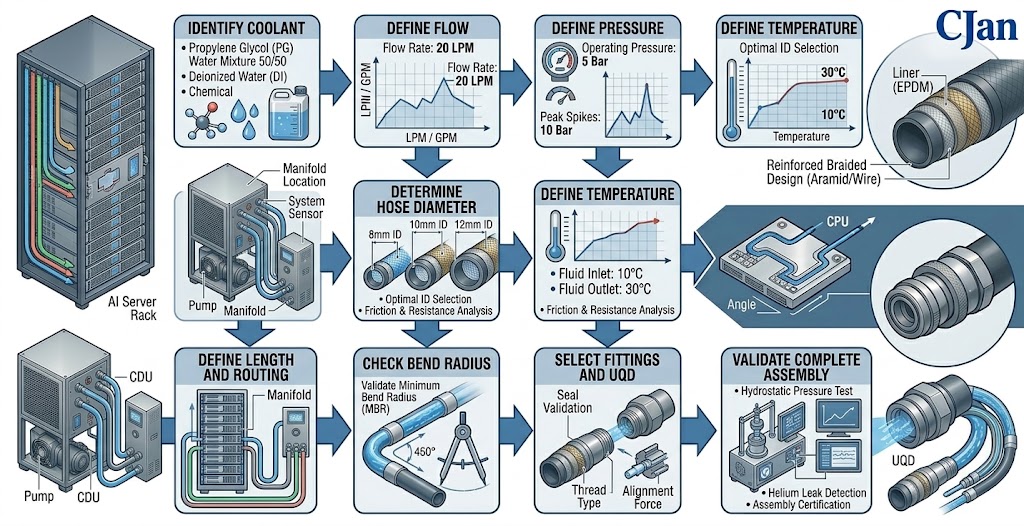
24. A Practical Selection Sequence
- Identify the coolant.
- Define required flow.
- Define operating and maximum pressure.
- Define operating and maximum temperature.
- Determine required hose diameter.
- Select suitable material and construction.
- Define hose length and routing.
- Check bend radius and mechanical movement.
- Select compatible fittings and UQD.
- Validate the complete assembly.
25. Common Selection Mistakes
Mistake 1: Choosing by Diameter Only
Two hoses with the same internal diameter can have very different material, pressure, temperature and flexibility characteristics.
Mistake 2: Looking Only at Maximum Pressure
Pressure rating does not address coolant compatibility, thermal cycling or mechanical routing.
Mistake 3: Ignoring Pressure Drop
A hose that fits physically may still create unnecessary hydraulic resistance.
Mistake 4: Ignoring Maintenance Access
A hose that works during initial installation may become difficult to handle during server maintenance.
Mistake 5: Treating the Hose and Connection Separately
The complete assembly determines practical leak and reliability performance.
26. CJAN Liquid Cooling Hose Options
CJAN provides liquid cooling hose configurations for evaluation according to the requirements of different thermal-management systems.
The current CJAN LCH Liquid Cooling Hose is part of the company's liquid cooling hose range.
Additional configurations include LCH-SD and LCH-SDS.
For AI data center applications, product selection should be based on the actual coolant, pressure, temperature, flow, dimensions, routing and connection requirements.
27. What Engineers Should Send to a Hose Supplier
A supplier can provide a more useful recommendation when the application information is clear.
For an AI server liquid cooling project, the initial inquiry can include:
- Coolant type
- Required flow rate
- Operating pressure
- Maximum pressure
- Operating temperature
- Maximum temperature
- Hose internal diameter
- Approximate hose length
- Minimum bend radius or available space
- Fitting requirements
- UQD requirements
- Expected application quantity
This information helps move the discussion from a generic hose quotation toward an application-specific solution.
Conclusion
Selecting a liquid cooling hose for a high-density AI server is a system engineering task.
The right choice starts with the coolant and continues through flow, pressure, temperature, material, construction, diameter, routing and connections.
Hose flexibility is important in compact server environments, but flexibility should always be balanced with hydraulic and mechanical requirements.
The hose should also be evaluated together with fittings, seals and UQDs because the complete assembly determines the reliability of the fluid connection.
CJAN's LCH, LCH-SD and LCH-SDS configurations provide options for liquid cooling applications where these requirements need to be considered together.
For engineers working on AI data center cooling projects, the most effective approach is to define the complete operating envelope first and then match the hose assembly to those conditions.
Explore the CJAN Liquid Cooling Solutions or review the current CJAN LCH Liquid Cooling Hose range.