GLOBAL
Liquid Cooling Hose Pressure Rating: How Much Pressure Does an AI Data Center Hose Need?
AI data center liquid cooling systems are often discussed in terms of heat load, coolant flow and thermal efficiency.
Pressure is sometimes treated as a secondary specification.
It should not be.
A liquid cooling hose operates inside a pressurized hydraulic circuit. The hose, fittings, quick disconnects and cold plates must work together under the same operating conditions.
For this reason, specifying a liquid cooling hose simply as:
"10 bar hose"
does not provide enough information.
Engineers need to distinguish between:
- Working pressure
- Maximum allowable pressure
- Burst pressure
- Pressure drop
- Temperature effects
- Pulsation
- Connection pressure capability
The correct question is not:
How much pressure can the hose survive?
It is:
What pressure must the complete cooling assembly reliably withstand throughout its expected service life?
1. Where Does Pressure Come From in an AI Liquid Cooling System?
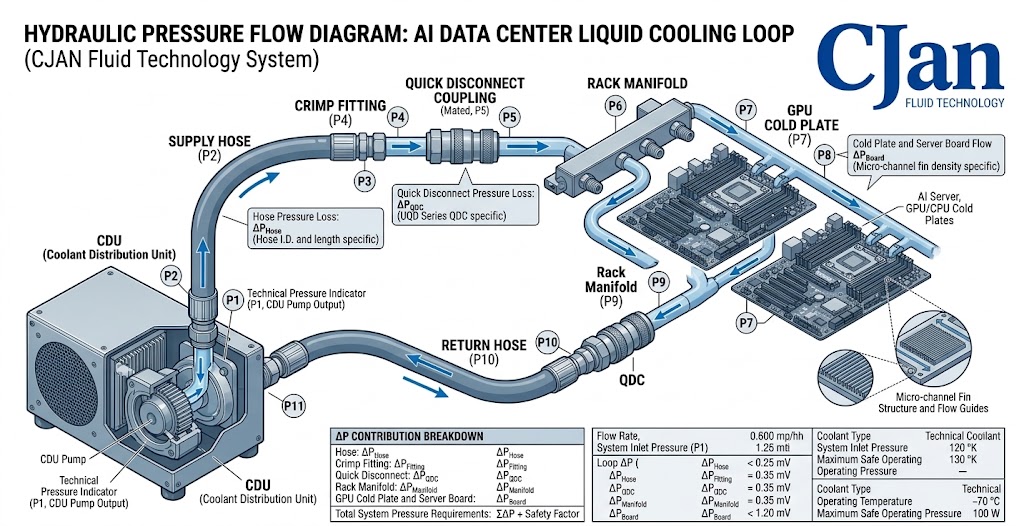
A typical direct-to-chip cooling loop may look like this:
The CDU pump provides the pressure required to overcome the resistance of the entire circuit.
Pressure is consumed by:
- Hose
- Fittings
- Quick disconnects
- Valves
- Manifolds
- Cold plates
- Other hydraulic components
Therefore, the hose is only one part of the pressure system.
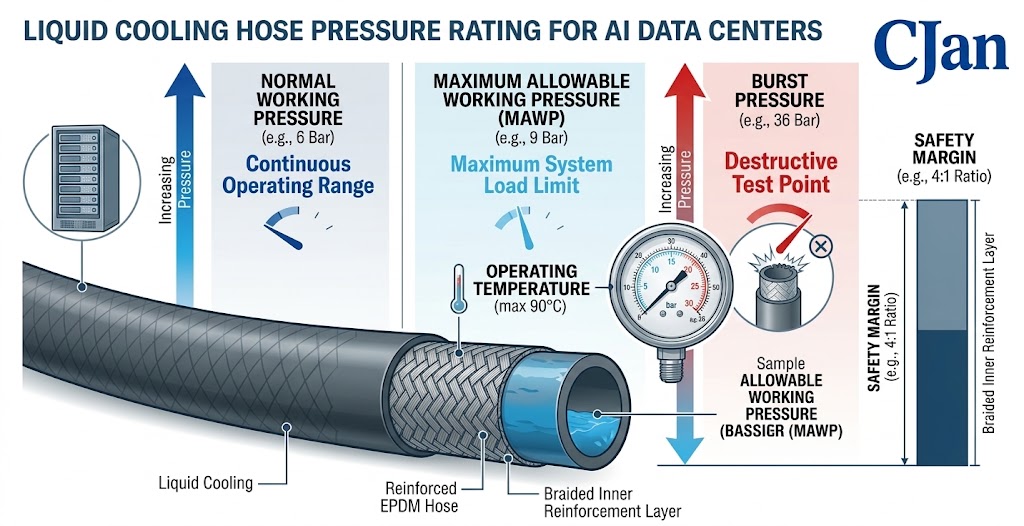
2. Working Pressure vs Burst Pressure
These two terms are frequently confused.
Working pressure
The pressure at which the hose is designed to operate continuously under specified conditions.
Burst pressure
The pressure at which the hose or assembly ultimately fails during a destructive pressure test.
They are not interchangeable.
A hose with a burst pressure of 40 bar should not automatically be operated at 40 bar.
The operating pressure needs to remain within the manufacturer's specified working limits, with an appropriate engineering safety margin.
3. Why Burst Pressure Should Not Be Used as the Operating Pressure
Imagine a hose specification showing:
Working pressure: 10 bar
Burst pressure: 30 bar
It would be incorrect to interpret this as:
"The system can operate at 30 bar."
Burst pressure is a failure threshold, not a normal operating target.
The engineering logic is:
The exact relationship depends on the applicable product standard, construction and testing requirements.
4. What Pressure Does an AI Cooling System Actually Need?
There is no universal pressure value for AI liquid cooling.
The required pressure depends on:
- Pump characteristics
- Coolant flow
- Hose ID
- Hose length
- Cold plate design
- UQD pressure drop
- Manifold design
- System elevation
- Allowable pressure loss
A high-flow system may need more pump pressure simply because its hydraulic resistance is higher.
Therefore:
Pressure and flow must always be considered together.
5. Flow Rate and Pressure Are Connected
Consider two systems.
System A
Flow: 30 L/min
Low resistance
System B
Flow: 120 L/min
Higher resistance
The second system may require substantially more pump pressure to maintain the desired flow.
This is why selecting a hose based only on its pressure rating can lead to an incomplete design.
The hose needs to satisfy both:
- Hydraulic requirement
- and
- Mechanical pressure requirement.
6. Hose Diameter Can Affect Required Pump Pressure
A smaller hose generally creates higher flow velocity.
Higher velocity can increase frictional pressure loss.
Conceptually:
Increasing hose ID can reduce hydraulic resistance, although oversized hoses can create other practical issues.
The objective is not simply:
"Choose the biggest hose."
It is:
Choose a hose diameter that provides the required flow within the system's allowable pressure loss.
7. Pressure Drop Is Different From Pressure Rating
These terms should not be mixed.
Pressure rating
Describes how much pressure the hose can safely withstand.
Pressure drop
Describes how much pressure is lost as coolant flows through the hose.
For example:
A hose might have:
Working pressure = 10 bar
but produce only:
0.2 bar pressure drop
at a particular flow rate and length.
Another hose may have the same working pressure but create substantially higher pressure loss because of its internal diameter or construction.
8. Temperature Changes Pressure Performance
A hose's pressure capability should always be considered together with temperature.
Materials can behave differently as temperature changes.
Therefore, a specification such as:
Working pressure: 10 bar
should be understood together with its specified temperature range.
Engineers should ask:
- At what temperature is the pressure rating valid?
- Does the rating change at higher temperature?
- Is the pressure rating based on the hose or the complete assembly?
This is particularly important for continuously operating data centers.
9. Pressure Is Not the Same as Temperature Resistance
A common mistake is:
"This hose can handle 150°C, so it can handle high pressure at 150°C."
Not necessarily.
Temperature resistance and pressure resistance are different performance characteristics.
A hose needs to satisfy:
Pressure + Temperature + Time
under the actual operating conditions.
10. The Fitting May Become the Weakest Point
Consider:
The hose itself may have adequate pressure capability.
But if the fitting or UQD has a lower pressure rating, the complete assembly is limited by that component.
Therefore:
The assembly rating should be considered, not just the hose-tube rating.
11. Quick Disconnect Pressure Rating
Quick disconnects are particularly important in GPU cooling because they provide a service interface.
The UQD should be checked for:
- Working pressure
- Burst pressure
- Flow capacity
- Pressure drop
- Temperature
- Leakage
- Connection cycles
A UQD with excellent flow characteristics but inadequate pressure capability is not suitable.
Likewise, a very high-pressure UQD may be unnecessary if the system operates at relatively low pressure.
12. Crimp Quality Matters
For high-performance cooling assemblies, the connection between the hose and fitting is critical.
A typical assembly may use:
Poor crimp control can result in:
- Leakage
- Pull-off
- Local deformation
- Reduced pressure capability
Therefore, pressure qualification should ideally cover the actual hose assembly, not merely the raw hose.
13. Why AI Data Centers Need a Safety Margin
A cooling system rarely operates under one perfectly constant condition.
Actual conditions can change because of:
- Pump control
- Server load
- Startup and shutdown
- Temperature changes
- Valve operation
- Maintenance
- Flow changes
A suitable design therefore needs an appropriate safety margin.
The safety margin should be based on:
- Product specification
- Applicable standards
- System design
- Operating environment
- Expected service life
It should not be selected arbitrarily.
14. Pressure Pulsation Should Also Be Considered
A system can experience pressure changes even when the average pressure appears stable.
Possible sources include:
- Pump operation
- Pump speed control
- Valve switching
- Rapid flow changes
A hose that is adequate for steady pressure may have different long-term behavior under repeated pressure cycling.
For demanding installations, ask the supplier whether the hose assembly has been evaluated for the expected pressure cycles.
15. Static Pressure vs Dynamic Pressure
A cooling system can experience different hydraulic conditions.
Static condition
Pump is stopped or flow is minimal.
Dynamic condition
Coolant is circulating at the design flow.
The dynamic condition creates pressure losses throughout the system.
Therefore, engineers should evaluate:
16. Does Higher Hose Pressure Rating Mean Better?
Not necessarily.
Suppose:
Hose A
Working pressure: 10 bar
Hose B
Working pressure: 30 bar
If the actual cooling system operates at 5 bar, both may potentially meet the pressure requirement.
Hose B is not automatically the better product.
It may be:
- Heavier
- Less flexible
- More expensive
- Larger in bend radius
The correct specification is the one that meets the application requirements with appropriate margin.
17. Pressure Rating and Flexibility Can Conflict
Reinforcement improves pressure capability.
But additional reinforcement can influence:
- Flexibility
- Bend radius
- Weight
- Installation force
This is especially important for GPU server connections.
A hose connecting a cold plate may need:
High flexibility
while a longer CDU-to-rack hose may place more emphasis on:
Flow + pressure + routing distance.
This is another reason why different parts of the same cooling system do not necessarily require identical hose constructions.
18. How CJAN's LCH-SD Fits Into This Picture
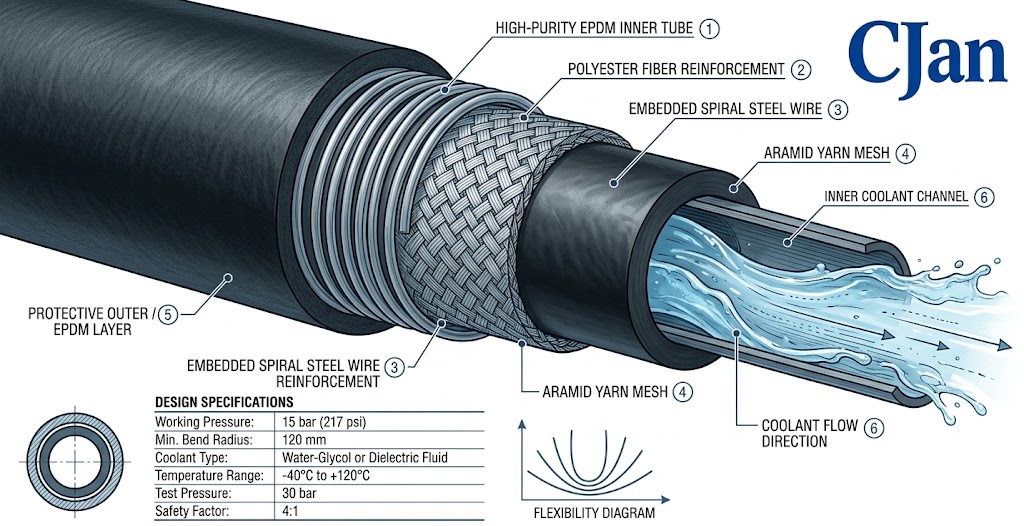
CJAN publishes the LCH-SD as a liquid cooling hose using high-purity EPDM with polyester fiber or aramid yarn reinforcement and embedded spiral steel wire.
The published working pressure is 10–16 bar depending on hose size, while the product information also lists a substantially higher burst-pressure range.
This type of reinforced construction is intended to provide pressure capability while maintaining the flexibility required for liquid cooling applications.
However, the correct model should still be selected according to:
- Required flow
- Working pressure
- Temperature
- Hose ID
- Connection
- Bend radius
rather than choosing solely because a pressure number looks high.
19. LCH-SDS: Pressure Plus Flexibility
The LCH-SDS is positioned as an ultra-flexible fire-resistant EPDM liquid cooling hose.
Its design addresses a common problem in AI racks:
High-density equipment creates complicated hose routing.
The challenge is therefore not simply:
"How strong does the hose need to be?"
It is:
"How strong and how flexible does the hose need to be at the same time?"
This becomes especially relevant around:
- GPU cold plates
- Rack manifolds
- Server trays
- Tight bends
- Maintenance connections
20. How to Specify Liquid Cooling Hose Pressure
A better specification looks like this:
Application: AI GPU Direct-to-Chip Cooling
Coolant: Water / Glycol
Working Pressure: ____ bar
Maximum Pressure: ____ bar
Operating Temperature: ____ °C
Maximum Temperature: ____ °C
Required Flow: ____ L/min
Hose ID: ____ mm
Hose Length: ____ mm
UQD: Required
Pressure Pulsation: Yes / No
Fire Resistance: Required / Not Required
Required Safety Standard: ____
This is much more useful than simply specifying:
"10 bar hose."
21. Example: Selecting a Hose for a GPU Rack
Assume a hypothetical system has:
- Working pressure: 5 bar
- Maximum operating pressure: 7 bar
- Coolant: water-glycol
- Temperature: 20–50°C
- Required flow: 80 L/min
- Flexible rack routing
- UQD connections
A reasonable selection process would be:
- Step 1 – Confirm coolant compatibility.
- Step 2 – Confirm required hose ID from flow and pressure-drop calculations.
- Step 3 – Confirm hose working pressure exceeds the actual operating pressure with appropriate margin.
- Step 4 – Check temperature-dependent pressure capability.
- Step 5 – Evaluate UQD and fitting ratings.
- Step 6 – Confirm complete assembly performance.
- Step 7 – Verify bend radius and installation conditions.
Only after these steps should the final hose assembly be selected.
22. Pressure Testing the Finished Assembly
For critical cooling applications, testing the finished assembly is important.
Possible tests include:
- Hydrostatic pressure testing
- Leakage testing
- Proof-pressure testing
- Burst testing
- Pressure cycling
The exact test method should follow the applicable hose, assembly and customer requirements.
A pressure test should not be interpreted as permission to operate the assembly at the test pressure.
23. Common Pressure-Related Mistakes
Mistake 1: Using burst pressure as working pressure – Burst pressure is a failure limit, not normal operating pressure.
Mistake 2: Ignoring temperature – Pressure capability may depend on temperature.
Mistake 3: Checking only the hose – Fittings and UQDs also have pressure ratings.
Mistake 4: Ignoring pressure drop – A hose can withstand pressure but still create excessive flow resistance.
Mistake 5: Using excessive safety margin without considering flexibility – Over-engineering can make the assembly unnecessarily stiff and expensive.
Mistake 6: Testing the tube but not the assembly – The crimped connection may behave differently from the hose itself.
24. Practical Pressure Selection Checklist
25. Pressure Rating Is Only One Part of Hose Selection
A reliable AI liquid cooling hose needs to balance:
This is why CJAN should position its liquid cooling products as engineered hose assemblies, rather than competing only on the pressure number printed on the product page.
26. CJAN Liquid Cooling Hose Portfolio
For AI data center applications, CJAN currently has several relevant products:
LCH
General liquid cooling hose for thermal management applications.
LCH-SD
Reinforced EPDM liquid cooling hose designed for data-center applications, with published working pressure varying by size.
LCH-SDS
Ultra-flexible fire-resistant EPDM liquid cooling hose for applications where routing flexibility is particularly important.
CJFLEX-HAT
High-airtightness liquid cooling hose intended for IDC cooling systems.
These products should not be presented as interchangeable.
The better GEO strategy is:
Application requirement → Engineering parameter → Recommended CJAN product
rather than:
CJAN product → generic product description