GLOBAL
When Should Liquid Cooling Hoses Be Replaced? Key Warning Signs
Liquid cooling hoses are designed to operate for extended periods, but no hose should be treated as a permanent component.
In an AI data center, a hose may be exposed continuously to coolant, pressure, temperature changes, bending and mechanical movement. Over time, these conditions can affect the hose or its connections.
The practical question is not simply how many years a hose has been installed. A replacement decision should consider its actual operating conditions, physical condition, service history and the requirements of the cooling system.
1. Why Liquid Cooling Hose Replacement Matters
A liquid cooling hose is part of the coolant path. Its condition therefore matters to the overall cooling system.
A deteriorated hose or damaged connection may affect:
- Coolant containment
- System reliability
- Flow performance
- Maintenance requirements
- Equipment availability
For high-density AI systems, the consequences of a cooling problem can extend beyond the hose itself because the cooling circuit serves equipment operating at significant thermal loads.
2. There Is No Universal Replacement Interval
One of the most common mistakes is assigning a single replacement period to every liquid cooling hose.
Actual service life can depend on:
- Hose material
- Hose construction
- Coolant chemistry
- Operating temperature
- System pressure
- Pressure cycling
- Bending and routing
- Mechanical abrasion
- Connection design
- Installation environment
For this reason, replacement planning should be based on the actual application rather than a generic calendar value.
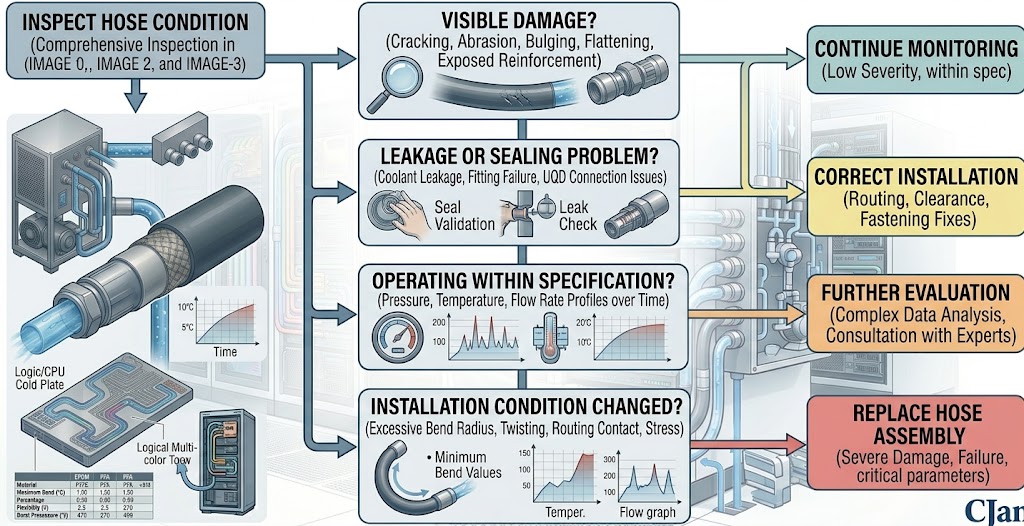
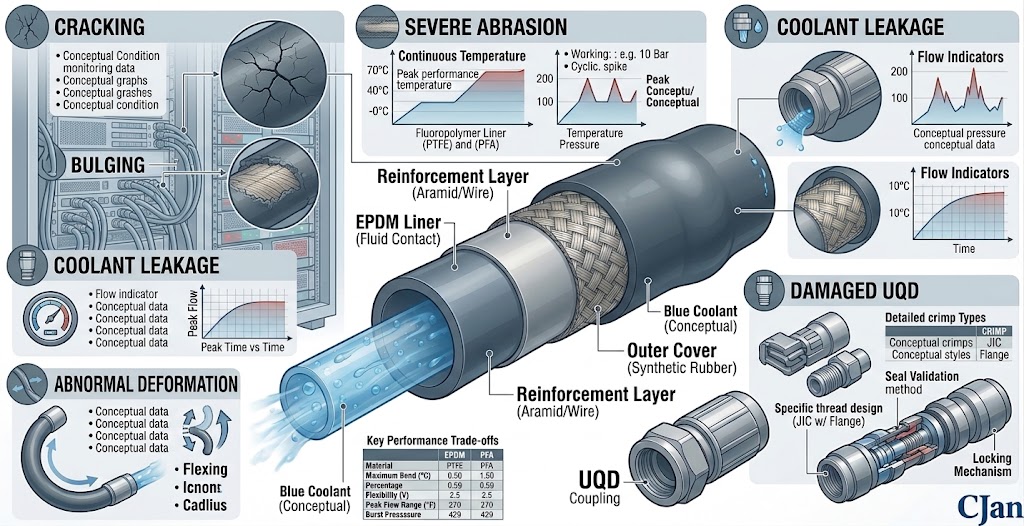
3. Warning Sign #1: Visible Cracks
Cracking on the hose surface should be treated as a condition requiring investigation.
Cracks may appear on the outer cover or other visible areas of the hose construction.
Inspect carefully around:
- Fittings
- High-bend areas
- Routing transitions
- Areas exposed to heat
- Areas subjected to repeated movement
The severity and location of the cracking should be evaluated against the hose construction and manufacturer's requirements.
4. Warning Sign #2: Severe Abrasion
Surface abrasion can occur when a hose repeatedly contacts a bracket, cabinet edge or another component.
Minor surface marks do not necessarily mean immediate replacement, but deep or progressive abrasion deserves closer attention.
Particular concern is appropriate when abrasion has affected protective layers or exposed reinforcement.
The cause should also be corrected so that a replacement hose is not subjected to the same damage.
5. Warning Sign #3: Abnormal Bulging
A localized change in hose diameter can indicate that the hose is no longer behaving as expected under operating conditions.
Bulging may occur for different reasons depending on the hose construction and application.
If a previously stable hose develops noticeable localized bulging, it should be evaluated rather than simply returned to service.
6. Warning Sign #4: Permanent Flattening
A flexible hose may become flattened when subjected to excessive bending, compression or an unsuitable routing condition.
Flattening can affect the internal flow area and may increase hydraulic resistance.
It can also indicate that the hose has been subjected to a mechanical condition outside its intended installation range.
Review the routing before deciding whether the hose should remain in service.
7. Warning Sign #5: Repeated Leakage
Repeated leakage should not be treated simply by repeatedly tightening or reconnecting the same assembly.
The source of the leakage should first be identified.
Potential causes can include:
- Damaged hose
- Damaged fitting
- Seal deterioration
- Improper connection
- Misalignment
- Excessive mechanical loading
For a detailed prevention approach, see How to Prevent Liquid Cooling Hose Leakage in AI Data Center Systems.
8. Warning Sign #6: Coolant Residue Around Connections
Visible residue near a fitting or coupling can be an indication that coolant has escaped from the connection.
The appearance of the residue depends on the coolant used in the system.
When residue is found, the connection and hose should be inspected rather than assuming that the residue is harmless.
9. Warning Sign #7: Damaged UQD Connection
UQD connections can simplify maintenance and equipment service, but they still require proper inspection.
A UQD connection should be evaluated if there is:
- Visible physical damage
- Abnormal movement
- Difficulty achieving proper engagement
- Evidence of leakage
- Damage to the sealing interface
The applicable UQD manufacturer's service instructions should be followed when determining whether a coupling can remain in service.
For background, see Liquid Cooling Hose Quick Disconnects: How to Choose UQD Couplings for AI Servers.
10. Warning Sign #8: Exposed Reinforcement
Many reinforced liquid cooling hoses use an internal reinforcement layer to provide mechanical strength.
If the reinforcement becomes exposed because of severe abrasion, cutting or damage to the hose cover, the assembly should be evaluated promptly.
The significance of the damage depends on the hose construction and the affected layer.
For more information, see How Hose Reinforcement Affects Liquid Cooling System Performance.
11. Warning Sign #9: Unexpected Changes in Flexibility
A hose that becomes noticeably harder, softer or less flexible than expected may require further evaluation.
Changes in flexibility can be associated with material condition, temperature exposure, chemical compatibility or aging.
Because different hose materials behave differently, the observation should be evaluated against the original hose specification.
12. Warning Sign #10: Discoloration or Surface Changes
Discoloration by itself does not automatically mean that a hose has failed.
However, a significant change from the original appearance can be useful as an inspection indicator when combined with other evidence.
Look for changes accompanied by:
- Cracking
- Swelling
- Hardening
- Softening
- Surface damage
- Coolant residue
13. Warning Sign #11: Hose Routing Has Changed
A hose can become mechanically stressed even when there is no visible surface damage.
For example, moving a rack, manifold or connected component may change the hose's routing and bend radius.
If the current routing differs significantly from the original installation condition, the assembly should be reviewed.
See Liquid Cooling Hose Routing: How to Avoid Kinks and Excessive Bending.
14. Warning Sign #12: The Hose Is Being Used Outside Its Original Conditions
A hose selected for one set of conditions may not be suitable after the cooling system is modified.
Changes to the system may include:
- Higher coolant temperature
- Higher operating pressure
- Different coolant
- Higher flow requirement
- Different connection configuration
- Different routing
When operating conditions change, the hose specification should be reviewed rather than assuming that the original selection remains appropriate.
15. Coolant Compatibility Can Affect Replacement Decisions
Hose material should be compatible with the coolant used throughout the intended operating range.
If the coolant formulation changes, the existing hose should be reassessed for compatibility.
This is particularly important when a cooling system moves from one coolant formulation to another.
See How Coolant Compatibility Affects Liquid Cooling Hose Selection for AI Data Centers.
16. Temperature Exposure Should Be Considered
Temperature is another factor that can affect hose material behavior over time.
Inspection and replacement decisions should consider both:
- Continuous operating temperature
- Temperature cycling
Nearby heat sources should also be considered when evaluating a hose installation.
See How Pressure and Temperature Affect Liquid Cooling Hose Reliability in AI Data Centers.
17. Pressure Cycling Matters
Liquid cooling systems may experience changes in pressure during startup, shutdown, flow adjustment or other operating conditions.
Repeated pressure cycling can be an important part of the service environment.
When investigating hose condition, engineers should consider not only the nominal operating pressure but also the actual pressure profile of the application.
18. Service Age Is a Factor, But Not the Only Factor
Installation age can be useful for maintenance planning, but it should not be used as the only replacement criterion.
Two hoses installed on the same date may experience very different service conditions.
For example, one may operate in a stable environment while another may experience frequent movement, tighter bends or higher temperature exposure.
19. Review the Hose's Maintenance History
Maintenance records can provide information that a visual inspection cannot.
Useful historical information includes:
- Previous leakage
- Previous repairs
- Connection replacements
- Routing changes
- Equipment movement
- Previous inspection findings
A hose with repeated maintenance events may deserve more detailed evaluation than an assembly with a stable service history.
20. Replacement Should Address the Root Cause
Replacing a hose without correcting the underlying problem can lead to repeated failures.
For example, if abrasion is caused by contact with a sharp cabinet edge, installing another hose without changing the routing or protection may simply reproduce the same condition.
A replacement decision should therefore consider both the hose and its installation environment.
21. When Replacement Is More Appropriate Than Continued Monitoring
Continued monitoring may be reasonable for minor changes that do not indicate loss of integrity and remain within the applicable specifications.
Replacement or further engineering evaluation becomes more important when there is evidence of:
- Active leakage
- Severe cracking
- Severe abrasion
- Exposed reinforcement
- Significant deformation
- Damaged sealing interfaces
- Repeated connection failures
- Operation outside the specified conditions
22. Do Not Wait for a Visible Leak
A hose does not need to show an active leak before it receives attention.
Cracking, severe abrasion, deformation and other abnormal conditions may justify investigation before leakage occurs.
This is one reason condition-based inspection is useful for liquid cooling systems.
23. Replacement After a Significant Installation Change
A hose may need reassessment after major changes to the cooling system.
Examples include:
- Changing the CDU
- Changing the manifold
- Moving server racks
- Changing cold plates
- Changing connection hardware
- Changing coolant
The existing hose should be checked against the new configuration before the system returns to normal operation.
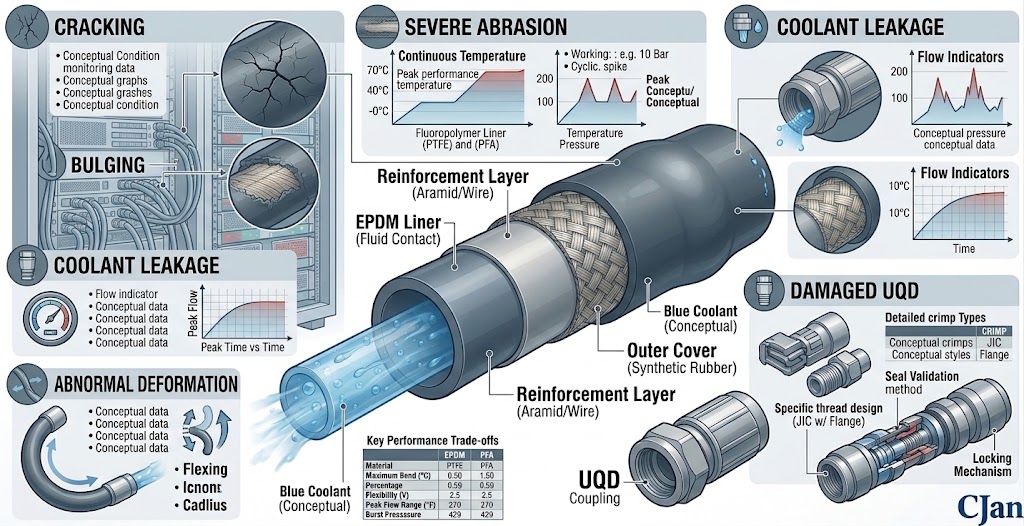
24. How to Decide Whether a Hose Can Remain in Service
A practical decision can begin with four questions:
- Is there visible damage?
- Is there evidence of leakage or sealing problems?
- Is the hose operating within its specified conditions?
- Has its installation condition changed?
If any answer raises concern, the assembly should receive further engineering or maintenance evaluation.
25. Replacement Decision Framework
| Observed Condition | Recommended Action |
|---|---|
| No visible abnormality and normal operating conditions | Continue routine inspection |
| Minor surface change | Document and monitor according to maintenance requirements |
| Routing or bend-radius issue | Correct installation and reassess hose condition |
| Severe abrasion | Evaluate condition and correct the source of abrasion |
| Cracking or significant deformation | Further evaluation and possible replacement |
| Active leakage | Follow applicable shutdown, isolation and replacement procedures |
| Damaged connection or UQD | Evaluate the hose and connection as an assembly |
| Operation outside specified conditions | Review hose selection before continued operation |
26. Replace the Hose With the Correct Specification
When replacement is necessary, the new hose should not simply be selected by matching the outside appearance of the old hose.
Important selection parameters can include:
- Inner diameter
- Pressure rating
- Temperature range
- Coolant compatibility
- Minimum bend radius
- Reinforcement
- Connection type
- Required length
See How to Choose the Right Liquid Cooling Hose for AI Servers.
27. Hose Length Should Also Be Rechecked
When replacing an assembly, the replacement length should be evaluated based on the actual installed routing.
A hose that is too short can introduce unnecessary tension or bending, while excessive length can create unnecessary loops or contact points.
Replacement should therefore consider the complete routing rather than simply duplicating the previous hose length.
28. Replacement Includes the Connection Assembly
In many applications, the hose and its fittings operate as an assembly.
When replacing a hose, engineers should determine whether the existing fittings, seals or couplings are suitable for reuse.
For critical applications, replacing only the flexible tube without evaluating the connection components may leave an existing weakness in the system.
29. Replacement Should Be Followed by Inspection and Testing
After installation of a replacement hose assembly, the new installation should be checked before returning the cooling system to normal operation.
Depending on the application, this can include:
- Visual inspection
- Connection verification
- Leak testing
- Pressure testing
- Flow verification
- Operating-condition verification
See Liquid Cooling Hose Assembly Testing: Pressure, Leak and Performance Checks.
30. Build Replacement Criteria Into the Maintenance Program
A maintenance program becomes easier to manage when replacement criteria are established before a problem occurs.
Facilities can define criteria based on:
- Visible damage
- Leakage
- Service history
- Operating conditions
- Manufacturer recommendations
- Application criticality
This approach allows maintenance teams to make decisions based on documented conditions rather than waiting for an unexpected failure.
31. CJAN Liquid Cooling Hose Solutions
CJAN provides flexible hose solutions for liquid cooling applications where coolant transport, flexibility and reliable connections are required.
Relevant liquid cooling hose products include:
Hose selection should be based on the actual coolant, pressure, temperature, flow requirements, routing and connection configuration of the cooling system.
See the CJAN Liquid Cooling application page for additional information.
32. Conclusion
Liquid cooling hoses should not be replaced simply because they have reached a certain age, nor should replacement be postponed until an obvious leak occurs.
A better approach is to combine inspection results with operating conditions, service history, installation changes and manufacturer requirements.
Cracks, severe abrasion, abnormal deformation, repeated leakage, damaged connections and operation outside the original specification are all conditions that deserve attention.
When replacement is necessary, the new assembly should be selected for the actual cooling application and checked after installation.
For AI data center liquid cooling applications, this approach helps maintain the integrity of the coolant distribution system while providing a more structured basis for maintenance planning.
Learn more about CJAN liquid cooling hose solutions.