GLOBAL
How to Select the Right Liquid Cooling Hose Size for AI Data Centers
Selecting the correct hose size for an AI data center cooling system is more than choosing a tube that fits the available connector.
The hose internal diameter influences coolant velocity, pressure drop and the amount of flow that can pass through the cooling loop. At the same time, physical dimensions affect routing, bend radius, connection hardware and installation space inside the rack.
For high-density AI systems, these factors need to be considered together.
For an introduction to the role of liquid cooling hoses in AI infrastructure, see How Does Liquid Cooling Work in AI Data Centers?.
1. Why Hose Size Matters in AI Liquid Cooling
Liquid cooling systems transfer heat from processors, GPUs or other high-power components into a circulating coolant loop.
The hose provides a flexible flow path between components such as cold plates, manifolds, CDUs and quick-disconnect couplings.
Its internal diameter directly affects the flow passage.
This relationship becomes increasingly important as the required coolant flow increases.
2. Start With the Required Coolant Flow
Hose sizing should begin with the cooling system's required flow rate.
The required flow depends on the thermal load and the temperature rise permitted across the cooling loop.
A simplified heat-transfer relationship is:
The actual engineering calculation may require additional system parameters, but this relationship illustrates why flow rate is fundamental to hose sizing.
A hose should therefore be selected after the required flow range has been established rather than before it.
3. Hose ID Is More Important Than Hose OD for Flow
When discussing hydraulic performance, engineers should distinguish between internal diameter and outside diameter.
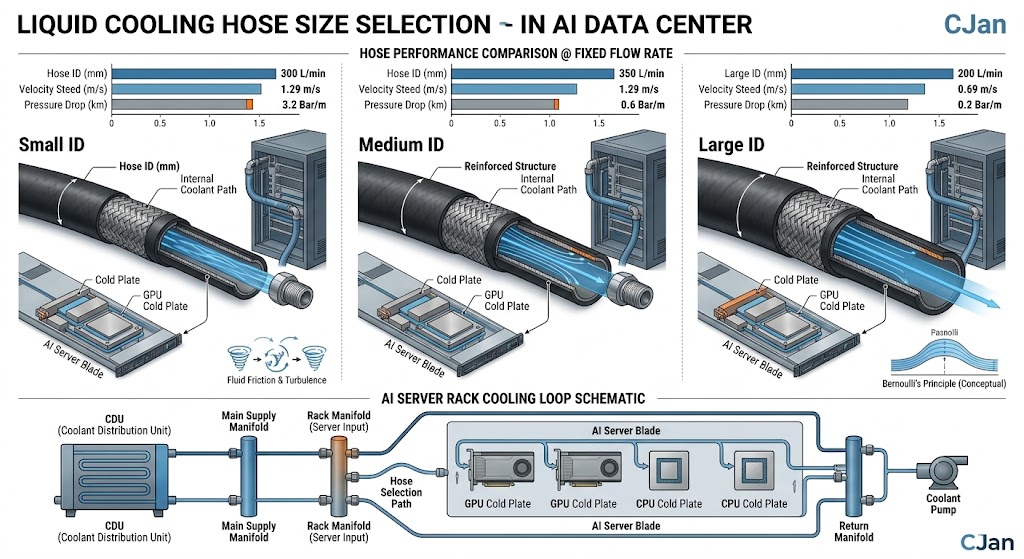
Internal diameter (ID) determines the approximate flow passage through the hose.
Outside diameter (OD) is more relevant to installation clearance, clamping, routing and mechanical integration.
Two hoses can have similar outside dimensions while having different internal flow passages because of differences in wall construction.
4. How Hose Diameter Influences Pressure Drop
For a given coolant and flow rate, reducing the internal diameter increases coolant velocity.
Higher velocity generally increases frictional pressure loss.
This is why an undersized hose can become a restriction in a high-flow cooling circuit.
Pressure-drop behavior should be checked at the actual design flow rather than at an arbitrary test condition.
For a deeper discussion, see Liquid Cooling Hose Pressure Drop: How to Calculate and Control It in AI Data Centers.
5. Does a Larger Hose Always Improve Cooling?
Not necessarily.
A larger internal diameter can reduce hydraulic resistance, but the hose still needs to integrate with the rest of the cooling system.
Increasing hose size may require larger:
- Fittings
- Manifold ports
- UQDs
- Clamps or connection hardware
- Routing space
A larger hose can also be less convenient in a tightly packed server environment.
The objective is therefore to select an appropriate size rather than simply maximizing diameter.
6. Consider the Complete Flow Path
The hose is only one part of the hydraulic circuit.
Each section can contribute hydraulic resistance.
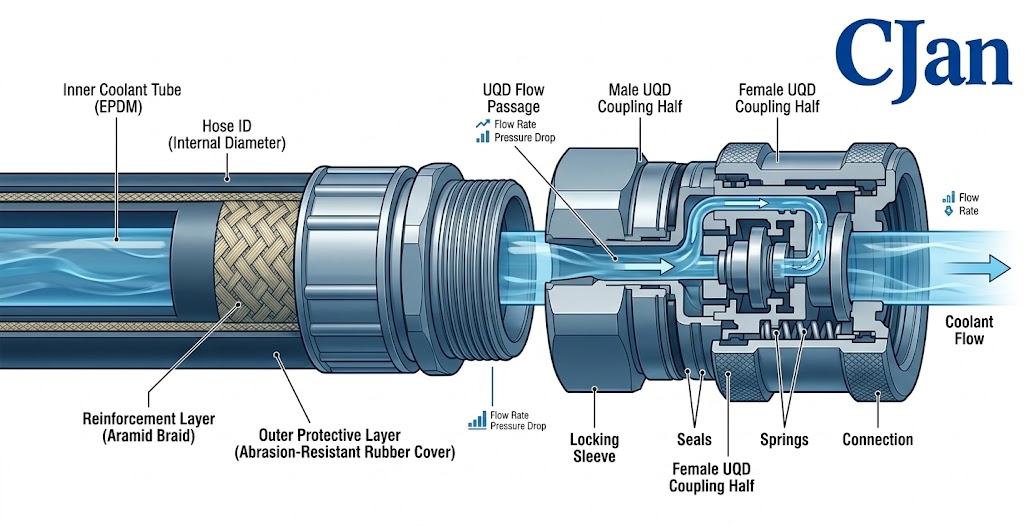
If a hose has a relatively large internal diameter but the UQD or fitting has a significantly smaller flow passage, the connection may become the limiting point.
Hose sizing should therefore be coordinated with the complete connection architecture.
7. Match the Hose Size With the UQD
UQDs provide a practical way to connect and disconnect liquid cooling components during equipment service.
However, the UQD is also part of the coolant flow path.
The hose and UQD should therefore be treated as an assembly during hydraulic evaluation.
A useful design question is not simply:
What hose diameter should I use?
It is:
What hose-and-connection configuration provides the required flow with acceptable pressure loss?
8. Hose Size and Minimum Bend Radius
Physical routing is another important consideration.
Larger hoses generally require more installation space and may have a larger minimum bend radius.
Inside an AI server rack, hoses may need to route around cold plates, power components, manifolds and other hardware.
A hose that performs well hydraulically may still be unsuitable if it cannot be routed without excessive bending.
9. Avoid Selecting a Hose That Is Too Small
An undersized hose can create several problems.
- Higher coolant velocity
- Higher pressure drop
- Greater pump pressure requirement
- Potential flow limitations
- Reduced design margin
The problem may not become obvious during low-load operation.
It can become more significant when the system reaches its intended high-load operating condition.
10. Avoid Selecting a Hose That Is Excessively Large
Oversizing also has disadvantages.
- More installation space
- Larger connection hardware
- Potentially larger bend radius
- Higher material usage
- More difficult rack integration
For this reason, hose selection should be based on engineering requirements rather than a general preference for larger tubing.
11. Coolant Type Should Be Considered
Different coolant formulations can have different physical properties.
Viscosity and density influence hydraulic behavior, while chemical compatibility determines whether the hose material is suitable for long-term service.
The hose size therefore should not be selected independently of the coolant.
For systems using water-based coolants, the hydraulic evaluation should still consider the actual coolant formulation and operating temperature.
12. Temperature Can Change Hydraulic Behavior
Coolant properties can change as temperature changes.
Because viscosity can affect flow resistance, pressure-drop behavior at one temperature may not be identical to behavior at another temperature.
For systems with a relatively wide operating temperature range, the hose evaluation should consider the relevant operating conditions rather than relying on a single nominal point.
13. Hose Length Also Matters
Once hose diameter has been selected, hose length should be considered.
Longer hose runs generally create more frictional pressure loss than shorter runs with the same internal diameter and coolant conditions.
In a rack-level cooling system, supply and return hoses may both contribute to total system resistance.
Routing should therefore be designed to provide sufficient serviceability without introducing unnecessary hose length.
14. Consider Supply and Return Lines Together
A liquid cooling loop normally contains both supply and return paths.
If both paths use flexible hoses, both contribute to the hydraulic resistance of the system.
Evaluating only the supply hose can underestimate total hose-related pressure loss.
15. Hose Construction Can Affect Available Flow Area
Liquid cooling hoses may use multiple layers, including an inner fluid-contact layer, reinforcement and an outer protective layer.
The construction influences mechanical performance and can affect the relationship between outside diameter and internal diameter.
For this reason, hose selection should use the manufacturer's actual dimensional data.
The hose should not be judged only by its external appearance or nominal outside size.
16. Pressure Rating and Hose Size Are Different Parameters
A hose may have an appropriate pressure rating while still being unsuitable from a hydraulic perspective.
Pressure rating describes pressure capability.
Hose size influences flow velocity and pressure loss.
17. How to Build a Hose Sizing Specification
Before contacting a hose manufacturer, prepare a basic application specification.
| Parameter | Information to Define |
|---|---|
| Coolant | Fluid type and formulation |
| Flow Rate | Normal and maximum required flow |
| Temperature | Operating and maximum temperature |
| Pressure | Operating and design pressure |
| Hose Length | Approximate supply and return length |
| Available Space | Routing and clearance limitations |
| Connection | Fitting and UQD requirements |
18. A Practical Hose Size Selection Process
This sequence helps prevent the common situation where hose diameter is selected before the actual cooling requirements are understood.
19. Why Application Conditions Matter More Than a Generic Hose Size
There is no single hose size that is automatically correct for every AI data center cooling system.
Different systems can have different:
- Thermal loads
- Coolant formulations
- Flow requirements
- Pressure limits
- Rack layouts
- Connection architectures
Consequently, a hose that works well in one cooling architecture may not be the best choice for another.
20. Hose Size Selection for High-Density AI Racks
High-density AI racks place additional demands on cooling infrastructure.
More thermal load may require higher coolant flow, while the physical space available for hoses remains limited.
This creates a practical engineering trade-off:
The best solution is therefore usually a coordinated system design rather than an isolated hose-size decision.
21. How CJAN Liquid Cooling Hoses Can Be Evaluated
CJAN provides several hose configurations for liquid cooling applications.
The CJAN LCH Liquid Cooling Hose can be evaluated according to the required flow, temperature, pressure, dimensions and connection configuration.
Additional configurations include LCH-SD and LCH-SDS.
For an application-specific recommendation, the actual operating parameters should be provided rather than selecting a product solely from nominal hose size.
22. Do Not Ignore the Finished Hose Assembly
The final product installed in an AI rack may contain hose, fittings, UQDs and other connection components.
The finished assembly should be checked for:
- Required flow
- Pressure drop
- Pressure rating
- Temperature range
- Leak tightness
- Bend radius
- Connection compatibility
This is particularly important when the cooling loop has limited pressure margin.
23. A Simple Engineering Example
Consider an AI cooling loop that requires a defined coolant flow through a flexible hose.
Instead of immediately selecting the hose by nominal size, the engineer can compare several candidate internal diameters under the same conditions.
| Evaluation Item | Candidate A | Candidate B | Candidate C |
|---|---|---|---|
| Coolant | Same | ||
| Temperature | Same | ||
| Flow Rate | Same | ||
| Hose Length | Same | ||
| Internal Diameter | Small | Medium | Large |
| Pressure Drop | Measure | Measure | Measure |
| Routing | Check | Check | Check |
This comparison provides a much stronger basis for selection than choosing a hose based only on the outside diameter.
24. Five Questions to Ask Before Ordering
1. What flow rate is required?
Define both normal and maximum operating flow where possible.
2. What coolant will be used?
The hose material must be compatible with the actual coolant.
3. What pressure drop is acceptable?
This helps determine whether the proposed internal diameter is appropriate.
4. What connection hardware will be used?
Hose and UQD dimensions should be considered together.
5. How will the hose be routed?
Check bend radius, available space and service access before finalizing the hose configuration.
25. Liquid Cooling Hose Sizing Checklist
| Requirement | Check |
|---|---|
| Required coolant flow | Defined |
| Coolant type | Confirmed |
| Operating temperature | Confirmed |
| Operating pressure | Confirmed |
| Hose internal diameter | Evaluated |
| Pressure drop | Checked at design flow |
| Hose length | Estimated from actual routing |
| UQD and fitting compatibility | Confirmed |
| Minimum bend radius | Confirmed |
| Final assembly | Validated |
Conclusion
Selecting a liquid cooling hose for an AI data center starts with the cooling requirement, not the hose itself.
Required coolant flow establishes the hydraulic target. Hose internal diameter then becomes an important factor in controlling coolant velocity and pressure drop. Hose length, coolant properties, temperature, fittings, UQDs and routing must also be considered before the final configuration is selected.
The most practical approach is to evaluate the hose as part of the complete cooling assembly.
CJAN's LCH, LCH-SD and LCH-SDS configurations provide options for liquid cooling applications where hydraulic performance, flexibility and system integration need to be considered together.
For AI data center projects, engineers can start the evaluation by defining coolant type, flow rate, pressure, temperature, hose length and connection requirements.
For more information, visit the CJAN Liquid Cooling Solutions page or review the CJAN LCH Liquid Cooling Hose.