GLOBAL
What Are the Key Requirements for AI Data Center Liquid Cooling Hoses?
Liquid cooling is becoming an increasingly important part of high-density AI infrastructure.
As GPU servers become more powerful, the cooling system needs to remove a larger amount of heat through a controlled coolant circuit. Cold plates, manifolds, CDUs, fittings, UQDs and hoses all become part of the thermal management system.
Among these components, the liquid cooling hose provides a flexible connection between fixed components.
That sounds straightforward, but an AI data center cooling hose has to satisfy several requirements at the same time.
This article explains the main requirements engineers should consider when evaluating a liquid cooling hose for AI data center applications.
1. The First Requirement: Coolant Compatibility
The inner surface of the hose is continuously exposed to the circulating coolant.
For that reason, coolant compatibility should be one of the first parameters considered during hose selection.
It is not enough to describe the coolant simply as "water-based."
Different cooling systems can use different formulations, additives and concentrations. The hose material should therefore be evaluated against the actual coolant chemistry used in the system.
Important considerations can include:
- Coolant composition
- Water concentration
- Glycol or other additives
- Long-term exposure
- Operating temperature
- Potential material swelling or degradation
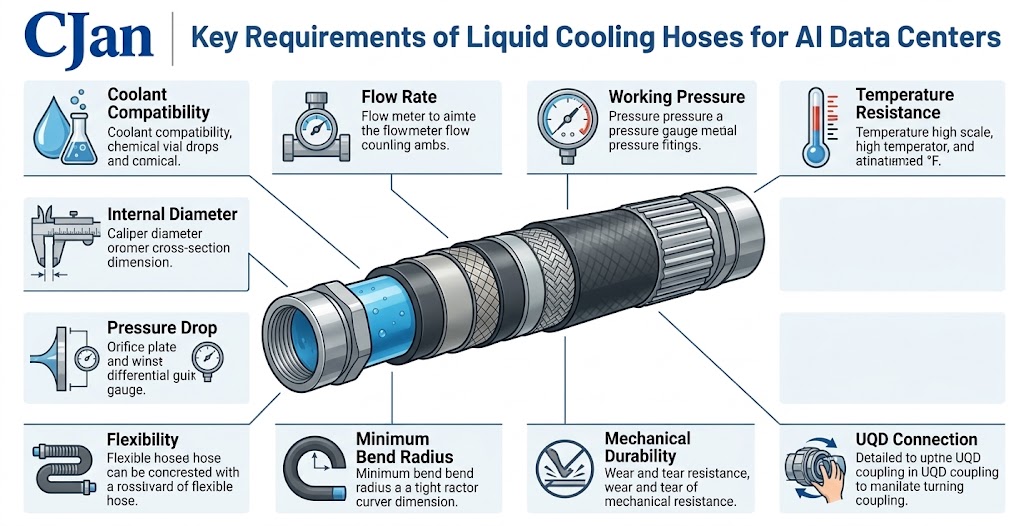
2. Pressure Capability Must Match the System
Liquid cooling loops operate under pressure. The hose therefore needs to withstand the pressure generated by the pump and the hydraulic resistance of the complete system.
Engineers normally need to distinguish between several pressure values:
- Normal working pressure
- Maximum working pressure
- Pressure during startup or transient conditions
- Test pressure
A hose selected only according to its normal operating pressure may not provide enough margin for the complete operating environment.
The final pressure requirement should be determined from the actual system design.
3. Flow Rate Is a Critical Design Input
The hose must provide an adequate flow passage for the required coolant flow.
Flow requirements are ultimately related to the amount of heat that needs to be removed.
This relationship is why hose selection should begin with the system's hydraulic requirements rather than starting with an available hose size.
4. Internal Diameter Affects Hydraulic Performance
The internal diameter of the hose directly determines the available flow area.
For the same flow rate, a smaller internal diameter generally produces higher fluid velocity and greater hydraulic resistance.
On the other hand, an unnecessarily large hose can create mechanical and installation problems.
| Hose ID Decision | Potential Effect |
|---|---|
| Too small | Higher flow velocity and pressure drop |
| Appropriately sized | Balanced flow and installation requirements |
| Too large | More space, larger fittings and potentially higher cost |
The objective is not to select the largest possible hose. The objective is to select an internal diameter appropriate for the required flow and pressure-drop budget.
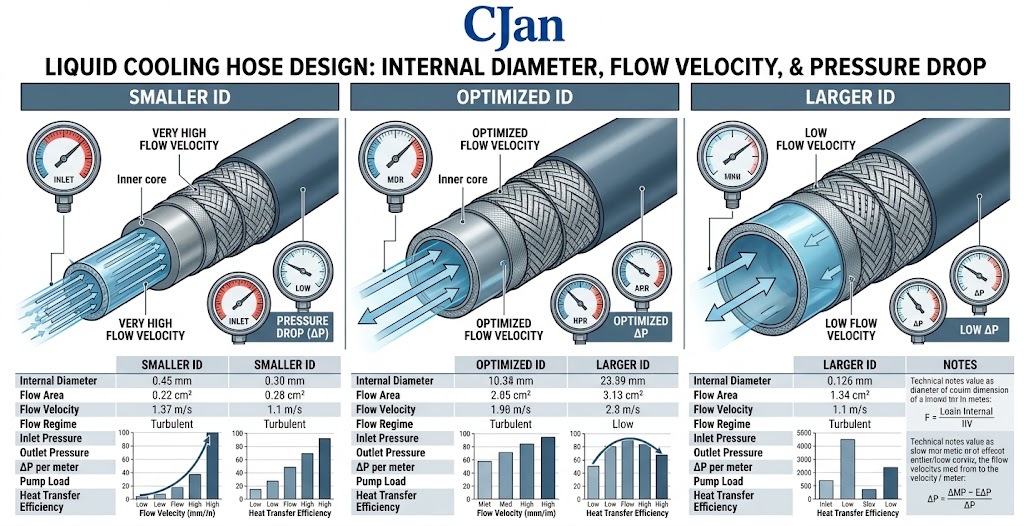
5. Pressure Drop Should Be Considered as Part of the System
A hose does not operate independently from the other hydraulic components.
The complete cooling loop can contain pressure losses from:
- Liquid cooling hoses
- Fittings
- UQDs
- Manifolds
- Cold plates
- Valves
- Other flow restrictions
The total pressure drop determines the pressure that the pump needs to provide at the required flow rate.
For this reason, a liquid cooling hose should be evaluated using pressure-drop data at a defined flow rate whenever such data is required for system design.
6. Temperature Resistance Is More Than a Maximum Temperature Number
A liquid cooling hose can experience changing temperatures during operation.
Temperature conditions can be influenced by:
- GPU workload
- Coolant supply temperature
- Return temperature
- Facility conditions
- Startup and shutdown
- Maintenance procedures
Engineers should therefore consider the complete operating temperature range rather than looking only at the maximum temperature.
Repeated temperature changes may also be relevant when evaluating long-term performance.
7. Flexibility Is a Major Advantage of Hose Connections
Unlike rigid tubing, flexible hose can accommodate complex routing inside a server rack.
This is particularly useful when the cooling connection needs to move around:
- GPU trays
- Cold plates
- Manifolds
- Rack structures
- Power components
- Electrical cables
However, flexibility should not be confused with unlimited bending capability.
A hose still needs to operate within its specified bend radius.
8. Minimum Bend Radius Protects the Cooling Path
When a hose is bent too tightly, its internal passage can become distorted.
This can affect flow and increase mechanical stress.
Excessive bending can also transfer additional load to the fitting or UQD connection.
For high-density AI racks, this should be considered during mechanical layout rather than after the hardware has already been installed.
9. Reinforcement Can Increase Mechanical Capability
Some liquid cooling hoses use reinforcement layers to improve mechanical performance.
Depending on the hose design, reinforcement may help support:
- Pressure resistance
- Dimensional stability
- Mechanical durability
- Resistance to deformation
The reinforcement construction needs to be evaluated together with the inner tube and outer protective layer.
A reinforced hose is not automatically suitable for every application. The actual construction needs to match the required pressure, flexibility and installation conditions.
10. The Inner Tube Needs to Protect the Coolant Path
The inner tube is the part of the hose that directly contacts the coolant.
Its role is therefore fundamental to the reliability of the cooling circuit.
Important characteristics can include:
- Chemical compatibility
- Temperature resistance
- Dimensional stability
- Long-term durability
- Resistance to fluid-related degradation
Material selection should always be based on the actual application environment.
11. The Outer Layer Has a Different Job
The outer layer does not normally contact the coolant. Its function is related to the surrounding environment.
Depending on the application, the outer layer may need to tolerate:
- Mechanical contact
- Abrasion
- Installation handling
- Environmental exposure
- Repeated movement
This is why hose construction needs to be evaluated as a complete assembly rather than by looking only at the inner tube material.
12. Connection Compatibility Is Essential
A technically suitable hose still cannot function properly if its connection does not match the surrounding components.
The hose assembly may interface with:
- Cold plates
- Manifolds
- CDUs
- Fittings
- UQDs
- Server cooling modules
Engineers should therefore define the connection configuration before finalizing the hose assembly.
13. Why UQD Compatibility Matters
UQDs can make liquid cooling connections easier to service.
In an AI server environment, maintenance access can be an important part of system design.
The hose assembly should therefore be compatible with the selected UQD in terms of:
- Connection size
- Connection type
- Pressure rating
- Temperature range
- Coolant compatibility
- Flow requirements
- Installation space
The UQD itself can also introduce pressure drop, so the connection should be evaluated hydraulically as well as mechanically.
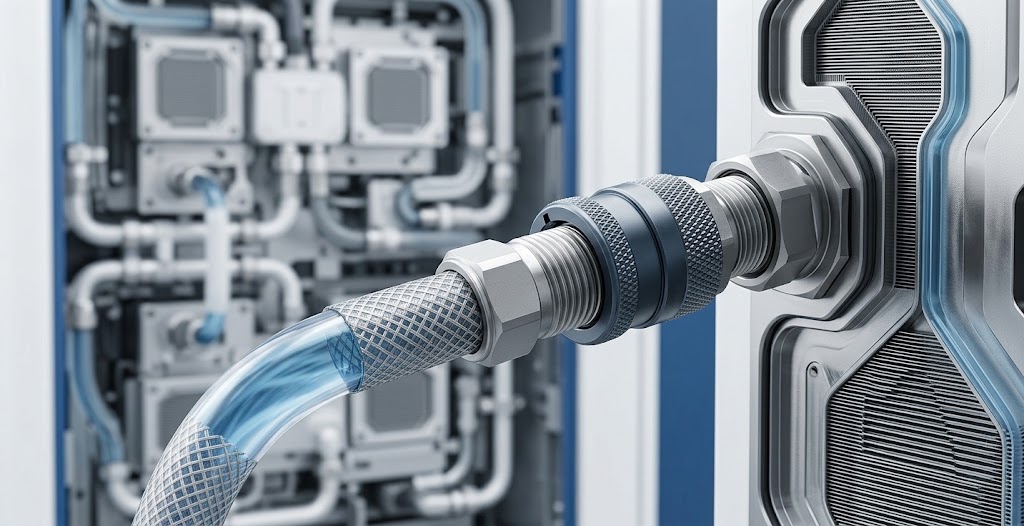
14. Leak Resistance Is a Fundamental Requirement
In liquid cooling, leakage control is an essential part of system reliability.
Potential leak points can exist at:
- Hose bodies
- Fittings
- Crimped connections
- UQD connections
- Manifold interfaces
- Cold plate interfaces
This means that testing only the hose tube may not be enough.
The complete hose assembly should be evaluated when the application requires a defined leakage performance.
15. Mechanical Stress Around the Fitting
One common mistake in hose installation is concentrating excessive bending or pulling force near the fitting.
The hose may appear flexible, but the connection area can become a mechanical stress concentration point.
Good installation practice should avoid:
- Sharp bending immediately behind the fitting
- Twisting the hose during installation
- Excessive axial pulling
- Forced misalignment
A smooth routing path normally provides a more reliable connection environment.
16. Hose Length Should Be Designed, Not Guessed
Hose length affects both installation and hydraulic performance.
A hose that is too short may create tension.
A hose that is excessively long may introduce unnecessary pressure drop and routing complexity.
The required length should allow for:
- Correct routing
- Minimum bend radius
- Equipment movement
- Installation tolerance
- Maintenance access
17. Hose Weight Can Matter in Dense Systems
In a single connection, hose weight may appear insignificant.
At rack scale, however, multiple hoses, fittings and connections can add up.
Weight can become relevant when designing:
- Server cooling modules
- Manifold mounting
- Rack infrastructure
- Movable service assemblies
The objective is therefore to achieve the required mechanical performance without unnecessary bulk.
18. Cleanliness Can Be Important
Cooling systems may have different cleanliness requirements depending on the application.
For some systems, engineers may care about:
- Internal contamination
- Particulate generation
- Manufacturing residues
- Fluid cleanliness
The required cleanliness level should be defined by the cooling system rather than assumed to be identical for every data center application.
19. Hose Permeation Can Be Relevant
Some fluids can interact with polymeric materials over long periods.
Depending on the coolant and application, engineers may therefore consider permeation and long-term material stability.
This is particularly relevant when coolant composition needs to remain stable over an extended service period.
The significance of permeation depends strongly on the material, coolant and system architecture.
20. Temperature and Pressure Should Be Considered Together
Pressure capability is not always independent of temperature.
For polymeric hoses, allowable pressure can change as temperature changes.
Therefore, engineers should not automatically assume that the maximum pressure listed at one temperature remains valid across the entire operating temperature range.
21. Hose Material Selection for Liquid Cooling
Several hose material families may be considered for liquid cooling applications.
| Material Family | Typical Consideration |
|---|---|
| EPDM | Commonly considered for water-based cooling applications where flexibility and durability are required. |
| Silicone | Often considered where flexibility and temperature capability are important. |
| Fluoropolymers | Considered where specific chemical compatibility or cleanliness requirements are important. |
| Other engineered elastomers | Selected according to specific coolant, pressure, temperature and mechanical requirements. |
There is no universal "best" liquid cooling hose material.
The appropriate material depends on the actual system conditions.
22. Why AI Data Centers Need More Than a Generic Industrial Hose
An industrial hose may be capable of carrying liquid, but AI server cooling introduces additional requirements.
The hose may need to work inside a compact rack while maintaining controlled flow and reliable connections over repeated maintenance cycles.
The design may also involve close integration with cold plates, manifolds and UQDs.
For that reason, application-specific hose design can be more useful than simply selecting a generic industrial hose based on nominal pressure.
23. What Should Be Checked Before Ordering?
A practical pre-order checklist can include:
| Parameter | Question to Confirm |
|---|---|
| Coolant | What exact coolant formulation will be used? |
| Flow | What flow rate is required? |
| Pressure | What are the normal and maximum pressures? |
| Temperature | What is the complete operating temperature range? |
| Hose ID | What internal diameter is required? |
| Bend Radius | What is the available routing space? |
| Length | What finished hose length is required? |
| Connection | Which fitting and UQD configuration is required? |
| Environment | What mechanical and installation conditions apply? |
24. The Finished Hose Assembly Matters
In many applications, the hose tube is only one part of the final assembly.
The finished product may include:
- Hose
- Fittings
- Crimped connections
- UQDs
- Protective components
The final assembly should be evaluated as a complete unit when reliability, leakage and hydraulic performance are critical.
25. Testing Should Reflect the Real Application
Testing requirements should be based on the actual system conditions.
Depending on the application, validation can include:
- Pressure testing
- Leakage testing
- Flow testing
- Pressure-drop testing
- Temperature testing
- Flexibility testing
- Connection-cycle testing
The objective is not simply to generate a test report. The objective is to verify that the hose assembly performs under the conditions it will actually experience.
26. Common Hose Selection Mistakes
Several selection mistakes appear repeatedly in liquid cooling projects.
Choosing by Size Alone
A hose that physically fits the connection may still have unsuitable pressure, temperature or coolant compatibility.
Choosing by Maximum Pressure Alone
A high pressure rating does not guarantee suitable flow performance, flexibility or coolant compatibility.
Ignoring UQD Pressure Drop
The UQD can become a significant hydraulic restriction depending on its internal design and the required flow.
Ignoring Bend Radius
A hose may pass a bench test but become problematic when forced into a tight rack installation.
Using an Unverified Coolant
Material compatibility should be checked against the actual coolant formulation.
Testing Only the Hose Tube
The final fitting and UQD connections can be critical leakage points and should be included in appropriate assembly validation.
27. How CJAN Approaches Liquid Cooling Hose Selection
CJAN provides several liquid cooling hose options for evaluating different application requirements, including LCH, LCH-SD and LCH-SDS.
The current LCH Liquid Cooling Hose product information is available on the CJAN website:
For applications requiring a different construction, engineers can also review the related CJAN liquid cooling hose products:
CJAN LCH-SD Liquid Cooling Hose
CJAN LCH-SDS Liquid Cooling Hose
For an overview of CJAN's liquid cooling industry solutions, visit:
Product selection should always be confirmed against the latest specifications and the customer's actual coolant, pressure, temperature, flow and connection requirements.
28. LCH Product Selection Should Start With Application Conditions
Instead of asking only "Which hose is the best?", a more useful engineering question is:
Which hose construction is appropriate for this particular cooling loop?
A practical selection process can start with the following information:
This approach reduces the risk of selecting a hose based on a single specification while overlooking the rest of the system.
29. AI Liquid Cooling Hose Selection Is a System Engineering Task
The most suitable hose is determined by the interaction between thermal, hydraulic and mechanical requirements.
A simplified relationship can be expressed as:
Changing one parameter can affect the others.
For example, increasing the required flow may influence hose diameter, pressure drop and UQD selection.
Changing the coolant may require a different hose material.
Changing the rack layout may require a different hose length or bend radius.
30. Key Takeaway
An AI data center liquid cooling hose needs to do more than simply transport coolant.
It must operate reliably within a specific hydraulic, thermal and mechanical environment.
The most important requirements include:
- Coolant compatibility
- Flow capacity
- Pressure capability
- Temperature resistance
- Appropriate internal diameter
- Controlled pressure drop
- Flexibility
- Minimum bend radius
- Mechanical durability
- Connection compatibility
- UQD compatibility
- Leakage performance
When these factors are considered together, the liquid cooling hose becomes part of a properly engineered thermal management system rather than simply a flexible pipe.
Conclusion
AI data center liquid cooling places increasing demands on every component of the coolant loop.
The hose occupies a relatively small physical space, but it connects the components that make the cooling system work.
A reliable hose selection therefore starts with the actual application: coolant, flow rate, pressure, temperature, installation space and connection requirements.
CJAN's LCH, LCH-SD and LCH-SDS product families provide options for evaluating different liquid cooling hose requirements.
To learn more about the current LCH product, visit:
For project-specific requirements, the most useful approach is to provide the actual coolant, flow, pressure, temperature, hose size and connection information so that the hose construction can be evaluated against the complete cooling system.