
BLOG
2026/08/04Clicks:352
a combination of:
These characteristics make EPDM suitable for many AI data center cooling loops.
EPDM cooling hoses are commonly used in:
EPDM performs well with many water-based coolants, including glycol mixtures.
This helps engineers route hoses through dense server environments.
EPDM maintains mechanical properties during continuous operation.
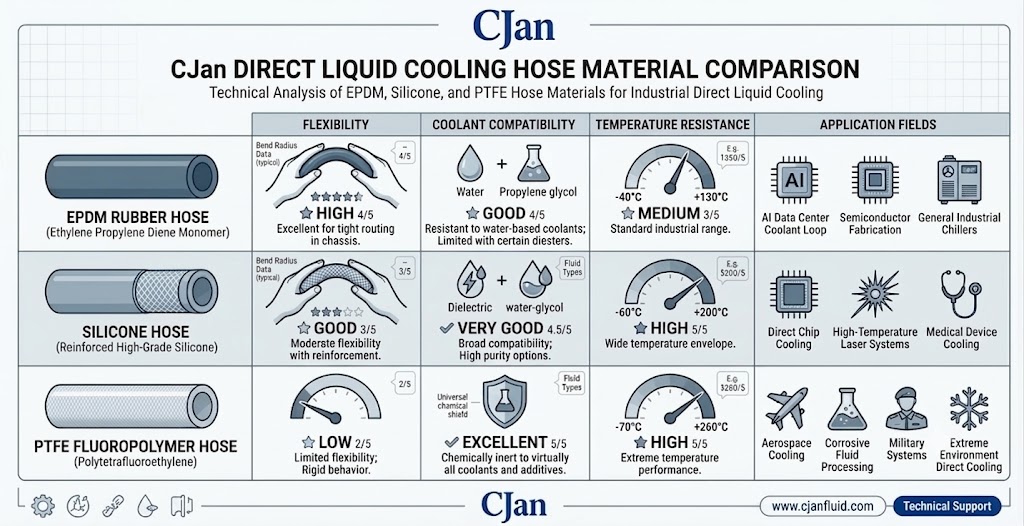
EPDM may not be suitable for every chemical environment.
For applications involving aggressive chemicals or high-purity requirements, alternative materials may be preferred.
Silicone rubber is known for:
It is often selected when installation flexibility is a major concern.
Silicone hoses are commonly considered for:
Compared with EPDM, silicone may have different characteristics regarding:
Therefore, application testing is recommended before large-scale deployment.
PTFE (Polytetrafluoroethylene) offers outstanding chemical resistance.
Advantages include:
PTFE and fluoropolymer hoses are often used in:
Compared with rubber hoses:
For standard AI data center cooling loops, EPDM is often a more practical choice, while PTFE solutions are valuable for demanding environments.
| Property | EPDM | Silicone | PTFE |
|---|---|---|---|
| Flexibility | Excellent | Excellent | Moderate |
| Coolant Compatibility | Excellent | Application dependent | Excellent |
| Chemical Resistance | Good | Moderate | Excellent |
| Temperature Range | Good | Excellent | Excellent |
| Cost Efficiency | High | Medium | Lower |
| Typical Application | AI cooling, CDU | Flexible cooling | Semiconductor/high purity |
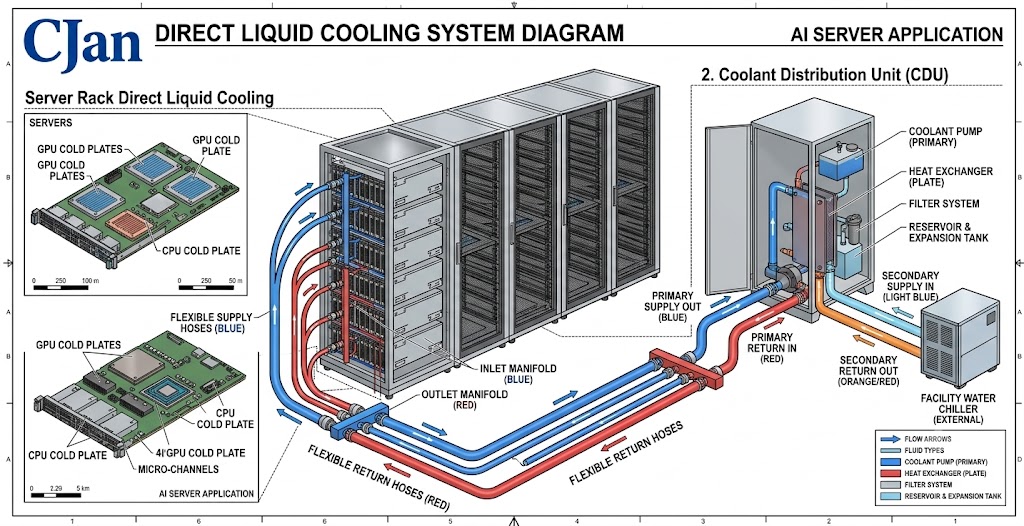
When selecting a hose material for DLC systems, engineers should evaluate:
Confirm compatibility with:
Consider:
Evaluate:
For AI infrastructure, consider:
A failed cooling hose may cause:
The cost of a hose failure is usually much higher than the cost difference between materials.
Therefore, material selection should focus on:
Total system reliability rather than initial purchase price.
CJAN develops liquid cooling hose solutions based on different application requirements.
Designed for:
Features:
Designed for applications requiring enhanced safety considerations.
Suitable for:
Designed for applications requiring:
Material selection is one of the most important decisions when designing a direct liquid cooling system.
EPDM, silicone, and PTFE each provide different advantages:
For AI infrastructure, the best hose material is not determined by one specification alone. It requires a complete evaluation of coolant type, operating conditions, installation requirements, and long-term reliability expectations.
As liquid cooling adoption continues to grow, selecting the right hose material will become an increasingly important part of building reliable thermal management systems.
 Mobile


 GLOBAL


