
BLOG
2026/08/06Clicks:345
As artificial intelligence infrastructure continues to expand, liquid cooling has become a key technology for managing the heat generated by high-performance computing systems.
Modern AI servers, GPU clusters, and HPC platforms require cooling systems that can operate continuously with extremely high reliability.
Within these systems, hoses play an important role.
At first glance, a liquid cooling hose may appear similar to a traditional industrial hose. Both transport fluids and use flexible materials. However, their design objectives are fundamentally different.
A traditional industrial hose is usually designed around general fluid transfer requirements.
A liquid cooling hose is designed specifically for:
For AI data centers, choosing the wrong hose type can create unnecessary operational risks.
A liquid cooling hose is a flexible connection component used in thermal management systems to transport coolant between components such as:
A typical AI cooling loop:
CDU
 ↓
Supply Hose
 ↓
Cold Plate
 ↓
GPU / CPU
 ↓
Return Hose
 ↓
CDU
The hose must maintain reliable coolant flow while operating continuously.
Traditional industrial hoses are designed for a wide range of applications, including:
Their design priorities usually focus on:
They are not necessarily optimized for precision cooling applications.
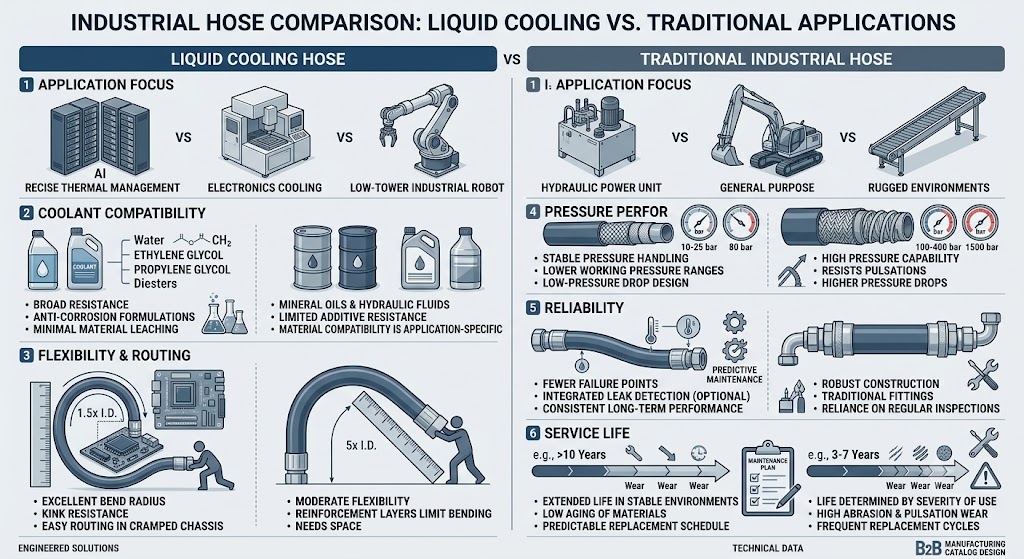
The biggest difference is the operating environment.
| Liquid Cooling Hose | Traditional Industrial Hose | |
|---|---|---|
| Main Purpose | Thermal management | Fluid transportation |
| Application | AI cooling, HPC, servers | General industry |
| Operation | Continuous 24/7 | Depends on application |
| Reliability Requirement | Extremely high | Application dependent |
AI data centers cannot tolerate frequent maintenance or unexpected coolant interruptions.
Liquid cooling systems often use specific cooling fluids.
Examples:
The hose material must remain stable over thousands of operating hours.
Potential problems from poor compatibility:
A general industrial hose may work initially but degrade over long-term exposure.
Common materials include:
Advantages:
Typical applications:
Advantages:
Applications:
Advantages:
Applications:
Industrial hoses may use:
These materials may be suitable for their original applications but may not meet AI cooling requirements.
Modern AI racks are becoming increasingly compact.
Cooling hoses must often be routed through:
A liquid cooling hose is designed to provide:
Traditional industrial hoses may be:
In ordinary industrial applications, a small leak may be manageable.
In AI data centers, coolant leakage can create serious consequences.
Potential impacts:
Therefore, liquid cooling hoses are designed with stronger emphasis on:
AI cooling systems often have strict requirements for coolant quality.
The hose should minimize:
This becomes especially important for:
Industrial hoses may be replaced based on routine maintenance schedules.
AI cooling infrastructure has different expectations.
Operators typically expect:
The hose is considered part of the reliability architecture.
| Feature | Liquid Cooling Hose | Industrial Hose |
|---|---|---|
| Designed for AI cooling | ? | Usually no |
| 24/7 operation | ? | Application dependent |
| Coolant compatibility testing | ? | Variable |
| Low leakage requirement | High | Medium |
| Flexible rack installation | Optimized | General |
| Thermal cycling resistance | Required | Depends |
| Data center application | ? | Limited |
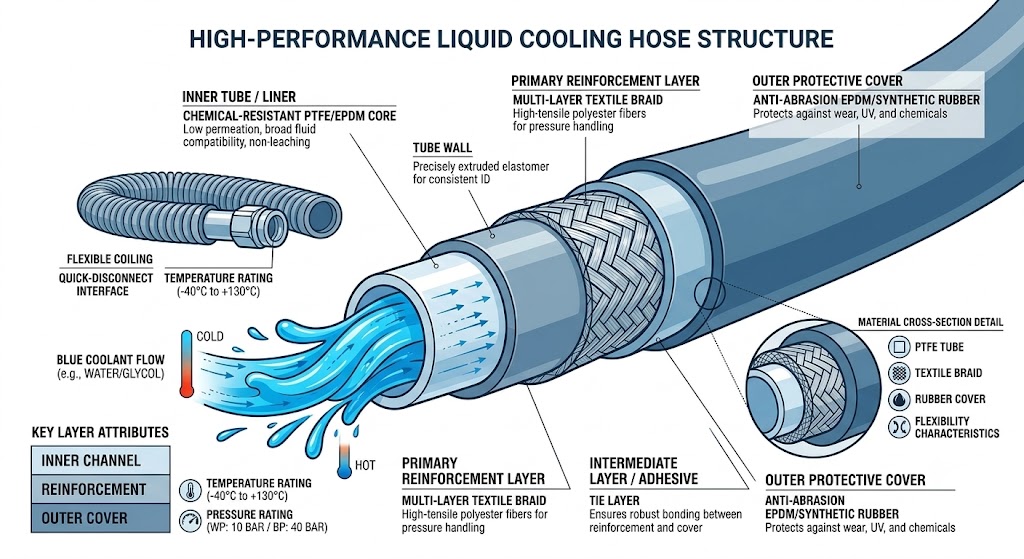
AI infrastructure is moving toward:
This means cooling components must evolve.
The hose is no longer just a simple connection tube.
It is part of a critical thermal management system.
A specialized liquid cooling hose helps ensure:
CJAN develops liquid cooling hose solutions designed for demanding thermal management applications.
Suitable for:
Features:
Designed for applications requiring additional safety considerations.
Suitable for:
Designed for:
Although liquid cooling hoses and traditional industrial hoses may appear similar, they are designed for completely different purposes.
AI data center cooling requires:
Using a general industrial hose in a high-performance cooling system may create unnecessary risks.
For next-generation AI infrastructure, selecting a purpose-designed liquid cooling hose is an important step toward building reliable and efficient thermal management systems.
 Mobile


 GLOBAL


