
BLOG
2026/08/04Clicks:359
The rapid expansion of artificial intelligence infrastructure is accelerating the adoption of liquid cooling systems.
Modern AI servers equipped with high-performance GPUs generate significantly more heat than traditional computing platforms. As a result, data center operators are increasingly adopting direct liquid cooling solutions to maintain stable operating temperatures and improve energy efficiency.
However, a liquid cooling system is only as reliable as its weakest component.
While cold plates, pumps, and CDUs often receive the most engineering attention, cooling hoses and hose assemblies are equally important. They are responsible for maintaining continuous coolant circulation between different parts of the system.
A wrong hose selection decision during the design stage can lead to:
This article explains the most common mistakes engineers encounter when selecting liquid cooling hoses for AI data centers and how to avoid them.
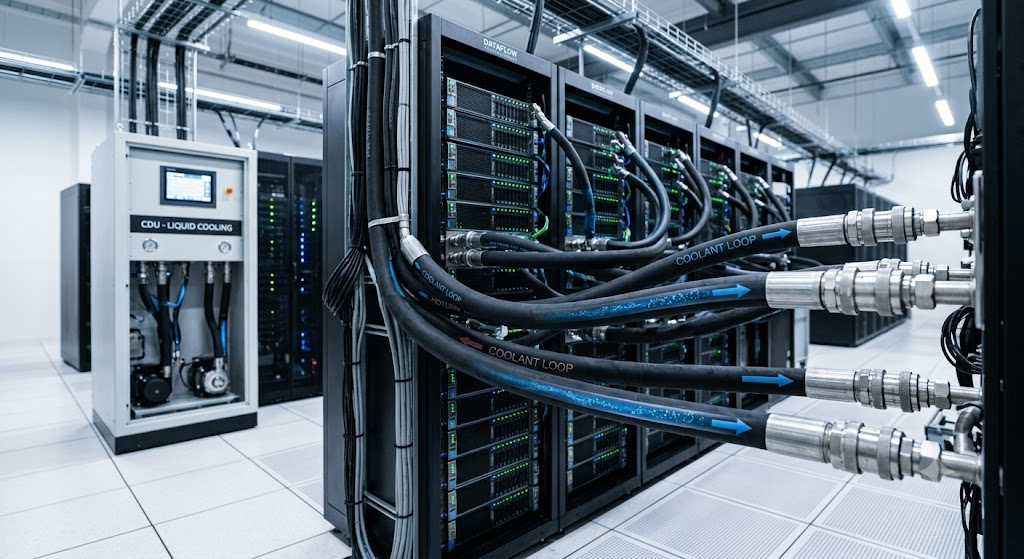
One of the most common mistakes is focusing only on pressure capability.
Many engineers initially evaluate:
"Can this hose handle the system pressure?"
However, pressure rating is only one part of hose performance.
A reliable liquid cooling hose must also consider:
A hose with a high pressure rating may still fail prematurely if the material is not compatible with the coolant or operating conditions.
Evaluate the complete operating environment:
| Parameter | Consideration |
|---|---|
| Pressure | Normal and peak operating pressure |
| Temperature | Continuous and thermal cycling conditions |
| Coolant | Chemical compatibility |
| Installation | Bend radius and routing |
| Service life | Long-term reliability |
Liquid cooling systems use different coolant formulations depending on application requirements.
Common cooling fluids include:
Different hose materials respond differently to these fluids.
For example:
Advantages:
Common applications:
Advantages:
Considerations:
Advantages:
Applications:
Always evaluate:
Hose material + Coolant + Temperature + Operating time
as a complete system.
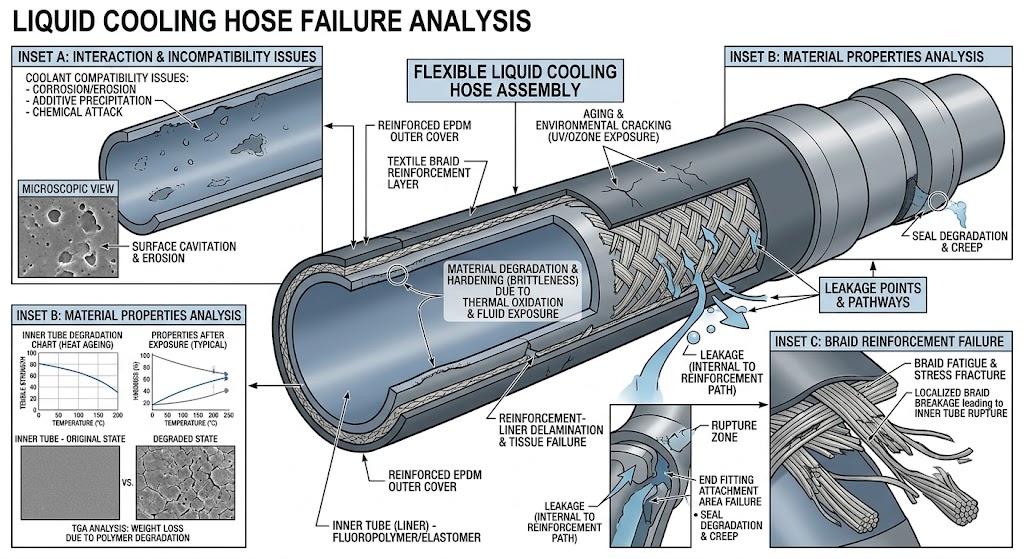
AI server racks are becoming increasingly dense.
Inside modern GPU racks, cooling hoses must often pass through limited spaces around:
A hose that is too stiff can create installation problems.
Possible consequences:
A flexible hose design allows:
For high-density AI infrastructure, flexibility is not simply an installation convenience—it directly affects system reliability.
Some companies attempt to use existing industrial hoses because they appear similar.
However, AI liquid cooling environments have unique requirements.
Industrial hoses may not have been designed for:
A liquid cooling hose should be developed specifically for thermal management applications.
Key differences include:
| Requirement | Industrial Hose | Liquid Cooling Hose |
|---|---|---|
| Continuous operation | Variable | Designed for 24/7 operation |
| Coolant compatibility | Application dependent | Specifically evaluated |
| Routing flexibility | General | Optimized |
| Leakage risk | Higher tolerance | Very low tolerance |
As AI rack power density increases, infrastructure safety becomes increasingly important.
Cooling hoses installed near high-value computing equipment should consider:
Fire-resistant cooling hoses can provide additional protection in demanding environments.
This is especially relevant for:
CJAN LCH-SD and LCH-SDS liquid cooling hose series are designed for applications where flexibility, coolant transportation reliability, and enhanced safety requirements are important considerations.
A common misunderstanding is:
Larger hose diameter always means better cooling.
In reality, hose size affects:
The correct hose size depends on:
Oversized or undersized hoses can both create performance issues.
Initial installation performance does not always represent long-term behavior.
AI data centers are expected to operate continuously.
A proper hose evaluation should consider:
The objective is not only:
"Will it work today?"
but:
"Will it remain reliable after years of operation?"
A liquid cooling hose does not work alone.
It is part of a complete system:
CDU
 ↓
Manifold
 ↓
Hose Assembly
 ↓
Cold Plate
 ↓
GPU
A good hose design must consider:
The best solution is usually a complete hose assembly rather than a standalone tube.
Before choosing a cooling hose, engineers should define:
Examples:
Confirm:
Evaluate:
Consider:
Review:
Liquid cooling hoses may represent only a small portion of an AI cooling system, but their reliability directly affects the performance and stability of the entire infrastructure.
The most common selection mistakes are not caused by lack of available products, but by insufficient understanding of application requirements.
A successful liquid cooling hose selection process should consider:
As AI data centers continue to increase in power density, selecting the right cooling hose will become an increasingly important engineering decision.
For next-generation AI infrastructure, a reliable liquid cooling hose is not simply a connection component—it is a critical part of thermal management reliability.
What Is a Liquid Cooling Hose and Why Is It Critical for AI Data Centers?
 Mobile


 GLOBAL


