GLOBAL
PTFE vs. PFA Liquid Cooling Hose: What Is the Difference?
Fluoropolymer hoses are not the first option that comes to mind for every liquid cooling system. But when a cooling circuit has demanding chemical, temperature or cleanliness requirements, PTFE and PFA can become important candidates.
PTFE and PFA belong to the fluoropolymer family and share several useful characteristics. At the same time, their processing characteristics, flexibility, permeability and application considerations are not identical.
For engineers specifying a liquid cooling hose, the question is therefore not simply whether PTFE or PFA is the "better" material. The more useful question is which material and hose construction fit the actual operating conditions.
For a broader material comparison, see EPDM vs. Silicone vs. PTFE: Which Hose Material Is Best for Liquid Cooling?.
1. Why Compare PTFE and PFA?
Liquid cooling systems can operate under different combinations of temperature, pressure, fluid chemistry and installation constraints.
In straightforward water-based systems, conventional elastomeric hoses may be sufficient. More demanding applications can require a fluoropolymer inner tube or a specialized multilayer construction.
PTFE and PFA are often considered when engineers need properties such as:
- High chemical resistance
- Wide temperature capability
- Low interaction with many fluids
- Good resistance to corrosion-related fluid environments
- Low surface reactivity
These characteristics can be useful, but they should always be evaluated against the actual coolant and system requirements.
2. What Is PTFE?
PTFE, or polytetrafluoroethylene, is a fluoropolymer known for its chemical resistance and broad temperature capability.
It has a relatively low-friction surface and is used in many demanding fluid-handling applications.
For liquid cooling, PTFE can be considered when fluid compatibility and temperature performance are important design factors.
However, the mechanical properties of a PTFE hose depend on its dimensions, wall construction and reinforcement.
3. What Is PFA?
PFA, or perfluoroalkoxy polymer, is another fluoropolymer used in demanding fluid-handling environments.
Like PTFE, PFA offers strong chemical resistance and broad temperature capability.
One practical difference is that PFA is melt-processable, which gives manufacturers greater flexibility in producing certain tube geometries and constructions.
Its properties can make PFA attractive in applications where chemical resistance needs to be combined with specific tubing or hose construction requirements.
4. PTFE vs. PFA at a Glance
| Factor | PTFE | PFA |
|---|---|---|
| Material Family | Fluoropolymer | Fluoropolymer |
| Chemical Resistance | Excellent for many demanding fluids | Excellent for many demanding fluids |
| Temperature Capability | Broad, application dependent | Broad, application dependent |
| Flexibility | Depends strongly on hose construction | Depends strongly on hose construction |
| Processing | Generally processed differently from melt-processable polymers | Melt-processable |
| Application | Demanding fluid-handling applications | Demanding fluid-handling applications |
This comparison should be treated as a material-level overview rather than a performance guarantee for a particular hose.
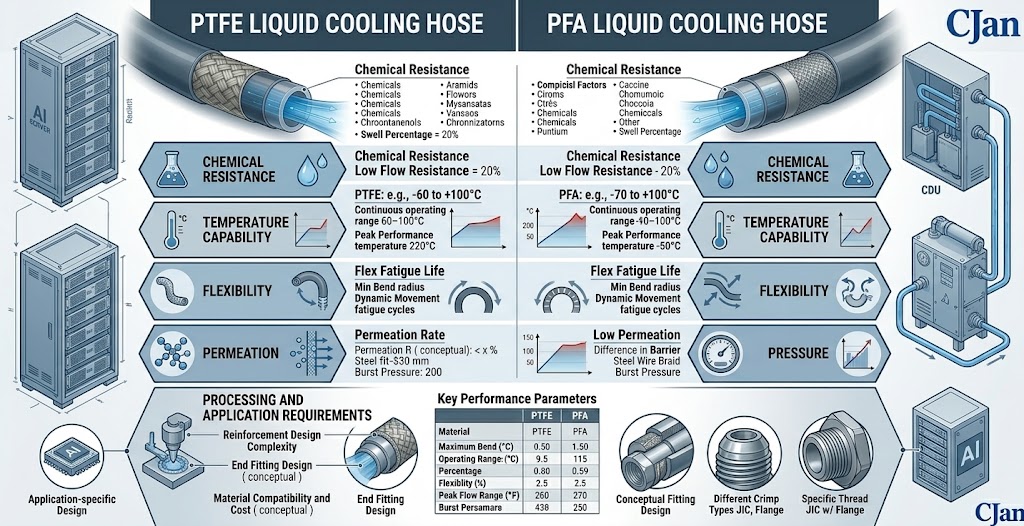
5. Chemical Resistance
Chemical resistance is one of the main reasons engineers consider fluoropolymers.
PTFE and PFA can resist a wide range of chemicals, which is valuable in systems where the fluid environment is more demanding than conventional water or glycol loops.
However, "chemically resistant" does not mean compatible with every possible coolant under every condition.
The actual fluid composition, concentration, temperature and exposure time should be considered.
6. Temperature Performance
Both PTFE and PFA are associated with broad temperature capability compared with many conventional elastomers.
That can be useful when a liquid cooling circuit experiences elevated temperatures or significant thermal cycling.
The actual operating limit, however, belongs to the complete hose assembly rather than the polymer name alone.
Reinforcement, fittings, seals and other construction elements may have different limits.
7. Flexibility Is a Construction Question
It is tempting to assume that all fluoropolymer hoses behave similarly. In practice, flexibility can vary significantly between hose designs.
Wall thickness, diameter, reinforcement and multilayer construction all influence how a hose bends.
This matters in AI data centers because cooling connections may have to fit around servers, cold plates, manifolds and rack infrastructure.
A fluoropolymer hose should therefore be evaluated using its actual bend-radius specification.
8. PTFE and PFA in High-Density Cooling Systems
As AI computing density increases, cooling systems have less physical space available for routing.
Hoses may need to connect components without interfering with neighboring hardware or creating excessive mechanical stress.
Material selection and hose construction should therefore be considered together.
See How to Choose the Right Liquid Cooling Hose for High-Density AI Servers for a broader discussion of high-density rack requirements.
9. PTFE vs. PFA for Coolant Compatibility
For both materials, compatibility should be confirmed using the actual coolant rather than a generic material chart alone.
Modern cooling fluids may contain additives designed to control corrosion, biological growth or other fluid properties.
Those additives can change the compatibility picture.
A proper evaluation should therefore include:
- Base coolant chemistry
- Additive package
- Concentration
- Operating temperature
- Exposure duration
- Pressure conditions
10. Permeation Considerations
Permeation can matter in closed-loop cooling systems where maintaining coolant condition over long periods is important.
The permeability behavior of the hose material can influence fluid retention and the interaction between the cooling loop and its environment.
When this is a critical design parameter, engineers should compare measured data for the specific hose construction rather than relying only on general polymer properties.
11. Cleanliness and Fluid Quality
Some thermal-management systems place strict requirements on coolant cleanliness.
In such applications, the inner tube material, manufacturing process, cleaning procedure and packaging can all be relevant.
PTFE or PFA may be considered when a fluoropolymer fluid-contact surface is desirable, but the complete manufacturing and validation process still needs to be reviewed.
12. Pressure Capability
PTFE and PFA should not be compared solely by their polymer properties when pressure is the main concern.
The pressure capability of a hose depends on its diameter, wall thickness, reinforcement, temperature and assembly design.
A reinforced fluoropolymer hose can therefore have substantially different pressure characteristics from an unreinforced tube.
For pressure selection, see Liquid Cooling Hose Pressure Rating: How Much Pressure Does an AI Data Center Hose Need?.
13. Reinforcement Can Change Hose Performance
When flexibility and pressure resistance need to be balanced, reinforcement becomes an important part of hose design.
The reinforcement layer can contribute to pressure capability and dimensional stability, while the inner fluoropolymer layer provides the fluid-contact surface.
This multilayer approach is often more useful than evaluating PTFE or PFA as isolated materials.
14. PTFE vs. PFA Processing
One important material-level distinction is processing.
PTFE is generally processed differently from melt-processable fluoropolymers, while PFA can be melt processed.
This difference can influence manufacturing methods and the types of tube geometries or constructions that can be produced.
For a customer, the practical question is whether the final hose can achieve the required dimensions, tolerances and performance—not simply which polymer has the more attractive material specification.
15. Surface Characteristics
Fluoropolymer surfaces are generally characterized by low surface energy and low friction.
For fluid-handling applications, these characteristics can be useful in certain designs.
Nevertheless, system cleanliness, fluid behavior and hose geometry remain important to actual cooling-loop performance.
16. Flow and Internal Diameter
The choice between PTFE and PFA does not remove the need for correct hose sizing.
Internal diameter affects flow velocity and pressure loss.
A hose with excellent material compatibility can still be unsuitable if its internal diameter creates excessive pressure drop for the required flow rate.
For sizing considerations, see How to Select the Right Liquid Cooling Hose Size for AI Data Centers.
17. Bend Radius and Installation
Fluoropolymer hoses should be routed according to their specified bend radius.
Sharp bends can introduce mechanical stress, affect the hose shape and place additional loads on fittings.
In a dense server rack, installation space should therefore be considered before the hose diameter and construction are finalized.
18. Fittings Matter as Much as the Tube
The hose does not operate as an isolated component.
Fittings, seals and UQD connections form part of the complete fluid path.
When using a fluoropolymer hose, engineers should verify that the connection system is suitable for the same operating temperature, pressure and coolant.
A compatible hose connected to an unsuitable fitting does not create a reliable assembly.
19. PTFE vs. PFA for AI Data Center Applications
For AI data center cooling, fluoropolymer hoses may be considered when the application has specific requirements that make them attractive compared with conventional elastomeric hoses.
Potential considerations include:
- Coolant chemistry
- Temperature range
- Fluid cleanliness
- Permeation requirements
- Pressure
- Flexibility
- Available installation space
The material should be selected based on the actual system rather than simply because it is classified as a fluoropolymer.
20. PTFE vs. PFA for Semiconductor Cooling
Fluoropolymer materials are also relevant to semiconductor equipment where fluid compatibility and cleanliness can be important considerations.
The requirements of semiconductor cooling can differ from those of an AI data center, even when both systems use liquid cooling.
That is why hose selection should begin with the process conditions and fluid specification.
CJAN also works with specialized fluid-handling applications where fluoropolymer hose constructions can be evaluated according to project requirements.
21. When PTFE May Be Considered
PTFE may be considered when an application requires a fluoropolymer fluid-contact layer with strong chemical resistance and broad temperature capability.
It can be particularly relevant when the fluid environment is demanding and compatibility is a primary design consideration.
The final hose construction should still be checked for pressure, flexibility, bend radius and connection requirements.
22. When PFA May Be Considered
PFA may be considered for applications requiring fluoropolymer chemical resistance together with manufacturing characteristics associated with a melt-processable fluoropolymer.
Its suitability depends on the actual geometry, temperature, pressure, coolant and performance requirements.
As with PTFE, the final decision should be based on the complete hose specification.
23. Should PTFE or PFA Always Replace EPDM or Silicone?
No.
Fluoropolymers can offer valuable properties, but those properties are not required in every liquid cooling system.
For many conventional cooling loops, an appropriate EPDM or silicone hose may provide the required performance with a simpler and more economical construction.
The material should therefore be selected according to the application rather than according to a hierarchy of materials.
See EPDM vs. Silicone Liquid Cooling Hose: Which Is Better for AI Data Centers?.
24. A Practical Selection Matrix
| Requirement | PTFE | PFA |
|---|---|---|
| Chemical Resistance | Strong candidate for demanding fluid environments | Strong candidate for demanding fluid environments |
| Temperature | Broad capability, application dependent | Broad capability, application dependent |
| Flexibility | Construction dependent | Construction dependent |
| Permeation | Evaluate specific construction | Evaluate specific construction |
| Pressure | Depends on reinforcement and dimensions | Depends on reinforcement and dimensions |
| Processing | Different processing requirements | Melt-processable |
| Final Selection | Based on complete application requirements | |
25. What Engineers Should Request From a Hose Supplier
When evaluating PTFE or PFA liquid cooling hose, a supplier should be given enough information to make a meaningful recommendation.
- Coolant type and formulation
- Operating and maximum temperature
- Operating and maximum pressure
- Required flow rate
- Hose internal diameter
- Required length
- Minimum bend radius
- Fitting requirements
- UQD requirements
- Cleanliness requirements
- Permeation considerations
26. CJAN Fluoropolymer and Liquid Cooling Capabilities
CJAN provides hose solutions covering different material and construction requirements for fluid-handling applications.
For liquid cooling applications, the CJAN Liquid Cooling range includes hose configurations designed for thermal-management applications.
The current LCH Liquid Cooling Hose, LCH-SD and LCH-SDS products can be evaluated according to project requirements.
Where a fluoropolymer material is required, the appropriate hose construction should be selected based on the coolant, temperature, pressure, flow and connection conditions rather than material name alone.
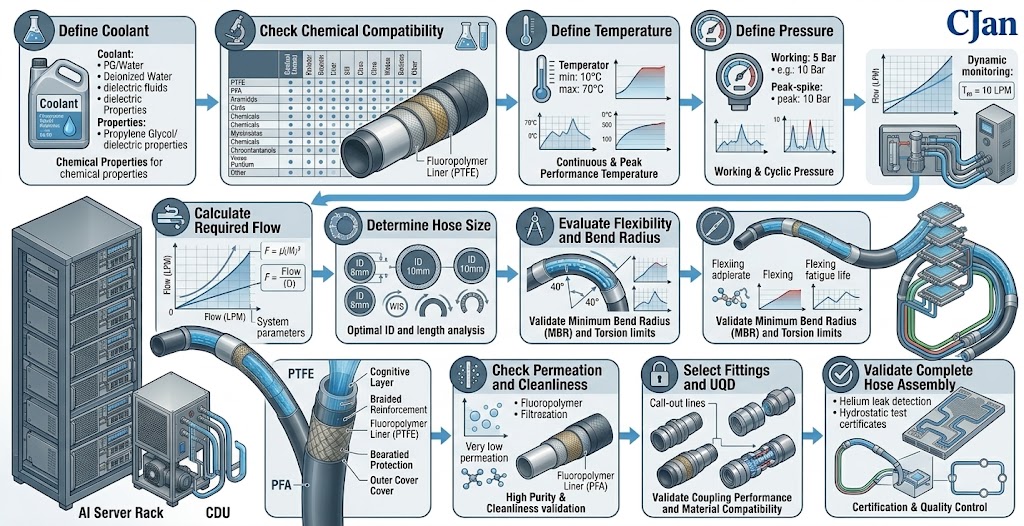
27. A Better PTFE vs. PFA Selection Process
This approach keeps material selection connected to the actual cooling system.
28. Final Considerations
PTFE and PFA are both important fluoropolymer options for demanding fluid-handling applications.
Their similarities make them attractive for applications requiring strong chemical resistance and broad temperature capability, while their differences can influence manufacturing and final hose design.
For AI data center liquid cooling, the correct choice should be based on the coolant, temperature, pressure, flow, flexibility, cleanliness, permeation and connection requirements.
In other words, the best material is not determined by a material comparison chart alone. It is determined by how well the complete hose assembly performs in the actual cooling system.
Conclusion
PTFE and PFA can both provide valuable performance characteristics for demanding liquid cooling applications.
PTFE is widely recognized for its chemical resistance and broad temperature capability, while PFA offers similar fluoropolymer characteristics together with melt-processable manufacturing advantages.
For engineers selecting a liquid cooling hose, the most important step is to evaluate the complete application rather than choosing between two material names in isolation.
Coolant compatibility, temperature, pressure, flow, bend radius, permeation, cleanliness, fittings and UQD requirements should all be considered before final selection.
Explore CJAN Liquid Cooling Solutions for more information about liquid cooling hose applications and configurations.