GLOBAL
How to Select the Right Liquid Cooling Hose for AI Data Centers
Choosing a hose for an AI liquid cooling system can look straightforward.
The system designer knows the coolant, checks the operating pressure, confirms the temperature and then selects a hose.
In practice, that approach can leave out several important factors.
A liquid cooling hose inside an AI server rack is exposed to a combination of:
- Continuous coolant flow
- Pressure
- Temperature changes
- Repeated bending
- Vibration
- Limited installation space
- Quick-disconnect connections
- Maintenance activity
The hose also has to work with the CDU, manifold, fittings and cold plate as part of the same hydraulic circuit.
That is why the better question is not:
"Which liquid cooling hose is the best?"
It is:
"Which liquid cooling hose matches the requirements of this cooling system?"
This article provides a practical framework for making that decision.
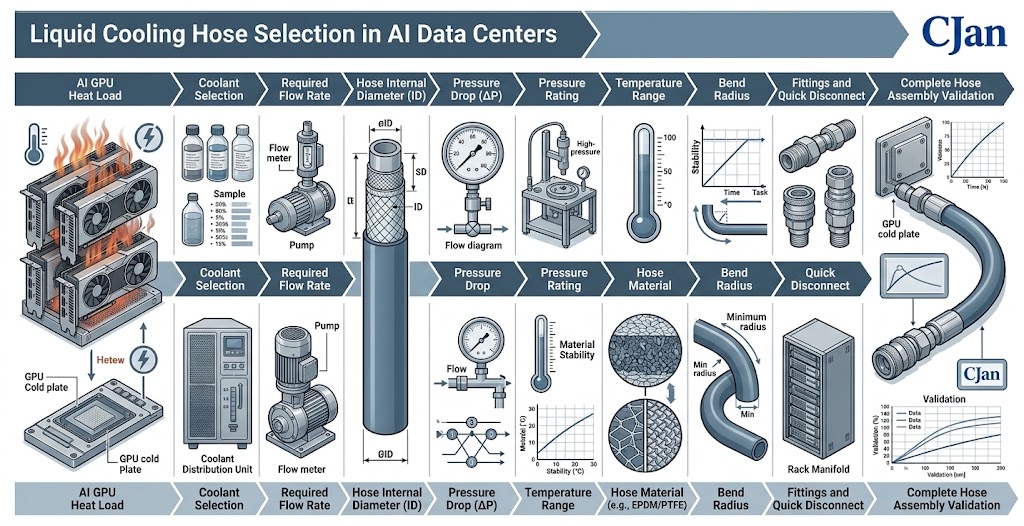
1. Start With the Cooling Application
Before comparing hose materials or product models, define the application.
Typical AI liquid cooling applications include:
- Direct-to-chip GPU cooling
- CPU cooling
- AI server cooling
- Rack-level liquid cooling
- CDU-to-manifold connections
- Manifold-to-server connections
- Cold-plate supply and return lines
The hose requirements can differ considerably between these applications.
For example, a short hose connected directly to a GPU cold plate may prioritize flexibility and compact routing.
A longer rack-level hose may place greater emphasis on pressure capability, mechanical durability and flow capacity.
2. Define the Coolant First
The coolant is one of the first specifications that should be established.
Common liquid cooling fluids include:
- Water
- Water-glycol mixtures
- Premixed cooling fluids
- Proprietary heat-transfer fluids
The hose's inner tube must be chemically compatible with the actual fluid.
Compatibility should be checked for:
- Inner tube
- Reinforcement
- Outer cover
- Fittings
- Seals
Do not assume that two fluids described as "water-based" have identical compatibility.
The formulation matters.
3. Determine the Required Coolant Flow
Once the heat load and coolant temperature rise are known, the required flow can be determined.
A simplified heat-transfer relationship is:
Q = ṁ × Cp × ΔT
where:
- Q = heat removed
- ṁ = coolant mass flow
- Cp = specific heat
- ΔT = coolant temperature rise
The actual system calculation should use the properties of the selected coolant.
Once the required flow is known, hose sizing becomes much more meaningful.
4. Choose Hose ID From Flow Requirements
The internal diameter determines the flow passage.
A simplified relationship is:
An undersized hose can create excessive hydraulic resistance.
An oversized hose may create unnecessary:
- Installation space
- Weight
- Bend radius
- Cost
The objective is to find an appropriate size rather than simply choosing the largest available hose.
5. Check Pressure Drop
Pressure rating and pressure drop are different specifications.
Pressure rating
Tells you whether the hose can withstand the operating pressure.
Pressure drop
Tells you how much pressure is lost as coolant flows through the hose.
For AI cooling systems, both matter.
A useful specification is therefore not simply:
Working pressure: XX bar
but also:
Pressure drop: XX bar at XX L/min
The test flow rate and coolant conditions should be stated.
6. Don't Evaluate the Hose Alone
A liquid cooling circuit may contain:
Every component contributes hydraulic resistance.
Therefore:
The correct hose is one that works within the pressure budget of the complete cooling loop.
A hose with excellent hydraulic performance cannot compensate for an excessively restrictive cold plate or UQD.
7. Define Working Pressure and Maximum Pressure
The hose should be selected based on the actual pressure conditions.
Specify:
- Normal working pressure
- Maximum working pressure
- Pressure fluctuations
- Startup pressure
- Pressure spikes
- Required safety margin
For critical systems, pressure cycling can be just as relevant as static pressure.
A hose that survives a one-time pressure test is not necessarily validated for years of repeated pressure cycles.
8. Check Temperature Range
Temperature selection should include more than the normal coolant temperature.
Consider:
The hose, fittings and seals should all be suitable for the complete range.
For many AI liquid cooling systems, temperatures may be relatively moderate, but the actual system specification should always be used.
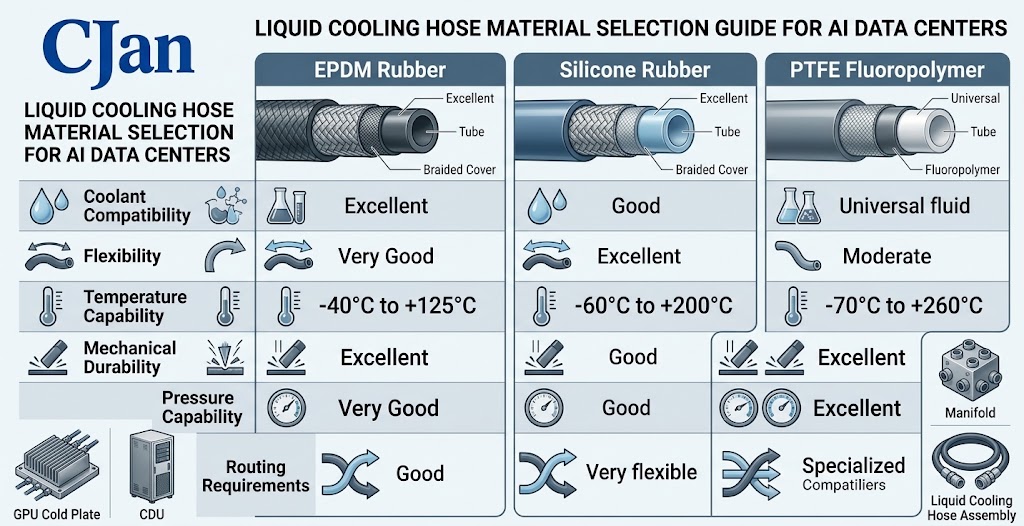
9. Select the Hose Material
After coolant, flow, pressure and temperature are defined, material selection becomes easier.
Common flexible hose materials include:
- EPDM
- Silicone
- PTFE and other fluoropolymers
- Other application-specific elastomers
For many water-based cooling systems, EPDM can offer a useful combination of:
- Water compatibility
- Mechanical durability
- Flexibility
- Cost effectiveness
Silicone may be attractive where:
- High flexibility
- Temperature capability
- Complex routing
are important.
PTFE and other fluoropolymers may be considered where chemical compatibility or purity requirements justify their use.
10. EPDM vs Silicone
There is no universal winner.
A simplified comparison:
| Requirement | EPDM | Silicone |
|---|---|---|
| Water-based coolant | Strong candidate | Strong candidate |
| Flexibility | Good | Excellent |
| Temperature capability | Good | Excellent |
| Mechanical durability | Strong | Application-dependent |
| Reinforced pressure applications | Strong candidate | Construction-dependent |
| Complex routing | Good | Excellent |
| AI liquid cooling | Suitable | Suitable |
The final decision should always be based on the specific hose construction and coolant.
11. Reinforcement Matters
The same elastomer can be used in very different hose constructions.
A reinforced hose may contain:
Reinforcement can improve:
- Pressure capability
- Burst resistance
- Dimensional stability
- Mechanical durability
For pressurized AI cooling circuits, reinforcement can therefore be an important part of the selection.
12. Check Minimum Bend Radius
AI server racks are densely packed.
The hose may need to route around:
- GPU trays
- Cold plates
- Manifolds
- Server rails
- Rack structures
- Other hoses
This makes minimum bend radius an important specification.
A hose that meets pressure requirements but cannot be routed without excessive bending may not be suitable.
13. Flexibility and Bend Radius Are Not the Same
A flexible hose is easier to route.
But flexibility does not mean that the hose can be bent without limitation.
The design should respect the manufacturer's minimum bend radius.
Excessive bending can potentially cause:
- Kinking
- Flow restriction
- Local stress
- Premature wear
- Connection loading
The goal is controlled flexibility.
14. Consider Hose Length
Longer hoses generally produce greater frictional pressure loss.
But making a hose too short can create mechanical problems.
An appropriate hose length should provide enough slack for:
- Bend radius
- Thermal movement
- Server removal
- Maintenance
- Connection
A useful principle is:
Use the shortest practical hose routing that still allows safe installation and maintenance.
15. Consider Hose Movement
Not every AI cooling hose is completely static.
Movement can occur during:
- Server installation
- Server removal
- Rack maintenance
- Cold-plate service
- Equipment vibration
If repeated movement is expected, the hose construction should be evaluated for flex-fatigue performance.
This is particularly important near fittings and UQDs.
16. Select the Connection Type
The hose is rarely connected directly to the cold plate without some form of fitting.
Common connection components include:
- Crimp fittings
- Threaded fittings
- Barbed fittings
- Quick disconnects
- Manifold interfaces
The connection must match:
- Hose construction
- System pressure
- Flow requirement
- Installation method
- Maintenance strategy
17. Quick Disconnect Selection
UQD selection should consider:
- Flow capacity
- Pressure drop
- Working pressure
- Temperature
- Coolant compatibility
- Leakage
- Connection cycles
- Physical dimensions
A UQD with a suitable nominal size may still create excessive pressure loss if its internal passage is restrictive.
This is why UQD selection should be integrated into the hydraulic design.
18. Leakage Requirements
Liquid cooling introduces an obvious concern:
Coolant must stay inside the cooling circuit.
Leakage can occur at:
- Hose body
- Crimp connection
- Fitting
- UQD
- Cold-plate interface
Therefore, a complete assembly should be considered rather than evaluating the hose alone.
For critical applications, ask the supplier about:
- Pressure testing
- Leakage testing
- Assembly validation
- Connection-cycle testing
19. Cleanliness Requirements
A liquid cooling system should also consider fluid cleanliness.
Depending on the application, the hose may need to meet requirements related to:
- Particles
- Extractables
- Residues
- Manufacturing contaminants
This is particularly important when the cooling circuit is connected to sensitive thermal-management hardware.
The appropriate cleaning and validation process depends on the application.
20. Check External Environment
The coolant is only one environment the hose experiences.
The external environment may include:
- Rack heat
- Vibration
- Abrasion
- Contact with metal structures
- Electrical equipment
- Limited ventilation
- Repeated maintenance
An outer protective layer can therefore be important.
The hose should be evaluated from both sides:
Inside → coolant compatibility
Outside → mechanical/environmental protection
21. Check Electrical and Material Requirements
Some data-center cooling applications may have specific requirements concerning:
- Electrical conductivity
- Static charge
- Flame behavior
- Smoke
- Material compliance
These requirements depend on the project and facility standards.
They should be specified explicitly rather than assumed.
22. Don't Ignore Installation Space
A hose may satisfy every technical specification and still be difficult to install.
Check:
- Hose OD
- Bend radius
- Fitting length
- UQD dimensions
- Connection orientation
- Clearance
- Access for tools
A few millimeters can matter in a densely packed server rack.
23. Consider the Complete Hose Assembly
A practical AI cooling assembly may look like:
The hose is only one component.
The complete assembly needs to be compatible mechanically and hydraulically.
24. Validate the Assembly
For demanding applications, the finished assembly should be validated.
Potential tests include:
- Pressure test – Check pressure integrity.
- Leakage test – Check connection sealing.
- Flow test – Confirm expected hydraulic performance.
- Pressure-drop test – Measure loss at defined flow rates.
- Temperature test – Evaluate performance over the operating range.
- Cycling test – Evaluate repeated pressure or connection cycles where applicable.
25. A Practical Selection Workflow
A useful sequence is:
This sequence can be used as a practical engineering checklist.
26. Example: Selecting a Hose for an AI Server
Consider a hypothetical application:
| Parameter | Requirement |
|---|---|
| Application | Direct-to-chip GPU cooling |
| Coolant | Water-glycol |
| Required flow | 60 L/min |
| Working pressure | 5 bar |
| Maximum pressure | 7 bar |
| Operating temperature | 20–50°C |
| Routing | Compact rack |
| UQD | Required |
| Maintenance | Regular server service |
The selection process would be:
- First – Confirm coolant compatibility.
- Second – Determine the required hose ID for 60 L/min.
- Third – Check pressure drop at 60 L/min.
- Fourth – Confirm 5 bar working pressure and required safety margin.
- Fifth – Check the 20–50°C temperature range.
- Sixth – Check bend radius and rack clearance.
- Seventh – Select compatible fittings and UQDs.
- Finally – Validate the complete assembly.
This is a much more robust process than choosing a hose from a catalog based on temperature alone.
27. How to Compare Two Liquid Cooling Hoses
When comparing two products, use the same conditions.
For example:
| Parameter | Hose A | Hose B |
|---|---|---|
| Material | EPDM | Silicone |
| ID | 20 mm | 20 mm |
| Working pressure | — | — |
| Temperature | — | — |
| Bend radius | — | — |
| Flow | 60 L/min | 60 L/min |
| Pressure drop | — | — |
| Coolant | Same | Same |
| Connection | Same | Same |
Only then does the comparison become meaningful.
Comparing two hoses with different IDs, lengths and test conditions can produce misleading conclusions.
28. What Should a Hose Supplier Provide?
For an AI liquid cooling project, useful supplier documentation should include:
- Product datasheet
- Dimensional drawing
- Material information
- Pressure ratings
- Temperature range
- Bend radius
- Coolant compatibility
- Flow information
- Pressure-drop data
- Connection options
- Testing information
The more critical the application, the more important the technical documentation becomes.
29. What Information Should You Send to CJAN?
A customer requesting a liquid cooling hose recommendation should ideally provide:
Application: ________________
Coolant: ________________
Required Flow: ________________ L/min
Working Pressure: ________________ bar
Maximum Pressure: ________________ bar
Temperature: ________________ °C
Hose Length: ________________ mm
Minimum Bend Radius: ________________ mm
Connection: ________________
UQD Required: Yes / No
Installation Space: ________________
Annual Quantity: ________________
This allows CJAN to make a more meaningful product recommendation.
30. CJAN Liquid Cooling Hose Portfolio
CJAN's liquid cooling portfolio includes:
- LCH
- LCH-SD
- LCH-SDS
The products should not simply be marketed as three hose models.
They can instead be positioned according to engineering requirements.
For general liquid cooling applications.
For applications where reinforced EPDM hose construction, pressure capability and mechanical durability are important.
For applications where flexible routing and system integration are important.
The exact selection should be confirmed against the actual product specifications and customer operating conditions.
31. Why a Product Matrix Is Important
For GEO and technical SEO, CJAN can turn the product portfolio into a selection matrix.
For example:
| Requirement | LCH | LCH-SD | LCH-SDS |
|---|---|---|---|
| General liquid cooling | ✓ | ✓ | ✓ |
| Reinforced construction | — | ✓ | — |
| Compact routing | ✓ | ✓ | ✓ |
| High flexibility | — | — | ✓ |
| AI data-center applications | ✓ | ✓ | ✓ |
| Custom assembly | Contact CJAN | Contact CJAN | Contact CJAN |
Important: The final table on the website should use CJAN's verified product specifications. Do not publish a technical ✓/— claim unless it is supported by the corresponding product data.
32. The Most Important Five Questions
If an engineer has only a few minutes to select a hose, ask these five questions first:
- What coolant are you using?
- What flow rate is required?
- What are the working and maximum pressures?
- What is the operating temperature range?
- How much space is available for hose routing?
These five answers eliminate many unsuitable options.
The remaining specifications can then be used to refine the selection.
33. Five Common Selection Mistakes
Mistake 1: Selecting only by pressure – A high-pressure hose may still have unsuitable flow characteristics.
Mistake 2: Selecting only by temperature – Temperature compatibility does not guarantee coolant compatibility.
Mistake 3: Choosing by outside diameter – The internal diameter determines the coolant flow passage.
Mistake 4: Ignoring bend radius – A hose that cannot be routed properly is not a practical solution.
Mistake 5: Ignoring connections – The fitting and UQD can determine the reliability and hydraulic performance of the complete assembly.
34. The Right Hose Is a System Decision
The most important conclusion is simple:
A liquid cooling hose should be selected as part of the cooling system, not as an isolated component.
The correct selection connects:
This approach is particularly relevant to high-density AI server cooling.
35. From Hose Supplier to Cooling-System Partner
For CJAN, this selection methodology also provides a stronger market position.
Instead of competing only on:
Hose price per meter
CJAN can compete around:
Liquid cooling hose engineering and assembly support
That can include:
- Hose selection
- Material selection
- Size selection
- Fitting selection
- UQD integration
- Hose assembly
- Pressure testing
- Leakage testing
- Application support
This is a much stronger B2B value proposition.
Conclusion
There is no single "best" liquid cooling hose for every AI data center.
The appropriate hose depends on the system's:
- Coolant
- Flow rate
- Pressure
- Temperature
- Pressure-drop budget
- Material compatibility
- Bend radius
- Installation space
- Connection requirements
- Maintenance conditions
For AI server liquid cooling, the selection process should therefore start with the cooling system requirements and work backward toward the hose.
For CJAN, this provides a clear engineering-based positioning:
CJAN helps customers select liquid cooling hoses based on actual flow, pressure, temperature, routing and connection requirements.
The LCH, LCH-SD and LCH-SDS product families can then be introduced as solutions within that engineering framework rather than as isolated catalog products.