
BLOG
2026/08/14Clicks:478
The rapid growth of AI computing has changed how data centers are designed and maintained.
Unlike traditional enterprise servers, modern AI racks often contain:
As computing density increases, maintenance becomes more challenging.
One common question faced by data center operators is:
How can cooling components be disconnected and replaced without draining the entire cooling loop?
The answer is often:
Quick Disconnect Couplings (UQDs).
Today, UQDs are widely used in:
They have become a critical component of modern liquid cooling architecture.
A Quick Disconnect Coupling is a connector designed to allow:
Without tools in many applications.
A typical UQD consists of:
Male Coupling
        +
Female Coupling
        +
Internal Shut-Off Valve
When disconnected:
The internal valve automatically closes.
This helps prevent:
Traditional hose connections often require:
This process can consume significant maintenance time.
For AI infrastructure running 24/7, downtime is expensive.
Quick disconnects help solve this problem.
CDU
 ↓
Manifold
 ↓
UQD Coupling
 ↓
Liquid Cooling Hose
 ↓
Cold Plate
 ↓
GPU Server
The UQD acts as a service interface.
This allows technicians to replace servers without affecting the entire cooling network.
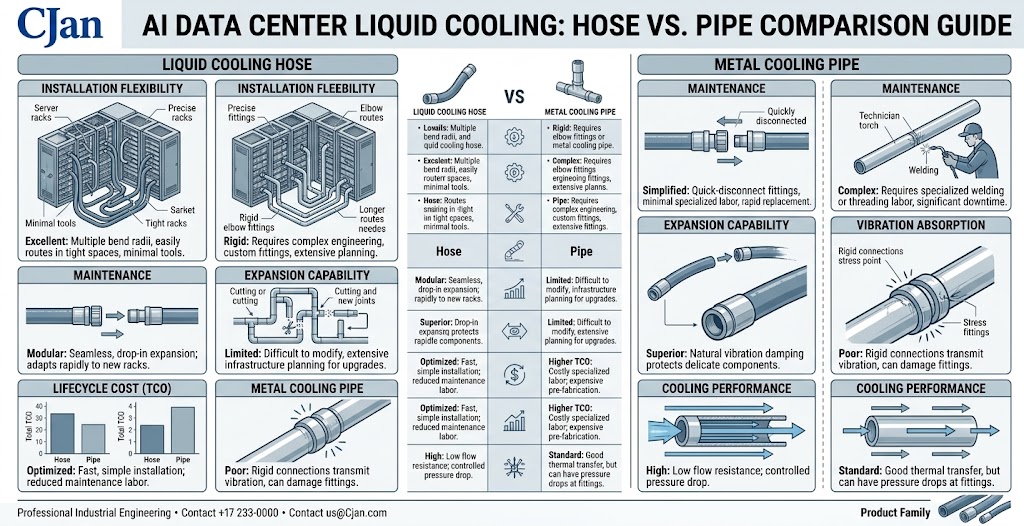
Without UQDs:
Replacing a server may require:
With UQDs:
The cooling loop can often remain operational.
Benefits include:
✓ Reduced maintenance time
✓ Reduced labor cost
✓ Faster server replacement
Modern non-spill UQDs are designed to minimize fluid loss during disconnection.
Advantages:
AI data centers evolve rapidly.
Infrastructure must support:
UQDs simplify these changes.
Coolant leakage can create:
Properly selected UQDs help reduce leakage risk.
Characteristics:
Typical applications:
Not commonly preferred in AI cooling environments.
Valve located on one side only.
Advantages:
Applications:
Valves located on both sides.
Benefits:
✓ Minimal leakage
✓ Reduced air ingress
✓ Improved cleanliness
Commonly used in:
Considered one of the most advanced designs.
Advantages:
✓ Extremely low fluid loss
✓ Reduced contamination
✓ Clean connection surface
Widely used in:
Selecting a UQD should not be based on connection size alone.
Several engineering factors must be evaluated.
Verify compatibility with:
Material compatibility is essential.
A coupling that is too small may create:
Engineers should evaluate:
The UQD should match or exceed:
Remember:
The coupling must be evaluated together with the hose assembly.
Leakage performance is often one of the most important specifications.
Questions to ask:
Common materials include:
Advantages:
Advantages:
Advantages:
Preferred for demanding environments.
Selecting based only on hose size.
Ignoring pressure drop.
Ignoring coolant compatibility.
Using industrial couplings in high-purity applications.
Focusing only on initial cost.
The lifecycle cost of downtime is often much higher than the component cost.
A UQD should never be considered independently.
The complete assembly includes:
UQD Coupling
      +
Fitting
      +
Liquid Cooling Hose
      +
Crimp Assembly
System reliability depends on all components working together.
Modern AI cooling systems increasingly use pre-assembled solutions.
Advantages include:
✓ Faster deployment
✓ Reduced installation errors
✓ Better quality control
✓ Simplified maintenance
This trend is driving demand for integrated hose assembly solutions.
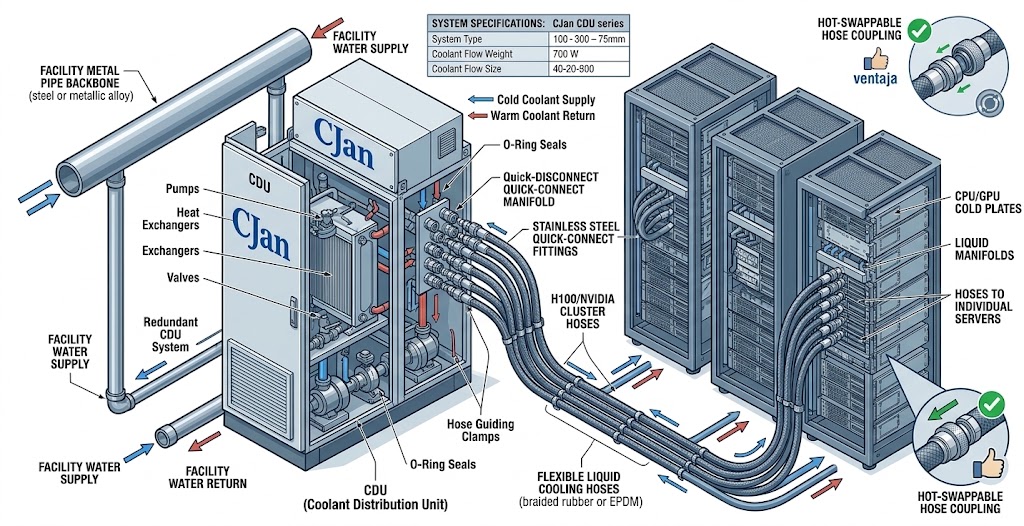
CJAN provides liquid cooling solutions designed for AI infrastructure and industrial thermal management.
Suitable for:
Features:
Suitable for:
Designed for:
CJAN can support:
This helps customers simplify procurement and installation.
Quick Disconnect Couplings have become a fundamental component of modern liquid cooling infrastructure.
For AI data centers, they provide:
As rack power density continues to rise, the combination of:
UQD Couplings + Liquid Cooling Hose Assemblies
will increasingly become the standard architecture for next-generation AI cooling systems.
The most effective approach is to evaluate UQDs as part of a complete connectivity solution rather than as individual components.
Liquid Cooling Hose Materials for AI Data Centers: EPDM, Silicone, PTFE and Beyond
 Mobile


 GLOBAL


