
BLOG
2026/08/10Clicks:373
The rapid growth of artificial intelligence infrastructure is changing the requirements for thermal management systems.
AI servers, GPU clusters, and high-performance computing platforms are operating at increasingly higher power densities. As a result, liquid cooling systems are becoming a critical technology for maintaining stable operating temperatures.
Within these systems, liquid cooling hoses are responsible for transporting coolant between:
Although hoses are relatively small compared with major cooling equipment, their service life directly influences overall system reliability.
A cooling hose failure can lead to:
Therefore, understanding what affects liquid cooling hose lifespan is essential for engineers designing reliable AI cooling infrastructure.
The lifespan of a liquid cooling hose is not determined by one factor alone.
It is the result of multiple conditions working together:
Material Selection

+

Coolant Compatibility

+

Temperature Conditions

+

Pressure Environment

+

Installation Quality

+

Manufacturing Consistency

=

Hose Service Life
A properly selected hose can provide long-term stable performance, while an unsuitable hose may experience premature degradation.
The hose material is the foundation of service life.
Different materials age differently under continuous operating conditions.
EPDM is widely used in liquid cooling applications because of its balanced performance.
Advantages:
Typical applications:
Silicone provides:
However, application conditions should be carefully evaluated because mechanical properties differ from EPDM.
PTFE offers:
Often selected for:
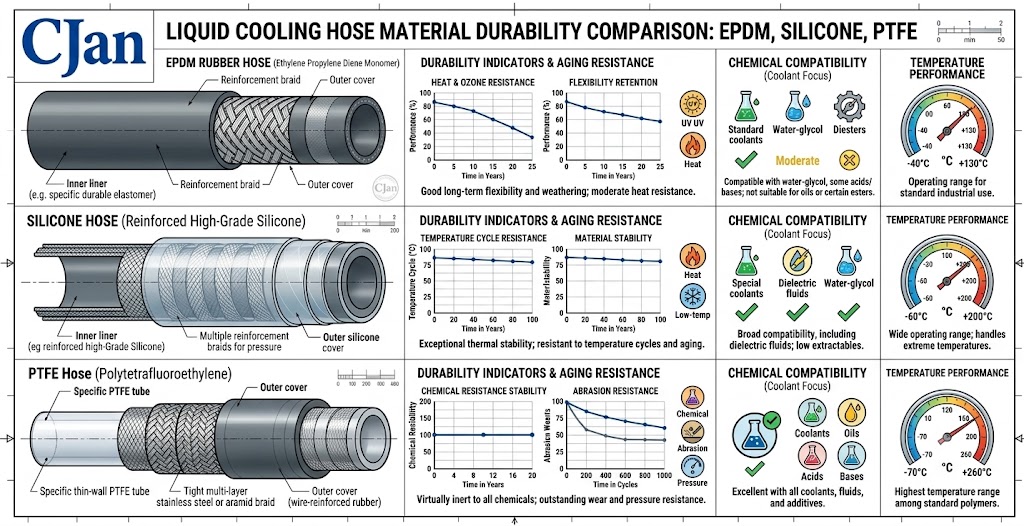
Coolant chemistry is one of the most important factors affecting hose lifespan.
Common cooling fluids include:
Long-term exposure to incompatible fluids may cause:
The hose dimensions may change, affecting performance.
The hose may lose flexibility.
Material degradation may create leakage risks.
Degraded materials may affect coolant quality.
Therefore:
The hose material must always be selected according to the actual coolant system.
Liquid cooling systems experience temperature changes during operation.
Typical conditions include:
Repeated thermal cycling can affect:
A reliable cooling hose should maintain performance after repeated temperature changes.
Liquid cooling systems operate under continuous coolant pressure.
The hose must withstand:
Factors affecting pressure durability include:
A hose designed only for short-term pressure resistance may not perform well in continuous operation.
Many hose failures are related to installation conditions rather than material defects.
Common installation problems include:
Small bend radius may create permanent stress.
Twisted installation can affect reinforcement layers.
Contact with other components may damage the hose.
Poor routing can increase stress on fittings.
A properly designed installation improves hose lifespan.
The hose and fitting assembly should be treated as one complete system.
Connection reliability depends on:
Potential issues include:
In many liquid cooling systems, connection quality is as important as hose material.
Consistent manufacturing directly affects long-term reliability.
Important quality control processes include:
Ensures stable raw material properties.
Maintains consistent hose size.
Verifies structural strength.
Confirms connection reliability.
Supports quality management throughout product lifecycle.
Even high-quality hoses require proper system management.
Important maintenance practices include:
Early detection can prevent unexpected failures.
Engineers can extend hose lifespan by following these principles:
Match hose material with:
Maintain:
Consider:
A complete solution includes:
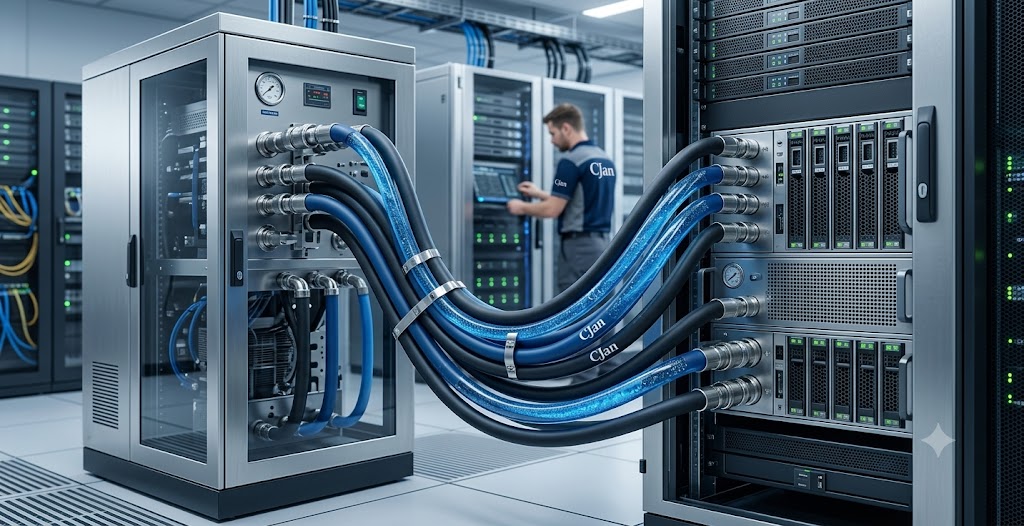
CJAN develops liquid cooling hose solutions for demanding thermal management applications.
The product portfolio includes:
Designed for:
Features:
Designed for applications requiring additional safety considerations.
Suitable for:
Designed for:
The service life of a liquid cooling hose depends on much more than the hose material itself.
Reliable performance requires a complete approach including:
As AI data centers continue to increase power density, cooling reliability will become increasingly important.
A high-quality liquid cooling hose is not simply a fluid connection component. It is an essential part of the thermal management system that protects valuable computing infrastructure.
Understanding Coolant Flow Requirements in AI Data Centers
 Mobile


 GLOBAL


