
BLOG
2026/08/07Clicks:8
In modern AI data centers, thermal management reliability has become as important as computing performance.
As GPU power density continues to increase, direct liquid cooling systems are being deployed in more high-performance computing environments. These systems rely on a continuous coolant circulation loop to remove heat from processors and maintain stable operation.
Within this cooling loop, the liquid cooling hose may appear to be a simple connection component. However, it performs a critical function:
Maintaining uninterrupted coolant transportation between every major cooling component.
A hose failure in a traditional industrial application may cause inconvenience.
A hose failure in an AI data center may result in:
Therefore, reliability is one of the most important selection criteria when choosing a liquid cooling hose.
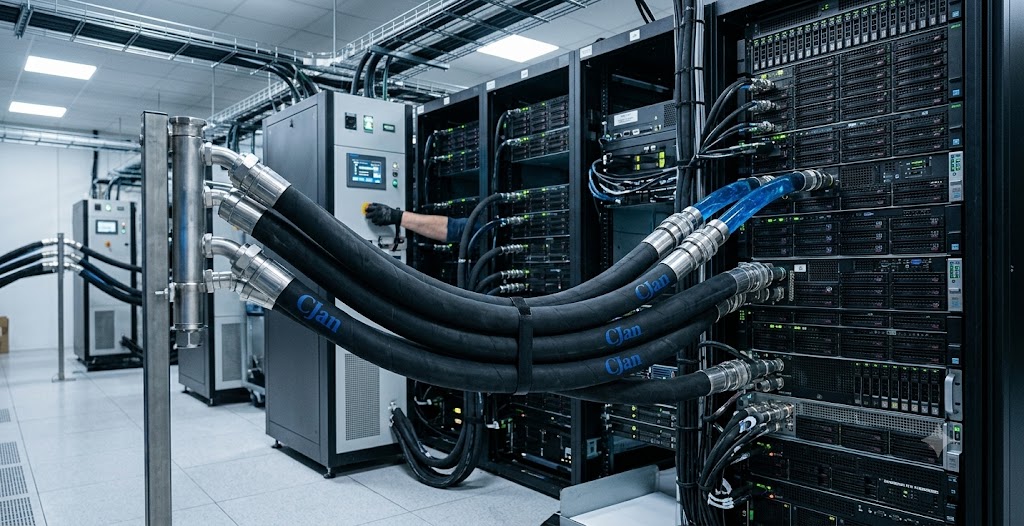
AI infrastructure is designed for continuous operation.
Typical operating conditions include:
Unlike temporary cooling applications, AI cooling systems require components that can maintain stable performance over years.
A reliable cooling hose must perform under:
Material selection is the foundation of cooling hose reliability.
Different materials provide different performance characteristics.
EPDM is one of the most commonly used materials for liquid cooling hoses.
Key advantages:
Allows easier routing in compact server environments.
Suitable for many water-based cooling fluids and glycol mixtures.
Maintains mechanical properties during long-term operation.
EPDM is widely used in:
Silicone hoses provide:
They are often selected when installation flexibility is a priority.
PTFE provides:
It is often considered for:
A reliable cooling hose must be compatible with the actual coolant used in the system.
Common cooling fluids include:
Poor compatibility may cause:
The hose may expand and affect dimensions.
The material may lose flexibility.
Long-term degradation may create leakage risks.
Material degradation may affect coolant quality.
Therefore:
Hose material selection must always be evaluated together with coolant chemistry.
Leak prevention is one of the highest priorities in liquid cooling systems.
A reliable hose solution requires attention to:
Potential leak points include:
A good cooling hose design minimizes mechanical stress throughout the system.
Cooling systems experience different pressure conditions during operation.
A reliable hose should handle:
Pressure capability depends on:
A higher pressure rating alone does not guarantee reliability.
The hose must maintain performance under actual working conditions.
Although AI cooling loops operate within controlled temperature ranges, hoses still experience thermal changes.
Common conditions include:
Reliable hoses should maintain:
after repeated thermal cycles.
AI server environments have limited installation space.
Cooling hoses often need to pass through:
A reliable hose should provide:
Excessive bending can create stress concentration and shorten service life.
Material selection alone is not enough.
Manufacturing consistency directly affects reliability.
Important quality control processes include:
Ensures consistent hose size.
Confirms structural performance.
Verifies assembly reliability.
Ensures stable raw material properties.
For critical AI cooling applications, manufacturing quality is part of system reliability.
The hose and fitting should be considered as one system.
A reliable assembly requires:
Many field issues are not caused by hose material itself, but by improper assembly.
Before selecting a hose, engineers should evaluate:
| Item | Key Question |
|---|---|
| Material | Is it compatible with coolant? |
| Temperature | Can it handle operating conditions? |
| Pressure | Does it meet system requirements? |
| Flexibility | Is routing practical? |
| Leakage | Are connections reliable? |
| Service Life | Can it operate continuously? |
| Safety | Does it meet facility requirements? |
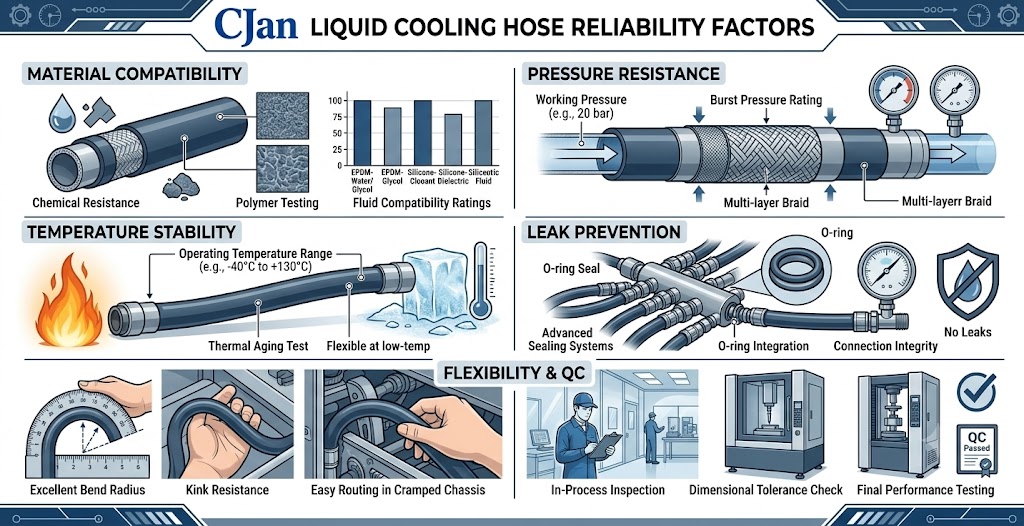
CJAN focuses on liquid cooling hose solutions designed for demanding thermal management environments.
The LCH series is developed for applications requiring:
Product families include:
Applications:
Designed for applications requiring enhanced safety considerations.
Suitable for:
Designed for:
A reliable liquid cooling hose is not defined by one specification.
True reliability comes from the combination of:
As AI data centers continue to increase computing density, cooling systems must achieve higher levels of reliability.
The cooling hose, although small compared with major cooling equipment, plays an essential role in maintaining continuous thermal management performance.
For engineers designing next-generation AI infrastructure, selecting a reliable liquid cooling hose is an important investment in system stability.
 Mobile


 GLOBAL


